Patient Protection and Affordable Care Act
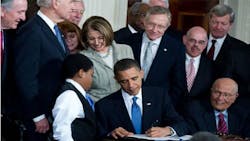
There is no change to ITR Economics' outlook of a second half-2013 and 2014 recession stemming from the recent decision upholding the Patient Protection and Affordable Care Act (the Act). Tax increases and ongoing deficits have been built into our 2014 forecast since we first announced the 2013-2014 recession probability in May 2010.
The promises and lofty goals of the Patient Protection and Affordable Care Act are fairly well known: Millions of people covered by insurance, no lifetime caps, no excluding pre-existing conditions, etc. We will also no doubt come to better understand the costs associated with the Act, which include:
- Employer penalties
- Additional hospital insurance tax
- Medicare tax increases
- Unearned Medicare income contributions
- Annual fee on health insurance providers
- Fee on pharmaceutical manufacturers and importers
- Medical device excise tax
- Individual mandate
- Raising the floor for itemizing non-reimbursed medical expenses
The true cost of the Act won’t be known for many years, but at least the Supreme Court told us what to call this policy -- it is a tax. It is a sizeable tax increase, although folks can argue just where it ranks in the pantheon of tax increases (modest estimates place it as #10 all time). While several of the Act’s key benefits are already in effect, we don’t really start paying for the benefits until 2013 - 2014.
In additional to the tax increases, the universal health care coverage experiment in Massachusetts has shown that the cost of health care is going to continue to rise. Higher costs and higher taxes imposed on businesses and individuals are not a prescription for economic growth, particularly since the ITR Leading Indicator™ is suggesting that the economy will be on the backside of the current business cycle post mid-2013 (a short-term issue). Since the Act certainly is not a prescription for balancing the federal books, fiscal policy remains a serious problem issue (a longer-term problem). Expanding Medicaid coverage is not going to help state budget imbalances either (another long-term problem).
If you were hoping that this blog would somehow tie in the passage of the Act with Independence Day, we have intentionally refrained from going down that political road. The economic forces are enough to contend with if you are running a business.
How might the passage of the Act relate to ITR Economics' long-term outlook for 2030-2040? Reread the above paragraph pertaining to unbalanced budgets being a longer-term problem.
About the Author
Brian Beaulieu
CEO
Brian Beaulieu has been an economist with ITR Economics since 1982 and its CEO since 1987. He is also Chief Economist for Vistage International and TEC, global organizations comprised of over 13,000 CEO’s. At ITR, Brian has been engaged in applied research regarding business cycle trend analysis and the utilization of that research at a practical business level.
For the past 25 years, he has been giving workshops and seminars across the US and Canada to thousands of business owners and executives.
Prior to joining the ITR Economics, Brian was an economist for the US Department of Labor where he worked on the health care component of the Consumer Price Index.
Brian is co-author of the book, Make Your Move.