"Stop production so that production never has to stop" is a Toyota proverb. The front end of the saying refers to production operators having a responsibility to stop a production line if they see a defect or believe that something abnormal is occurring. The latter end of the proverb refers to the end goal of these stops: to root out the cause of the defects, remove them and continually improve the process so that stopping the line no longer is necessary because defects no longer are occurring.
Kevin Kelsey has developed a corollary with regard to visual management: "Always communicate so you never have to talk." Visual management, explains the continuous improvement manager at boat manufacturer Boston Whaler, is all about communicating visually, from simple tape on the floor to indicate where equipment or material should be staged, to kanban systems, to color coded bins, to display boards that show constantly updated metrics. Give a material handler visual signals to indicate when and where to stage material, for example, and "an operator never has to stop working because he's out of material," Kelsey provides as an example. The alternative may be 30 minutes or so of unproductive time spent as an operator flags down a supervisor to flag down a material handler to get the material where it needs to be. That kind of conversation is waste.
While visual management helps the entire work force do its job better, it truly is a process for managers to understand, at a glance, what is going on and to lead more effectively, Kelsey says. "It is about understanding the normal versus the abnormal. Normal is operating the way we want it to operate," he says.
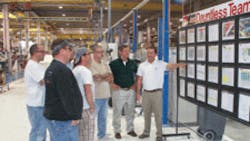
Visual management is particularly powerful when used in combination with MBWA, or management by walking around, he says. (MBWA emphasizes the practice of managing by going to the work area directly and interacting with the work force to better understand and react to what is happening, as opposed to managing from a distance, or from behind a desk.) For example, where visual signals indicate that production lines are operating as they should, a plant manager or other leader can provide positive feedback and quickly move along. Stop by a communication board that shows abnormal conditions, however, and "that immediate feedback allows us to take action when we need to take action." In some instances, the issues challenging production lines can be management-created errors of commission or omission. Those issues become more quickly apparent if plant leaders walk the plant floor and in combination with the appropriate visual signals. "It's a great way to understand what's going on," Kelsey notes. It's also the least wasteful way to lead.
The continuous improvement manager points out that plant managers routinely visiting the plant floor and reviewing communication boards, and engaging with operators or value-stream managers, is visual management in and of itself. It says to the plant floor workers that the managers care about quality, effort and improvement.
About the Author

Jill Jusko
Bio: Jill Jusko is executive editor for IndustryWeek. She has been writing about manufacturing operations leadership for more than 20 years. Her coverage spotlights companies that are in pursuit of world-class results in quality, productivity, cost and other benchmarks by implementing the latest continuous improvement and lean/Six-Sigma strategies. Jill also coordinates IndustryWeek’s Best Plants Awards Program, which annually salutes the leading manufacturing facilities in North America.
Have a story idea? Send it to [email protected].