Supply Chain Metrics: Choose an RFID Strategy Carefully

The advancement of technology, combined with demand from customers, has continued to fuel interest in radio frequency identification (RFID) tagging systems. Yet for all the attention paid to RFID, data from APQC’s Open Standards Benchmarking in logistics shows a majority of organizations have not adopted an RFID tagging strategy (Figure 1). The remaining respondents use three strategies most often:
- tag all products in manufacturing;
- place tags on products before shipping to comply with customer mandates (“slap and ship”);
- maintain separate inventories of tagged and untagged items.
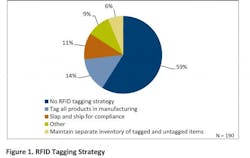
Given the variety of RFID strategies organizations can adopt, it can be difficult to determine which strategy (if any) is best. To decide, organizations must consider multiple factors, including potential benefits to logistics operations and any customer requirements.
The potential benefits of RFID tagging on inventory management are well known. These include greater accuracy in tracking inventory, more efficient inventory counting and improved trend forecasting. However, organizations participating in APQC’s Open Standards Benchmarking indicate other potential benefits. These organizations were asked to select up to three of five possible benefits that they believe will result from implementing RFID tagging. One of the top benefits is meeting compliance requirements, which is in line with the rise in RFID tagging requirements from customers such as Walmart and the U.S. Department of Defense. The two other benefits identified most by respondents are improved distribution processes and reduced distribution center or warehouse cost.
To determine whether one RFID tagging method results in better logistics performance than the others, APQC looked at how organizations with different strategies perform on metrics related to distribution processes and warehouse cost.
Percentage of Sales Orders Delivered on Time
One metric related to distribution processes is the percentage of sales orders delivered on time. Figure 2 presents the performance on this metric for organizations without RFID tagging strategies as well as for organizations with the top three RFID tagging strategies presented in Figure 1.
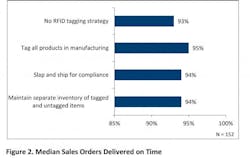
Although the difference among the groups is not significant, organizations that tag all products during manufacturing have a slightly higher percentage of sales orders delivered on time, and all organizations with an RFID tagging strategy perform higher than organizations without RFID. This could be because RFID tags make items easier to find during the packing and shipping process, and organizations that tag items during the manufacturing process do not have to spend extra time tagging items before shipping.
Cost to Operate Warehousing
A metric related to warehouse cost is the total cost to operate warehousing per $1,000 in revenue. For its analysis, APQC defines operating warehousing as all activities related to receiving products, storing products, shipping products for outbound delivery, and tracking shipments. There is a significant variation in the median total cost to operate warehousing among the RFID strategy groups.
Organizations that maintain separate inventories of tagged and untagged items have the lowest median cost associated with operating warehousing ($2.67 per $1,000 in revenue), whereas organizations using a slap-and-ship strategy have the highest median cost ($11.41 per $1,000 in revenue). The higher costs obtained by organizations using a slap-and-ship tagging strategy may result from the extra labor needed to place and monitor tags on products destined for specific customers. The organizations would need to identify the products that need to be tagged and then have employees tag those items before the products could be shipped to customers.
Consider All Factors
APQC’s data indicates that there is no clear best choice among RFID tagging strategies. Organizations that have adopted a specific tagging strategy perform better on some logistics metrics than on others. When the potential for RFID requirements from customers is considered, the situation becomes more complex.
When evaluating whether to adopt an RFID tagging strategy, and which strategy to adopt, organizations should look at their unique situations and consider several factors. How would a particular strategy fit into the organization’s current logistics processes and would it improve logistics performance? How would the RFID system function on a day-to-day basis? What would be the cost of purchasing the RFID system? And would additional employees be needed to use and maintain the new technology?
Although RFID tagging offers the potential for more efficient logistics processes, an organization looking to implement this technology should weigh the potential benefits against any additional costs and longer delivery times that could result.
APQC is a member-based nonprofit and a proponent of benchmarking and best practice business research. Working with more than 500 organizations worldwide in all industries, APQC focuses on providing organizations with the information they need to work smarter, faster and with confidence.