Lean Culture and Continuous Improvement Require Enabling Structures
Culture tends to spin around the core work process of an organization. It may either enable or hinder the work processes that we spend so much time trying simplify. Lean implementers generally agree that the most difficult part of achieving a truly lean organization is changing the culture.
A Framework for Lean Culture
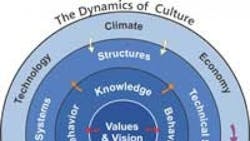
A good place to start is with a simple framework of what comprises the culture of any organization. Cultures are whole systems, like the human body or the economy. They are complex, interdependent systems and should be redesigned with an understanding of how the different components interact with one another.
Every culture must adapt to the external environment: changes in technology, economy, climate, social trends, resource availability and even the political environment. Having spent a number of years working with oil exploration and production companies, I am well aware how little control they have over the economy, the climate, or political events, which have huge impacts on their business. They cant control them, but they must sense and respond to these changes.
At the heart of any culture are the values, vision or beliefs of the culture. The cultures of the United States, Middle Eastern countries, or any corporation are built on a value system. It is the job of leaders to manage this cultural core and align behavior and other factors to the core beliefs. Symbols and stories often do the most to pass on and preserve the values of a culture.
Lets take a look at how organization structure may inhibit or enhance improvement efforts.
The Structure of Change Efforts
Change efforts are often structured to their own detriment. Continuous improvement efforts often follow a model that is very similar to the Quality Circle idea (repackaged, of course) of forming teams to address specific problems. These teams use good problem-solving methods, make a recommendation and then dissolve. This can and often does result in useful improvements.
Management is often attracted to this model because it does not require them to make fundamental changes in the way they do their own work or to address the real systems and structure that drive the culture. Lets face it -- initiating a problem-solving team is easy for management. It sells well.
There is, however, a serious problem with this approach. If a temporary team is formed to find and eliminate waste, one might ask the question, Who created that waste? Did the problem-solving team create the waste? Do they have the power to make truly significant changes? Will they be the ones to follow through on the implementation of solutions, evaluate and learn from those solutions?
Generally, not.
Power resides in the line management teams. Invariably, it was the line management team who made decisions that resulted in the creation of waste. In fact, the management teams own behavior is often a major source of waste in the organization. Their behavior and poor decisions are often the root cause. Why, then, are the line management teams not the ones who are analyzing the problem, using good problem-solving tools and making decisions to solve the problems?
The answer is simple: It is much easier for management to appoint a temporary team, with no formal authority, to study and make a recommendation, than it is to look in the mirror and address their own behavior and solve their own problems.
Consultants are often guilty of being enablers of the problem. It is easier to say to management, Lets form a temporary team, throw some money at it, well take care of it, and you can continue to function as you do, unscathed by the improvement effort.
That may be an exaggeration, but not by much.
If you want to create serious and sustained change in the culture of the organization, you MUST address the functioning of the line management teams. This is the core management structure, this is where power resides. This is where the big money decisions get made.
Structures that Create Teamwork Follow the Flow
I was once asked by a senior executive, Why do we need any structure at all? The question surprised me because it is one of those things we all just take for granted. But, it is a good question to ask.
When you consider what an organization does, it takes in input, processes that input, changes its state in some way, then sells the output to a customer. This is the core work of the organization. Everything, and I mean everything, must add value to this core work. The structure of the organization should be designed for one purpose: to facilitate, and not interrupt, the flow of the core work process.
Second, the structure should be designed to maximize the ability to solve problems and make improvements in the process. Ask yourself whether or not the structure of your organization accomplishes these two objectives. Or, does it inhibit the work flow, creating walls, interruptions in decision making, and separating people who need to solve problems as a unified team?
Most of the organizational structures of our corporations were created in an age in which lean, flow, and rapid improvement was not the basis of organization design. They were not designed to optimize the horizontal flow that serves customers. They were not viewed from the eye of the customer. Rather, they were viewed from the perspective of functional specialization. The focus was on moving up the ladder in the engineering, manufacturing, or marketing department. Up mattered more than sideways teamwork. The customer view is entirely horizontal, and our organization design should first and foremost meet the needs of our customers.
I spent considerable time working with a major petroleum exploration and production company to redesign the deep-water exploration and drilling work process and culture, in other words, the whole system. The process is massive. It requires years of work to explore a property, do exploratory drilling, analyze the results, and develop the well for production.
As the design team mapped the process, one thing became clear: There were dozens of handoffs from geologists, to economists, to explorationists, to various engineering departments, etc. Each handoff resulted in redo loops, blame between one group and the other, and delays. But, one thing was missing. No one owned the project and process from beginning to end. It was like a child who was handed off to new parents each couple of years, parents who specialized in the development during those years. By the time the child reaches maturity he would be an orphan for whom no one would take responsibility. Fortunately, we dont raise children that way!
The redesign of this process resulted in one project owner team, who managed the project from womb to tomb. They brought in expert teams as those teams were needed, but they maintained the horizontal view and they were given the necessary authority to make the important decisions that guided the process.
That process now takes less than half of the time it did before the redesign. The primary reason for this success was the creation of organizational structure and decision processes that enabled rather than disrupted the process.
Design from the Bottom Up
When designing the whole system of organizations, I have found it most helpful to design the structure from the bottom up -- a zero-base design process. You start with the work process only. You then ask how best to group first-level employees who do the real value adding work. How can you group them around the process to give them maximum control over the process, create maximum learning and improvement? You design the tools, the training, the information flow, and anything else you can think of to optimize their ability to do their work. These are your work teams.
Once you have done this, you then ask, What help do they need? You dont ask, What is the job of supervisors? You ask the question from the perspective of what will optimize the work of those who create value to customers. Then you form those first-level managers into teams. Again, you ask, What help do they need?
By starting from the bottom and seeking to optimize the ability of each team level, you will find that you often need fewer levels than when you started. You will also create a team structure that follows the flow rather than interrupting the flow. You will create not only a customer-focused process, but also a customer-focused organization design.
Lawrence M. Miller has been doing organizational change consulting for 35 years, beginning with his work creating a free economy in prisons. He has worked with Honda, Shell Oil, and dozens of other corporations. He is the author of nine books, most recently Lean Culture The Leaders Guide. His website and blog is www.ManagementMeditations.com.
See Also: