Setting the Safety Standard for Cage-Free Robots
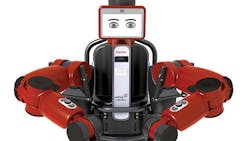
Baxter might be the perfect employee.
He is conscious of his environment, he takes utmost care not to hurt his fellow workers. He is adaptable, amiable and a lighting fast learner. Best of all, he works tirelessly across multiple shifts -- all day if necessary -- without breaks, without food and without complaint.
Baxter, of course, is the latest in a new kind of industrial robot that has been popping up on small and midsized manufacturing lines across Europe these last couple of years and, more recently, trickling into the U.S. scene.
Called "cage-free" or "industrial partner" or even "inherently safe" robots, these new tools are fundamentally altering our notions of what industrial robots are and what they can do.
From their easy programming and expanded flexibility to their comparably low cost and decreased footprint, Mitch Rosenberg, vice president of Marketing and Product Management at Rethink Robotics -- Baxter's Boston-based manufacturer -- has an endless list of features that have made these robots so notable in the industry of late.
But the key feature holding them all together and driving this emerging market, he said, is safety.
"We are seeing increased interest in robots that can work safely alongside humans without safety barriers," Rosenberg explained. The appeal, of course, is that "robots working shoulder to shoulder with people don't require manufacturers to completely rework their workspaces or manufacturing processes."
Unlike traditional caged robots, he said, these robots can simply be added to the existing manufacturing line with very little process redesign. This increases the overall flexibility of the robot while reducing risks as compared to accommodating traditional robotic tools.
Add to that the low investment costs they carry and that "inherently safe" label Rosenberg uses to describe them and these new machines seem destined for a record fast market takeover.
However, very few companies -- most notably Rethink Robots and Universal Robots -- have yet ventured into this ripe field. The rest in the industry are all stymied by that same prickly issue that makes the technology so attractive for U.S. users. Safety.
Cause for Delay
According to Jeff Fryman, director of Standards Development with the Robots Industries Association, the delay in mass adoption of this technology is due to a frustrating lack of safety standards to guide -- and protect -- companies as they enter the market.
"The ISO Robot Safety Standard of 2006 provided some basic guidelines on how these robots could perform, but these robots do not claim compliance with that standard," Fryman noted. "And that's probably because the standard -- at least the technical data behind the standard -- isn't complete. The ISO community is still working on that."
As they develop those specs, robots like Baxter -- which are designed with power or force limiting controls to help minimize injuries when in contact with human co-workers -- are running with no defined limits of acceptable power or force. And that puts companies in a very dangerous position.
"At the moment, these companies are the leading edge of technology without any firm standards guidance," Fryman said. "These guys are out front without any top cover or bottom support."
Without that support, he explained, companies using these technologies are wholly responsible for their safe employment.
"Now you're the integrator; now you're responsible for the risk assessment to determine if it is acceptable to work the way it was advertised to work," he said. "The only person who is on the line is the user that bought it."
And that, Fryman said, is a heavy load of risk for any company to take on.
"If you injure someone at work," he said, "there is a prescribed scenario that you are going to experience. And it is not a pleasant one."
A Cage-Free Future
Despite these concerns, Fryman does see a bright future for the technology.
"These robots have very interesting capabilities and I can understand 100% why someone would want to employ them," he said.
In fact, he reported that all of the "big" robot companies -- including Fanuc (IW 1000/687), Kuka and ABB (IW 1000/121) -- are developing this type of tool, but they haven't yet released them to the market "because they understand that without the appropriate guidance of industry consensus, they would be swimming up hill."
"I think in a few years we're going to see these devices out there; I think we're going to see some good uses for them," he said. "I'm very encouraged by the development, but at the moment these guys are out front from the group."
Citing the same concerns, Rethink Robotics' Rosenberg echoes this point.
"[These robots] are of great interest to industry and have a lot of potential in the near future, but are not yet a major force impacting manufacturers today," he said. "We believe that roll out of inherently safe robots that will work next to humans will take years."
In the meantime, these smaller companies that are planting their flags in the industry ahead of the pack have a vital role to play.
"Until these robots get out there and we get some experience with them, we don't have the experience with which to give the considered guidance that we can with six axis industrial robots," Fryman explained. "We've got a lot of experience there with what is okay and what is not okay' but not so much with this new breed of robot."
So these companies are put in a tough place -- by earning the first mover advantage in the U.S. market, they are also expanding the documented practical experience with that machines that will help define the future ISO standards, thereby cementing their place in the industry. However, that comes at the cost of bearing 100% of the risk.
As Fryman put it, "That's a double-edged sword."
About the Author
Travis M. Hessman
Editor-in-Chief
Travis Hessman is the editor-in-chief and senior content director for IndustryWeek and New Equipment Digest. He began his career as an intern at IndustryWeek in 2001 and later served as IW's technology and innovation editor. Today, he combines his experience as an educator, a writer, and a journalist to help address some of the most significant challenges in the manufacturing industry, with a particular focus on leadership, training, and the technologies of smart manufacturing.