At Bosch, High-Tech Manufacturing Depends on People
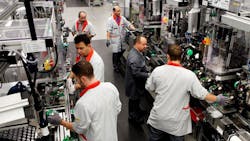
In the heart of Bosch's Feuerbach factory, located near Stuttgart, Germany, a team of skilled associates in gray work coats carefully assemble the CP4 high-pressure diesel pump in a narrow work cell. Each associate in the cell performs his function and then moves the component over to the next worker.
While the Feuerbach facility is a model of advanced manufacturing with a wide array of sophisticated machining tools, robots, computer screens showing real-time production figures and the kanban systems and signage emblematic of lean manufacturing, Bosch executives have made people the heart of this operation. In fact, six years ago, executives decided to abandon a fully automated line and make skilled operators the heart of their production process for this product.
"Our high quality comes from dedicated people,” says Werner Müller, executive vice president, manufacturing and quality management, for the Diesel Systems division.
Müller stresses that manning the line with people, not robots, was a business decision. During the downturn, he notes, Bosch did not have huge amounts of capital tied up in automation that was running below capacity. As demand has increased for the pumps, Bosch has added production lines and now produces 1 million pumps every four months.
The work cell producing the CP4 pump reflects the Bosch Production System, which is based on the Toyota Production System and emphasizes one-piece flow. Bosch bases its system on eight principles: process orientation, pull system, standardization, perfect quality, flexibility, transparent process, waste elimination and CIP.
Parts for the pumps are stocked in an external supermarket so that material flow is kept outside the assembly line. The supermarket holds about two hours of stock.
As each pump begins the assembly process, a transponder is attached to the pump and information on its production is tracked electronically. Pumps undergo a variety of step tests during production and every pump goes through a functional test before it is shipped.
It is demanding work. Bosch's clients for the diesel systems include a vast number of global automakers such as Mercedes, VW, Honda, GM and Ford. Müller points out these clients have no tolerance for equipment failures. The piston clearance in the pumps is 2.5 microns; for comparison, a human hair is approximately 60 microns in diameter. Müller notes that the pumps have just a 2 ppm failure rate worldwide and there are virtually no field problems.
Such precision manufacturing demands knowledgeable employees operating smoothly as a team. Bosch associates go through initial training to familiarize them with the pumps and the assembly process. Each month, leaders hold a team meeting to discuss continuous improvement initiatives, customer needs and other issues. And at each shift change, there is a brief meeting to go over any immediate issues.
Feuerbach is global headquarters for Bosch's Diesel Systems division, which employs 50,000 worldwide and has 24 production locations. The division had sales of 8 billion euros in 2011, with more than 80% of its sales outside Germany. At the Feuerbach factory, some 3,100 associates manufacture diesel products.
Growing the Skilled Workforce
Bosch benefits from Germany's dual-track school system, which provides students with a vocational education path that introduces them to manufacturing skills and offers them apprenticeships at employers such as Bosch.
"The German education system gives us a big boost," says Müller, who strongly endorses the skills training and introduction to actual manufacturing environments.
At the Feuerbach complex, for example, more than 500 young people are training for technical or commercial careers. In addition, Bosch's occupational training department supervises 200 students from the Baden-Württemberg University of Cooperative Education.
In 2011, 1,500 young people started an apprenticeship at Bosch in Germany. Altogether, Bosch had 6,600 students in apprenticeship programs around the world.
Sustainability Pays Off
Bosch's associates also play a key role in the firm's ambitious sustainability efforts. Company executives have set targets to reduce CO2 emissions by 15% by 2012 and 25% by 2020 compared to the 2007 baseline. At Feuerbach, company executives divided up the work on the goals among departmental teams and encouraged employee ideas for energy-saving projects.
One approach was simply to stop using energy when it was not needed. If lines were not running on the weekends, for instance, department leaders were authorized to use the building management system to turn off power, switch off lights and take other appropriate measures.
Other actions have involved retrofitting machines, such as introducing frequency converters on high-pressure washing machines. For energy-saving investments, plant officials look for a payback period of 2 years or less.
To help employees understand the energy saving goals, plant officials translated the goals in kilowatt hours and referenced the energy output of a nearby wind turbine that the local utility had erected. That windmill produces 767 megawatt hours of electricity in a year. In 2011, Bosch was able to save energy equivalent to the output of 28 windmills.
Bosch is on target to slightly exceed its 2012 goal at Feuerbach. Company officials note with pride that this was a goal no one thought was possible when it was set five years ago. Moreover, that dedication to energy efficiecnyis helping the facility save more than 2 million euros annually.
And, notes Müller, "Most of the changes are coming from the workforce, not engineers."
About the Author
Steve Minter
Steve Minter, Executive Editor
Focus: Leadership, Global Economy, Energy
Call: 216-931-9281
Follow on Twitter: @SgMinterIW
An award-winning editor, Executive Editor Steve Minter covers leadership, global economic and trade issues and energy, tackling subject matter ranging from CEO profiles and leadership theories to economic trends and energy policy. As well, he supervises content development for editorial products including the magazine, IndustryWeek.com, research and information products, and conferences.
Before joining the IW staff, Steve was publisher and editorial director of Penton Media’s EHS Today, where he was instrumental in the development of the Champions of Safety and America’s Safest Companies recognition programs.
Steve received his B.A. in English from Oberlin College. He is married and has two adult children.