Shale Gas Strategy: Southwestern Energy Chief Calls for a New 'Social Contract'
A "Drill Baby Drill" sign greets motorists passing through Ohio's rural Columbiana County on U.S. Route 30 east of Canton.
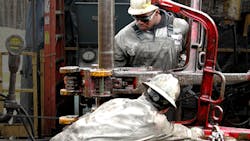
About 10 miles or so down the road Chesapeake Energy Corp. (IW 500/104) wraps up drilling its third natural gas well at a site called Ayrview Acres. It's early March and rig workers at the Chesapeake site are separating long sections of drill bits with large wrenches called tongs.
The work is physically demanding and sometimes dirty. The rig hands employed by Chesapeake drilling affiliate Nomac are occasionally splattered with drilling fluid as they remove pipe from the hole, a process known in the industry as "tripping pipe."
For people tough enough to endure the elements and grime, the payoff is quite substantial. Entry-level rig workers can make as much as $65,000 a year, according to a Chesapeake representative.
Many politicians, businesses and residents in eastern Ohio hope similar high-paying jobs will come to their towns as the shale gas boom takes off.
Chesapeake's Ayrview Acres site is in the Utica Shale region, an area drawing oil and gas producers from around the world attracted to the liquids-rich natural gas locked underground.
As of mid-March, Chesapeake had eight rigs operating in the Utica Shale, says Pete Kenworthy, a company spokesman. By the end of the year, the company expects to have 20 rigs operating in the region.In addition to the direct jobs created by this "shale gale," oil and gas industry suppliers and service companies continue to expand near shale gas-drilling regions.
Hotels, restaurants and rental properties are also filling up in some of the towns impacted by the shale boom.
But similar to other fast-expanding industries of the past, oil and gas producers find themselves contending with public concerns about the social impact of their growing footprint.
It's a conundrum that has some industry leaders demanding more accountability and transparency from their peers.
"You have to have a social contract wherever you're at," Steve Mueller, president and CEO of Southwestern Energy Co. (IW500/269), said during the CERA Week energy conference in Houston on March 7. "One thing about the shale and unconventional plays is, for a large part, they're in areas where we've never been before as an industry. So you have to start with that social contract."
That social contract takes into account how society as a whole can benefit from oil and gas industry activities, Mueller says.
It also means the industry "gets it right," says Mueller, referring to concerns about hydraulic fracturing. Royal Dutch Shell plc (IW 1000/2) CEO Pete Voser takes it a step further, saying shale drillers should insist on strong regulation and enforcement to ensure everyone conducts hydraulic fracturing properly.
"While we all recognize the significance of this opportunity, our industry needs to do a better job of convincing the world that natural gas is a force for good," Voser said during his CERA Week keynote address.
Voser added that he backs President Obama's call for shale gas drillers to disclose chemicals used in hydraulic fracturing. Shell also is working with the Environmental Defense Fund to measure methane emissions from natural gas production in the United States, Voser said.
Community Impact
About 20 miles east of Chesapeake's Ayrview Acres site is Carrollton, Ohio, a small town in Carroll County that's growing up fast.
Chesapeake and other drilling companies have converged on Carroll County, which borders Columbiana, to expand operations in the Utica play. Louisiana, New Jersey and Pennsylvania license plates dot the village square parking lot, an unusual sight in such a rural community.
Around 1 p.m. on a Friday, a local Ponderosa Steakhouse is still bustling with activity. Since the shale gas rush took off about a year ago, the restaurant has increased business by an average of 200 to 300 customers a day, says Teresa Keane, a manager and waitress at the Carrollton Ponderosa.
"There's a lot of extra money in this town," she says while seated in a window-side booth.
Some workers at the restaurant have doubled their hours, working four days instead of two because of the rush. Keane says overall the experience has been positive.
She's hoping to eventually receive royalties from a well operating on her road. But with the good comes the bad. The drilling and transportation crews have created "a lot of dust and potholes," Keane says.
Elsewhere, environmental concerns over groundwater contamination from hydraulic fracturing have created a public stir.
The Environmental Protection Agency said in a draft report that it found evidence hydraulic fracturing contaminated water wells in Pavillion, Wyo. Ecana Corp., the Canadian company that fracked in the area, and lawmakers have criticized the EPA report, saying the agency's study methods were flawed.
In recent years, homeowners in several states have sued energy companies, including Chesapeake and Southwestern, alleging hydraulic fracturing has contaminated their water sources.
In 2010, 13 families from Pennsylvania's Susquehanna County sued Southwestern claiming the company contaminated their wells. Mueller says the well in question in Pennsylvania never produced gas, and Southwestern never fracked the well. As of press time, the case was still pending.
In Arkansas, residents complained their water was contaminated after Southwestern repaired a water well on federally owned property at the state's request. Mueller says the allegations have nothing to do with hydraulic fracturing and instead question the company's actions during the repair process.
Most of the public fears have more to do with misinformation than facts, Mueller contends. Nonetheless, Mueller and other industry executives say many public doubts can be eliminated through more transparency and communication.
Getting it Right
During CERA Week, one of the world's largest annual energy industry conferences, several oil and gas CEOs, including Voser and Exxon Mobil Corp.'s (IW 500/1) Rex Tillerson, touted their companies' participation in the online FracFocus registry as evidence they're embracing transparency.
Companies participating in FracFocus disclose the chemicals used in the hydraulic fracturing process. FracFocus is managed by the Interstate Oil and Gas Compact Commission and the nonprofit Ground Water Protection Council.
Part of Mueller's social contract involves gaining a better understanding of how much a company's activities impact neighborhoods, including the negative. Shale fields are much larger than traditional oil and gas sites. In the past, a large field might include 100 wells.
By comparison, Houston-based Southwestern has approximately 2,500 wells in Arkansas, and Mueller expects the industry to continue drilling in the region for about 30 years.
"The size of an unconventional play is so large; you're there for a much, much longer period of time, and it does wear on a community," Mueller tells IndustryWeek.
Companies operating in these communities must have workers living in the towns so they can relate to the residents and quickly address any issues, Mueller says.
"You have to tell them what you're going to do, what some of the issues are they're going to face -- and live in the community," Mueller says. "You have to be there suffering the same thing they are or gaining the same benefits they are."
In Arkansas, Southwestern's top-producing area, the company has approximately 1,100 of its 2,000 employees living and working near drilling sites. The company began operations in Pennsylvania last year and already has 100 people living near drilling activity, Mueller says.
Another key component of the social contract is to engage in activities that clearly provide benefits to both the company and consumer. Southwestern is trying to address this aspect by putting more compressed natural gas, or CNG, vehicles on the ground.
In October, the company started a program that provides incentives for employees to either purchase CNG vehicles or convert their existing cars or trucks.
The program goal is to help 10% of the workforce convert to CNG vehicles. Why 10%?
"If you just took 10% of the taxable vehicles in the country, two things would happen: People would pay $1.60 per gallon less in gas, and you'd add 4 bcf (billion cubic feet) a day in demand," Mueller remarked during CERA Week.
In other words, the industry profits while helping consumers cut costs, a break from the current model that relies on high natural gas prices to drive earnings.
The response from employees has exceeded expectations. In early March, the company gave away CNG vehicles to 21 employees along with home fueling units. Southwestern is in the second phase of the program, during which the company plans to provide CNG conversion kits and fueling units to select employees.
The company plans to continue the program until it converts about 200 workers to CNG vehicles, Mueller says.
Making natural gas-powered vehicles a reality may be several years in the making and will likely require the industry to collaborate more with the auto industry and policymakers, says Mueller.
But it's a step toward changing consumer perceptions that the industry profits at an unreasonable cost to its customers and the environment.
In the more immediate future, technological advancements focused on the hydraulic fracturing process itself could help the industry win more public support.
Oilfield services provider Schlumberger is working on a technology that more accurately characterizes reservoirs so only the most productive wells are fracked and water usage is significantly reduced, Patrick Schorn, president of reservoir production at Schlumberger, said during a CERA Week panel discussion.
In addition, Exxon and General Electric Co.(IW 500/4) are collaborating to provide $2 million in seed money to develop university-led programs that provide state regulators with access to the latest environmental assessment technologies, Tillerson said at the energy conference.
If the oil and gas industry "gets it right," as Mueller says, employing an open-book policy and continued innovation, more communities may welcome the potential shale gas offers.
If not, the enthusiasm exhibited in those "Drill Baby Drill" signs will likely give way to "Not In My Backyard."
About the Author
Jonathan Katz
Former Managing Editor
Former Managing Editor Jon Katz covered leadership and strategy, tackling subjects such as lean manufacturing leadership, strategy development and deployment, corporate culture, corporate social responsibility, and growth strategies. As well, he provided news and analysis of successful companies in the chemical and energy industries, including oil and gas, renewable and alternative.
Jon worked as an intern for IndustryWeek before serving as a reporter for The Morning Journal and then as an associate editor for Penton Media’s Supply Chain Technology News.
Jon received his bachelor’s degree in Journalism from Kent State University and is a die-hard Cleveland sports fan.