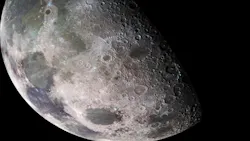
SYDNEY — The quest for rare earths vital to some of modern life's most indispensable technologies may see mining robots jet to the stars within decades, a world-first conference in Australia was told Wednesday.
Yttrium, Lanthanum and the other 15 minerals which make up the group of elements known as rare earths are crucial to everything from wind turbines and hybrid cars to cruise missiles and the ubiquitous smartphone.
As technology advances so too does demand for the elements which, although relatively abundant, require laborious and waste-intensive processing to be freed from surrounding rock.
They are a precious commodity -- so precious scientists are now looking beyond Earth's reaches for new supplies, with moon and asteroid mining becoming a lucrative prospect, according to researchers and tech firms gathered in Sydney for the world's first formal "Off-Earth Mining Forum."
"It's about joining the dots," explained conference convenor Andrew Dempster from the Australian Centre for Space Engineering.
"I think we've got to the point where people are saying 'Yeah, I think we can do this'."
A cross-section of the space and mining industry's top minds have gathered to swap ideas about the latest advances in space and mining technology, from Rio Tinto and Sandvik to NASA and Japan's space agency JAXA.
Rene Fradet, of NASA's Jet Propulsion Laboratory -- the organization behind the current Mars Curiosity Rover mission -- believes space mining will be possible and economical within 20 to 30 years.
But Dempster thinks it could be quicker than that.
"Most of the technology already exists, but there needs to be a business case. It depends on making that business case."
Costs are Sky-high
Like the challenges, the costs are substantial: to transport one kilogram to the moon is $100,000, and none of the cutting-edge completely automated technology comes cheap.
One delegate, NASA affiliate Berok Khoshnevis from the University of Southern California, has developed technology to make waterless sulphur-based cement from the loose rubble on Mars and Earth's moon.
Matthew Dunbabin, from the Australia's government's science agency CSIRO, has done a large-scale simulation of using mining machinery in space and told delegates the main issue was electrical power.
Few space missions had attempted significant excavations -- the sum total of all NASA's Apollo missions had been 382 kilograms and the Mars program had netted in the order of "grams," Dunbabin said.
Gravity, temperatures, atmospheric pressure, radiation and the consistency of surfaces themselves all present unique problems, complicated by the fact that operations in space would have to be largely automated and remote-controlled.
Space drilling also throws up the question: who owns the moon's resources?
SingTel Optus lawyer Donna Lawler likened it to the law of the high seas, where energy firms can mine in international waters without claiming territorial ownership.
More than 100 countries including the U.S. have ratified the 1967 Outer Space Treaty, which holds signatory nations responsible for activities in space but it is as yet untested.
It may be soon if space mining joins the moon landings in the annals of science fiction-turned-reality.
"There's nothing really science fiction about any of this. In many ways a lot of the technology already exists, I don't think we really have to invent much science," said Dempster.
Amy Coopes, AFP
Copyright Agence France-Presse, 2013
About the Author
Agence France-Presse
Copyright Agence France-Presse, 2002-2025. AFP text, photos, graphics and logos shall not be reproduced, published, broadcast, rewritten for broadcast or publication or redistributed directly or indirectly in any medium. AFP shall not be held liable for any delays, inaccuracies, errors or omissions in any AFP content, or for any actions taken in consequence.