There are no secrets in a manufacturer's toolbox anymore.
In this age of high-tech factories and connected, collaborative production, the tools and software that companies need to compete are, for the most part, too well known and well advertised for anyone to claim proprietary interest. From ERP and MRP, to CAD and simple spreadsheets, there is little variation anymore in the tools employed by manufacturers to drive production, though they employ them with vastly different results.
This is a conundrum central to the research of Jim Brown, president of the industry research company, Tech-Clarity.
See Also: Manufacturing Industry Technology News & Trends
"Everybody is facing the same challenges today," he says. "These challenges don't necessarily change much between the top performing and average manufacturing companies. Even the strategies they take to overcome them don't vary much."
With such little variation between them, he says, "the question becomes what are they doing differently? If they have the same strategy and use the same technologies, they must be accomplishing it in a different way."
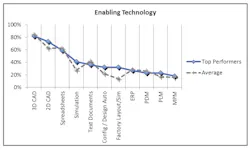
In other words, the only secret left to manufacturing success is in the particular high-tech cocktail of technologies and software that companies mix to lead their production.
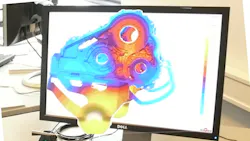
Surveying the high and average performing companies to answer this, Brown found one sizeable gap in equal deployment that might make all the difference: the use of simulation in product design.
"What really set these companies apart tended to be not necessarily their strategy or their focus, but the way they were going about designing product," he says.
There is a wide margin here, too. The top 17% of companies in Brown's "top performing" category those that show profit margins and revenue growth more than twice that of average companies are 49% more likely to use simulation software as a key component of this design process.
The perfect technology cocktail, this seems to say, requires a simulation base.
Simulation in the Fiery Heart of Manufacturing
This comes as no surprise to Christof Heisser, president of MAGMA Foundry Technologies, who has long sung the praises of simulation.
"Simulation technology has evolved from a geeky engineering thing to an essential business tool that helps companies change how they communicate," he says. "It literally changes the way they operate."
Heisser has a unique focus here. Foundries make up the fiery heart of manufacturing, responsible for creating product in the most basic sense possible. It is, as Heisser is quick to note, a centuries-old process that generally still relies on centuries old technologies.
However, just like manufacturing's more modern side, foundries are now entering a new high-tech age and, like Brown, Heisser sees this development centered around product development and simulation technology.
"Foundries use a 5,000-year-old technology and there has not really been anything new," he says. "Simulation is really the only thing that has happened to the industry that has made a fundamental change in how you run your foundry and how you make money."
Heisser sees this as the key to not only engineering success, but for transforming the whole business process.
Shaking the Foundations
Product design in the foundry has historically required a good deal of costly guesswork.
"For every new product or design, you have to take regular production off the line to do test runs to tell if the part works," Heisser says. That review process costs companies thousands of dollars and needs to be replayed over and over again until the right combination of temperatures, cooling times, risers and every other variable is found.
This process severs communication between each department and the customers, leaving each piece of the production puzzle isolated and in the dark during long experiments, revisions and retests.
Bringing the process up-to-date with simulation software however, has the potential to radically transform the business.
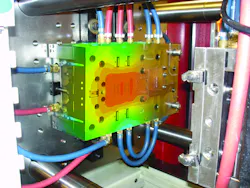
While offering some general perks like reduced energy and material consumption and easing the rework and trimming requirements, Heisser notes, "These tools can open a line of communication between the engineer and a partner on the shop floor."
Using appropriate tools, he explains, rather than sending simple plans down the line, the engineering department can include critical parameters on temperature thresholds, fill rates and process requirements for best results.
"They can say to them, ‘Here are the parameters or the work window you have to use and here's what happens when you don't do that,'" he explains. "This way the production floor gets much more buy-in as to why certain parameters are given to them."
Even more so, he says, "If you can use it for internal communication, you can obviously use it for external communication. So you can go to the customer and say this part is really tough to make because of this thin wall here where we cannot drill through. Here's an idea of how we can change that and you resolve that issue and the part is manufactured. Or the part gets cheaper to make, or gets made faster, or with fewer defects."
Looking at it like this, he says, can be quite a shift for manufacturing executives. "The CEOs and the presidents of the world, whenever they see the word 'simulation,' they immediately send it to an engineer," Heisser says. "But this has a much bigger reach than just the engineering department. It reaches every department of the operation. It fundamentally changes the way you operate."
About the Author
Travis M. Hessman
Editor-in-Chief
Travis Hessman is the editor-in-chief and senior content director for IndustryWeek and New Equipment Digest. He began his career as an intern at IndustryWeek in 2001 and later served as IW's technology and innovation editor. Today, he combines his experience as an educator, a writer, and a journalist to help address some of the most significant challenges in the manufacturing industry, with a particular focus on leadership, training, and the technologies of smart manufacturing.