An intricately designed nylon mesh egg large enough to have been hatched by a dinosaur may portend the future of custom manufacturing. Prominently displayed in the window of the Hugo Boss store in Sloane Square in the Knightsbridge section of London, the 24-inch-tall egg was created using additive manufacturing.
One of 200 custom-made entries in this year's Faberge Big Egg Hunt, an annual event staged each year for charity, the big egg is important to manufacturing because it was created using a method called laser sintering, in which layers of material are added to create a three-dimensional object or part from a 3-D computer-aided design. This particular egg is so complex in its design -- with mesh and apertures throughout -- that it couldn't have been fashioned using conventional manufacturing techniques.
"The egg has more empty space than solid space," observes David Bennion, sales and marketing director at Ogle Models, a rapid prototyping and additive manufacturing firm. Ogle produced the one-off creation on its EOS laser-sintering machine over 42 hours and 46 minutes.
"We normally focus on industry applications in aerospace, medical, automotive and the like," says Stuart Jackson, UK regional manager for EOS Electro Optical Systems GmbH of Krailling, Germany, which makes additive manufacturing machines. "This laser-sintered egg is a perfect example of the vast possibilities the technology can offer. Parts can be created that would not have been possible with conventional manufacturing technologies."
Technology Goes Mainstream
As the advantages of additive manufacturing become more realizable with new technologies, numerous companies are turning to this custom approach to build not only prototypes, but also to produce parts by the hundreds.
"We saw the technology as a benefit to us, and we've been using it for three or four years," says Tim Kamleiter, aerospace manager at C&A Tool, a privately held contract manufacturer of parts for the medical, automotive and aerospace industries based in Chiarabusco, Ind. "Most of what we do is production of parts for final assembly, such as diesel-fuel injectors." With about 535 employees, C&A Tool uses additive manufacturing to turn out parts in quantities ranging from one to a few hundred.
In the additive manufacturing process, parts are created from a 3-D computer-aided design model by building up successive layers of metal or plastic in the desired form and shape. This method differs from most traditional manufacturing methods, in which parts are formed by subtraction -- shaping, boring, cutting, trimming, sanding and otherwise removing material until the finished item has been reduced to the desired shape and size.
Although traditional manufacturing also has included fabrication methods that are basically "additive" -- joining metal plates, forgings and rolled steel via rivets, screws or welding -- these methods aren't driven by the information-technology component of a CAD model.
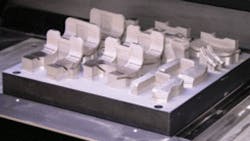
Currently, the chief limitations for the additive process are the type of materials and the part size. Most parts are made with titanium, specialized steels or other metals, or various plastics. The size limitation is dictated by the build platform. C&A Tool, for instance, which uses an EOS machine, works with a 10-inch by 10-inch by 8-inch build platform. "That's pretty consistent with what we make," Kamleiter says.
The chief advantages of additive manufacturing are the speed of manufacture versus traditional machining, and the flexibility of design. Most parts can be produced in a matter of hours, although Kamleiter says some parts can take up to 400 or 500 hours. Parts that contain blind holes or inside passages that are impossible to produce via other methods can be built through the additive or layering process. "Using laser-sintering technology, we can produce something you can't make in the traditional ways," he points out.
The process may sound labor-intensive, but it's not. "Thirty hours is a typical build time, but the machine runs lights out, although we check on it from time to time," Kamleiter says.
The additive process also is attractive to markets such as the medical industry that need products right away. "Speed is important for the medical industry," Kamleiter says. "We can make a part in hours without the delays of the machining process."
Effective Low-Volume Approach
But additive manufacturing can be costly. Although this approach can't compete with the low per-unit cost of mass production, it's effective when it comes to manufacturing in low volumes, and often is quicker than traditional methods. "It's not always a cheap process compared to conventional machining," Kamleiter says. "But if you need a complicated part or a part that can't be machined in a short time, this is a cost-effective way to go."
Similarly, additive manufacturing enables the creation of a single part that has all the complex design features of what otherwise would have required three separate parts if manufactured through traditional methods.
Two of the most common additive manufacturing processes are laser sintering and fused-deposition modeling. The former uses a high-power laser to fuse powdered metals into fully dense 3-D objects, layer by layer. In the latter approach, a plastic filament or metal wire is unwound from a coil, supplying material to an extrusion nozzle. The model or part is produced by extruding small beads of material to form successive layers. In each case, the exact geometry of the part is defined by the 3-D CAD model.
At C&A Tool, once the rough part has been built through the laser-sintering process, workers complete the manufacturing process by performing the finishing work on its fleet of precision lathes and milling machines.
Another manufacturer that depends on additive manufacturing is GPI Prototyping, which uses laser-sintering systems built by Germany-based EOS, which also has offices in Michigan. "We have two EOS machines and we are building direct from 3-D CAD files," says Tim Ruffner, GPI vice president of new business development and marketing manager. GPI's medical customers use their products for trials for surgical instruments and surgical implants, "which can be done in days," Ruffner says. A typical production run of parts, he says, "is a couple hundred."
Driven by Design
One of GPI's customers is 3De, a rapid product development company in Fort Lauderdale, Fla. "We are producing an entire high-precision surgical system using this technology," says 3De founder Scott Hay. He is such a believer in the speed and flexibility of additive manufacturing that he calls it "a terrific win for American manufacturing." GPI produces the parts for 3De from CAD designs provided by 3De, and the latter finishes the raw parts -- polishing, anodizing, etc.
"You can capture any geometry you want," Hay says. "It's almost impossible to make the parts we are making with traditional manufacturing. High-precision milling is the only way you could produce these parts, and these are very complex tasks. There is only a limited amount of manufacturing skill out there that can meet these challenges." He adds that at least 30% of the parts in this surgical system will be manufactured using additive manufacturing.
Hay likens the process to building a tree. "It's a lamination process, with metal being deposited layer by layer," he says. "Each layer has a different profile, and you literally start growing a part like a tree with this technology," he explains. "Unlike machining, which is a subtraction process, this is an additive process. One big difference with this technology is that you are able to capture geometry that you couldn't mill."
Kamleiter of C&A Tool describes the difference between traditional manufacturing methods and the additive process as a very basic one. "Before, we used manufacturing-driven design that was dictated by the manufacturing tools we had," he explains. "By contrast, additive manufacturing is design-driven."
Manufacturers are leveraging additive manufacturing to handle relatively limited production runs of particularly difficult product designs. A good example is Kelly Manufacturing Co., which makes a variety of general aviation instruments -- air and electric-attitude gyros, directional gyros, turn-and-bank indicators, tachometers, gauges, voltage warning systems and more.
Kelly had a turn-and-bank indicator that provides the pilot with the rate of aircraft turn. A crucial piece of the M3500 is the toroid housing containing the coil used to power the gyro at the instrument's core. In the past, the housings had been made of urethane castings. But using this method of manufacture, it was difficult to maintain the tight dimensional specifications for housing height, and manual sanding was necessary to remove unwanted elements introduced in the casting process. Another issue was that new tooling had to be made at considerable expense whenever a new design was introduced. What's more, the delivery lead time to produce 500 castings was three to four weeks.
Volumes of 500 Units
Kelly turned to a contract manufacturer, Rapid Processing Solutions Inc., which specializes in direct digital manufacturing and makes production parts for various jet manufacturers. Using a 3-D production system from Stratasys Inc. of Eden Prairie, Minn., RPSI was able to build the 500 toroid housings out of a strong, lightweight thermoplastic used in aircraft interiors in a single production run. In the end, Kelly Manufacturing got a final product that had improved dimensional accuracy and required no hand sanding. "The lead time for 500 units has been shortened to three days from order to delivery of parts," says Justin Kelly, KMC president.
In another case, Mission, Kan.-based ScriptPro, a maker of automated pill-dispensing systems for pharmacies, uses a Stratasys 3-D production system to make selected parts for its products. ScriptPro uses the machine to make both the prototypes of the bezels that accept vials for pills, as well as the actual vials shipped to pharmacies. "Not only were the tolerances in line, but there was little to no post production work, such as sanding or painting," says Bill Thomas, vice president of manufacturing at ScriptPro. "We produce the vial bezels, wash them, and install them on the machines."
ScriptPro has found that although the per-part cost is higher using additive manufacturing, the company still reaps an overall savings by eliminating the machining and tooling costs to create new bezel shapes and sizes. Based on its median annual machine-production volume, the company estimates that bezel production would cost $5,100 more with direct digital (additive) manufacturing, but the elimination of tooling would save about $30,000, for a net savings of about $24,900.
With savings like that, it's no wonder additive manufacturing is starting to catch on. And while it may not replace mass production anytime soon, the additive approach has proven to be a cost-effective and efficient way to produce limited volumes of parts.