Global Manufacturer: Is There a Manufacturing Renaissance or Not?

Since manufacturing employment cratered in February 2010, the sector has been slowly and steadily adding jobs. Today, U.S. manufacturing employment stands just under 12 million, a gain of about 500,000 in the ensuing three years.
The growth in manufacturing has prompted some to proclaim a manufacturing renaissance in the United States. That view caught fire in 2011 when the Boston Consulting Group noted the rapid rise in Chinese labor costs and predicted that China would lose its labor wage advantage over the United States in 2015. Later that year, BCG predicted that cheaper energy prices and labor costs would result in a surge of U.S. exports and reshoring. The result: 2.5 million to 5 million jobs by the end of the decade.
See Also: Global Manufacturing Economy Trends & Analysis
Is the renaissance actually underway? On March 22, Jan Hatzius, an economist with Goldman Sachs, said the evidence for a manufacturing renaissance was "scant so far."
"The recent strength of U.S. manufacturing output looks squarely cyclical," said Hatzius. "Measured productivity growth has been strong, but U.S. export performance -- arguably a more reliable indicator of competitiveness -- remains middling at best. And at least so far, there is not much evidence for large positive spillovers from the U.S. energy cost advantage to broader manufacturing output."
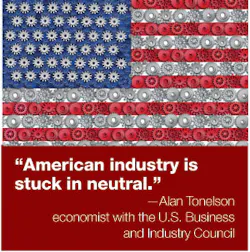
Alan Tonelson, an economist with the U.S. Business and Industry Council, also worries that the word "renaissance" has been thrown around prematurely. Looking at the February industrial production report from the Federal Reserve, Tonelson said, "American industry is stuck in neutral."
"Overall, manufacturing production is still 3% below its level when the Great Recession began in December 2007 -- despite literally trillions of stimulus dollars poured into the U.S. economy by the Bush and Obama administrations and the Federal Reserve," Tonelson observed.
Aspen Forecast for Manufacturing Growth
Don't despair yet. On March 26, the Aspen Institute's Manufacturing and Society program and the Manufacturer's Alliance for Productivity and Innovation (MAPI) struck a more optimistic note when they released an econometric forecast for major growth in U.S. manufacturing.
The forecast isn't meant as a sure-fire prediction. Instead, Aspen and MAPI showed a "manufacturing resurgence" scenario based on a healthier world economy, greatly increased exports by the U.S. and a series of "modest" policy changes that would allow the country to benefit from new domestic energy sources, lower corporate tax rates and a lid on costly regulations.
What would be the result if the U.S. followed these recommendations? Aspen and MAPI said manufacturing's share of U.S. GDP would grow from the current 11.6% to 15.8% by 2025. U.S. GDP itself would grow an additional $1.5 trillion, with most of the increase due to manufacturing.
Manufacturing employment would grow by 307,000 a year under the resurgence scenario, totaling 3.7 million additional workers by 2025. That compares to a baseline projection where U.S. manufacturing would add just 23,000 workers annually.
The balance of trade in goods and services would dramatically shift from the current deficit of $500 billion annually to a surplus of approximately $700 billion, including nearly $200 billion in manufactured goods. Under the baseline scenario, the country's balance of trade would continue to run deficits.
"The robust results presented in the study are achievable with only modest acceleration of current trends, and none of the policy recommendations mark a radical departure from current policy trajectories," said Thomas J. Duesterberg, executive director of the Aspen Institute's Manufacturing and Society program and the report's author. "But they require a willingness to change in a disciplined way."
The truth is that it may be too early to tell if we are just showing a modest recovery from a terrible recession or if the alchemy of smarter government policies, abundant domestic energy and a better economic environment will indeed fuel a U.S. manufacturing renaissance.
About the Author
Steve Minter
Steve Minter, Executive Editor
Focus: Leadership, Global Economy, Energy
Call: 216-931-9281
Follow on Twitter: @SgMinterIW
An award-winning editor, Executive Editor Steve Minter covers leadership, global economic and trade issues and energy, tackling subject matter ranging from CEO profiles and leadership theories to economic trends and energy policy. As well, he supervises content development for editorial products including the magazine, IndustryWeek.com, research and information products, and conferences.
Before joining the IW staff, Steve was publisher and editorial director of Penton Media’s EHS Today, where he was instrumental in the development of the Champions of Safety and America’s Safest Companies recognition programs.
Steve received his B.A. in English from Oberlin College. He is married and has two adult children.