Learning to Fly -- China's Airplanes Take Off
If at first you don't succeed, try again.
China, in its decades-long quest to build a domestic airplane, seems to have taken that age-old pearl of wisdom to heart. Despite a string of foibles and failures in its previous efforts, there's good reason to believe that China's latest initiative -- the Commercial Aircraft Corp. of China (Comac) -- has a decent chance of getting off the ground.
"I think their prospects for success this time around are much greater," asserts Anil Gupta, a professor of strategy at the University of Maryland and a visiting professor at INSEAD business school's Singapore campus.
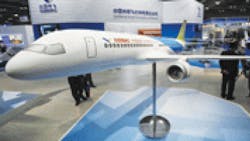
Formed in 2008 by the Chinese government, Comac already is taking orders for its two airplanes: the ARJ21 regional jet, which is scheduled to enter service in third-quarter 2011; and the C919 jumbo jet, which is scheduled to enter service in 2016.
With the C919, China is angling for a piece of the pie in the single-aisle aircraft category dominated by Airbus and Boeing -- a category that Boeing expects to more than double in fleet size globally by 2029.
But China's goals for Comac go beyond capturing market share. Comac is part of China's codified strategy to develop "national champions" in the aviation and aerospace, automotive, electronics, oil and gas and other key industries, explains Usha Haley, a professor of international business at Massey University in Auckland, New Zealand, and co-author of the upcoming book "Subsidies to Chinese Industry: State Capitalism, Business Strategy and Trade Policy."
"The Chinese have seen it as in their strategic interest to bolster these industries, which accounts in part for why they want to build national champions and challenge the dominance of Boeing and Airbus through them," Haley says. "They're not so much interested in making profits. What they're interested in is size, growing and dominating the industry. That's their goal."
Comac has a lot going in its favor. It is lustily capitalized (by a consortium of government agencies and state-run companies), and it is partnering with Western technology leaders such as GE, Honeywell and Rockwell Collins to develop and build the subsystems and components -- a departure from China's past insistence on de novo technology creation.
Then there's the Chinese aviation market. Boeing recently projected that China will need 4,330 new commercial airplanes over the next two decades, which would triple China's airplane fleet and make it the largest airplane market outside of the United States. Boeing predicts that 71% of that demand will be for single-aisle airplanes -- a category that includes the Boeing 737, the Airbus A320, and, potentially, the Comac C919.
"China is one of the world's fastest-growing and dynamic aviation markets, driven by the urbanization of China, the growth of its economy and ever-increasing personal wealth," said Randy Tinseth, vice president of marketing for Boeing Commercial Airplanes, when Boeing released its market outlook this past November. "We expect domestic passenger traffic for China to grow at a rate of 7.9% on average."
At a Glance: COMAC
Name: Commercial Aircraft Corp. of China |
With the three largest Chinese airlines -- Air China, China Eastern and China Southern -- under state control, Comac could have a leg up on Boeing and Airbus in the scramble to capture China's booming domestic market, says Perry Flint, editorial director for Air Transport World magazine.
"You can be pretty sure that the Chinese airlines are going to be under strong pressure to order [a Comac jet] whether they want to order it or not," Flint says.
A different test will be whether Comac's C919 can challenge the Boeing-Airbus duopoly outside of China. Noting that commercial airlines are, by necessity, "extremely risk-averse," Gupta asserts that "foreign airlines are unlikely to buy the C919 until some time has passed and it has proven itself as a safe, reliable plane within China."
Scott Hamilton, founder of Leeham Co. LLC, an Issaquah, Wash.-based aviation industry consulting firm, agrees, adding that "both the ARJ21 and the C919 are going to have limited sales outside China to [China's] political allies."
In fact, Hamilton doesn't expect either jet to be especially competitive, and he notes that neither jet features anything groundbreaking in the way of technology or design. The ARJ21 looks like a "downsized" version of the McDonnell Douglas MD-80, Hamilton says, while the C919 "looks pretty similar to the [Airbus] A320, which is not particularly surprising since Airbus established an A320 assembly line in Tianjin."
But that's not the point, Hamilton argues.
"This is going to take some time. This isn't going to happen overnight," Hamilton says. "The Chinese are very patient people. As I like to put it, they waited 99 years to get Hong Kong back. They can wait a generation to create a viable commercial aviation industry."
Through Comac and its relationships with Western suppliers, the Chinese are gaining valuable experience in modern production techniques and are immersing themselves in our technology, Hamilton says. That's why he calls the ARJ21 and the C919 "proof-of-concept airplanes" -- and he believes they are the "first of airplanes to come."
"It took Airbus 25, 30 years to reach parity with Boeing," Hamilton says. "There's absolutely no reason in the world to think that China can't do the same thing. That's a generation."
'Indigenous Innovation'
Gupta is so impressed with China's handling of Comac that he believes the initiative could become a template for other nations aspiring to establish their own aviation industries, particularly larger emerging economies such as India.
In Comac, Gupta sees a shrewd application of both state capitalism and "market logic." For example, one of China's top steel producers, Baosteel, and other domestic raw materials suppliers each have 5.3% equity stakes in the company. Although these companies are owned by the state, Gupta believes that giving them equity ownership in Comac "adds an element of market logic to their willingness to cooperate."
"Theoretically, the Chinese government can just order [Baosteel] to do what it wants to do," Gupta says. "But instead of using fiat as the operating mechanism, the Chinese government has done something smarter. Essentially it's a smoother, more effective way to get various entities to cooperate."
Perhaps China's masterstroke, in the eyes of Gupta, is how it has allied itself with international corporations to supply the subsystems and components for the Comac project -- rather than simply import them.
Comac has made it clear that it prefers to work with international suppliers that form joint ventures with domestic partners. Consequently, GE Aviation Systems, for example, is supplying the avionics core processing system, the on-board maintenance system and other electronics for the C919 through a joint venture with state-owned Aviation Industry Corp. of China (AVIC). Rockwell Collins will provide the cabin core system, which allows flight attendants to control subsystems such as inflight entertainment, heating/cooling and lighting on the C919, through a joint venture with Shanghai Aero Measurement-Controlling Research Institute, a subsidiary of AVIC.
Eaton, Parker Aerospace and Goodrich are among the other corporations that are supplying subsystems to the C919 through joint ventures with Chinese partners.
The strategy is part of China's national policy emphasis on bolstering its "indigenous innovation" by absorbing and improving upon foreign technology, Gupta says.
It's a pay-to-play model, Leeham's Hamilton asserts.
"What they're requiring from Western manufacturers is that, If you're going to do business with us in China, we need to have joint ventures. We need to be able to learn some of your technology,'" Hamilton says. "And so basically the Western manufacturers are creating their own competitors in China."
A Long-Term Threat?
One analyst who isn't buying the hype about Comac is Richard Aboulafia, vice president, analysis, at the Fairfax, Va.-based Teal Group Corp. Aboulafia, who suggests that Comac should be pronounced "comic," says the Chinese government's attempt to build an airplane is "like watching the DMV trying to design a car."
"China has a fantastic market and a lot of talent and resources. But if you approach the commercial aviation industry from a government-directed standpoint, things go bad very fast," Aboulafia says. "If China were to approach this in pretty much any other direction, I think Western aerospace companies would be understandably concerned. It would be another Japan -- a major competitor on several important levels of the supply chain. But that's not what they're doing."
Aboulafia is particularly skeptical that foreign suppliers, knowing China's reputation for intellectual property theft, are providing their most cutting-edge technology to Comac for the project.
"The result, of course, is that [Comac's] first jet works like it was designed in 1972," Aboulafia says.
Gupta disagrees, arguing that "the Chinese are technologically a whole lot more sophisticated than they might have been 15 years back." Says Gupta: The Chinese buyers "know what is the leading-edge technology and what is not."
Underscoring Gupta's point: Since August 2008, a joint venture between Airbus and a Chinese consortium has been performing final assembly on some Airbus A320 jets at a facility in Tianjin. This past September, Airbus announced that it had signed a contract with a Chinese company to produce spoilers and droop panels in China for its A350 XWB jet.
Even if Comac is loaded with the latest and greatest aviation technology, Air Transport World's Flint thinks the C919 won't pose much of a threat to Boeing and Airbus, especially outside of China. But like Hamilton, he acknowledges that Comac "puts [China] on a path" of learning. "I would think 2020 is when you really would see China emerge," Flint says.
When he considers Comac's future, Hamilton recalls that when Airbus' first production jet, the A300B2, entered service in the early 1970s, it didn't exactly take the world by storm.
"It was just an OK airplane," Hamilton says. "It didn't have any particularly new technology. It was underpowered. Its range was designed more for Europe than it was for the United States. But look at what the A300B2 begot. Forty years later, Airbus has a full family of airplanes." That's why Hamilton views Comac as a long-term threat to Boeing and Airbus.
"You cannot underestimate [China's] capabilities," Hamilton says. "They have now passed Japan to become the world's second-largest economy. They own a third of the U.S. debt. They're developing a blue-water navy. They put a man in space. We know that they're very aggressive in cyber issues and cyber security attacks -- even though they deny it, the evidence is sure there. They are very active in industrial espionage. They are very determined to become a world superpower in every sense of the word.
"Creating a national aerospace industry is a national goal. I have no doubt whatsoever that they will achieve that, given time."
About the Author
Josh Cable
Former Senior Editor
Former Senior Editor Josh Cable covered innovation issues -- including trends and best practices in R&D, process improvement and product development. He also reported on the best practices of the most successful companies and executives in the world of transportation manufacturing, which encompasses the aerospace, automotive, rail and shipbuilding sectors.
Josh also led the IndustryWeek Manufacturing Hall of Fame, IW’s annual tribute to the most influential executives and thought leaders in U.S. manufacturing history.
Before joining IndustryWeek, Josh was the editor-in-chief of Penton Media’s Government Product News and Government Procurement. He also was an award-winning beat reporter for several small newspapers in Northeast Ohio.
Josh received his BFA in creative writing from Bowling Green University, and continued his professional development through course-work at Ohio University and Cuyahoga Community College.
A lifelong resident of the Buckeye State, Josh currently lives in the Tremont neighborhood of Cleveland. When the weather cooperates, you’ll find him riding his bike to work, exercising his green thumb in the backyard or playing ultimate Frisbee.