Is US Manufacturing Ready for its 'Mega-Opportunity?'
Many of the stories about manufacturing reshoring these days involve baby steps – a single operation moving back, the return of a product line, a gain of a few employees. Daniel Mahler thinks it’s time for bolder thinking.
Mahler, leader of management consulting firm A.T. Kearney’s America’s region, says he is in the camp that believes the U.S. is entering a manufacturing renaissance rather than simply witnessing a cyclical rebound for the industry. He bases that in part on “dramatically lower energy costs in the U.S. and dramatically rising labor costs in China.”
But he also says there is a market opportunity for U.S.-made goods that goes beyond purchasing them for patriotic reasons. Companies can also serve the desire of younger consumers to purchase products that are produced in an environmentally and socially sound manner throughout their supply chain. Younger consumers, he says, want to purchase “computers that weren’t made with child labor in China or shipped half-way around the world, resulting in a lot of CO2.”
“That is an underestimated benefit that a company has to look at holistically when considering the business case for reshoring,” he said. He says recent decisions by Apple to return some manufacturing to the U.S and by Wal-Mart to commit to sourcing $50 billion in goods domestically underscore both the shifting economics of domestic production and the brand value from producing in the U.S.
Mahler stresses that U.S. manufacturers have an opportunity to “reset” their thinking and include reshoring decisions in a more strategic view of their business. Such a view, he says, includes considering whether manufacturing in the U.S. provides a “sustainability advantage for your brand, for your value proposition.” It will also involve decisions about a number of significant issues facing U.S. manufacturers.
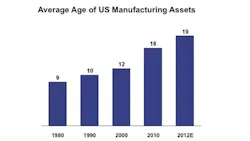
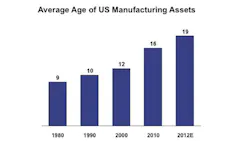
Aging Assets: The manufacturing asset base in the U.S. has aged significantly as many companies underinvested in capital equipment and maintenance. “Ten years ago, the average asset base was 12 years old. Now, it is 19 years," says Mahler, citing U.S. Bureau of Economic Analysis data. "Dusting off the equipment we have won’t do." Companies will need to make significant investments, he says, though those investments could have substantial benefits in terms of productivity and energy efficiency.
Aging Workers: The impending retirement of many U.S. manufacturing workers and the corresponding skills shortage is the second reason for concern, he says. In the 1970s, 25% of the workforce was involved in manufacturing. Now, it is 9% and that is a rapidly aging cohort with operational knowledge that often is difficult to replace. Some 10% of the manufacturing workforce will retire in the next 5 years. And Mahler warns that as manufacturing rebuilds in the U.S., labor will become more expensive.
Disrupted Supply Networks: If manufacturers bring operations back to the U.S., will they have the supply networks needed to support them? “The supporting supply base for an asset in the U.S. for many companies has evaporated,” he says. Along with these external challenges, many companies have moved at least some of their product development function overseas. Will that need to be moved back to the U.S. as well? If not, will the company have the communication systems in place to make the multi-location setup work efficiently?
Making Manufacturing Sexy
Manufacturers can’t deal with these issues strictly on their own, Mahler says. To support a manufacturing renaissance, he says the U.S. government needs, for example, to pass immigration reform and support ways to rethink and accelerate education to support the needs of the future manufacturing workforce.
For their part, he adds, manufacturers need to “make manufacturing sexy again as a career path.” He agrees that manufacturing would benefit from rebranding, emphasizing, for example, the opportunities in the field to maximize the benefits of supply chains.
Faced with these decisions, says Mahler, companies should consider more fundamental reviews of their operations. For example, are their facilities in the best locations in terms of taxes or supply base, or are they there solely because of historical precedent? The right execution of a strategic plan and investments, he says, can present U.S. companies with a “mega-opportunity” to leapfrog other nations in terms of competitive advantage.
“It is not just catching up or being almost as good as China, but much better,” he says.
Even with the right policies and investment, Mahler warns, don’t expect a manufacturing renaissance to happen overnight. He expects the transformation to take at least a decade.
“I don’t think it is cyclical. I think it is here to stay,” says Mahler. “But the big caveat is it will take much longer and is much more complex than most people think.”
About the Author
Steve Minter
Steve Minter, Executive Editor
Focus: Leadership, Global Economy, Energy
Call: 216-931-9281
Follow on Twitter: @SgMinterIW
An award-winning editor, Executive Editor Steve Minter covers leadership, global economic and trade issues and energy, tackling subject matter ranging from CEO profiles and leadership theories to economic trends and energy policy. As well, he supervises content development for editorial products including the magazine, IndustryWeek.com, research and information products, and conferences.
Before joining the IW staff, Steve was publisher and editorial director of Penton Media’s EHS Today, where he was instrumental in the development of the Champions of Safety and America’s Safest Companies recognition programs.
Steve received his B.A. in English from Oberlin College. He is married and has two adult children.