
Big data is real and it is costing you money.
This is according to a recent report put out by Oracle breaking down some of the most pressing big data business challenges facing manufacturers today.
The report offers a wake-up call for executives who still think of big data and advanced data management as IT problems alone.
"Big data equals big revenue and big dollars," explained Rod Johnson, vice president of Industry Strategy at Oracle. "Dealing with it is not an IT strategy -- it needs to be enabled by IT, but it is really a business strategy that should be on every CEO's agenda."
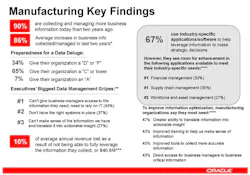
The 333 C-level executives from industrial manufacturing and 10 other industries surveyed for the report indicate that failure to adequately tap into the data is resulting in the loss of 10% of their average annual revenue, which adds up to an average loss of $40.8 million per year.
These figures cement the merger between IT and manufacturing after a decades-long collapse of the once segregated industries.
With the precarious state of today's manufacturing environment -- slimmed down by the recession and reliant upon new technologies to pick up production to drive the recovery -- that slow collapse has accelerated into a new age of high-tech, data-driven production.
The impact of this is fundamentally reshaping the market as manufactures scramble to adopt strategies to take advantage of these new capabilities and capture those $40 million in lost costs -- a challenge the report indicates most companies are unprepared to face.
Facing the Data Explosion
Some 90% of manufacturing execs reported they are facing this data crisis today and of those 65% rated their company a "C" or worse for its efforts to prepare for it.
"The data explosion is real in the minds of these business executives," Johnson said. "They reported that on average, across all of the companies, there is an 86% growth in data volume, but there are some really significant gaps in people and skills and process and information management tools to capture, secure and make available to business executives in a timely manner."
The respondents highlight three frustrations at the forefront in their work to tame big data:
- They can't give business managers access to the information they need.
- They don't have the right systems in place.
- They can't make sense of the information they have and translate it into actionable intelligence.
In order to meet these challenges, explained Sasha Banks, senior director of manufacturing industry strategy and marketing at Oracle, manufacturers need to invest in new tools, new practices and new processes to make up lost ground.
"Manufacturers are becoming deluged with data from operations, supply chain and product lifecycle management and need to be able to leverage it in a meaningful way to achieve a competitive advantage," she said. "To move forward, manufacturing firms are looking for strategies and solutions to help them transform data into revenue -- including new applications and analytical tools, as well as staff and specialized training."
In the end, the report indicates four objectives these companies feel they need to accomplish to compte in this increasingly high-tech field:
- Greater ability to translate into actionable insight.
- Improved training to help them make sense of the information.
- Improved tools to collect more accurate information.
- Direct access for business managers to business critical information.
About the Author
Travis M. Hessman
Editor-in-Chief
Travis Hessman is the editor-in-chief and senior content director for IndustryWeek and New Equipment Digest. He began his career as an intern at IndustryWeek in 2001 and later served as IW's technology and innovation editor. Today, he combines his experience as an educator, a writer, and a journalist to help address some of the most significant challenges in the manufacturing industry, with a particular focus on leadership, training, and the technologies of smart manufacturing.