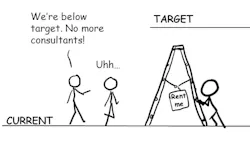
Remember Evel Knievel? Garbed in the tacky, white leather outfit that only the 1970s could produce, Knievel would launch himself and his Harley-Davidson across obstacle-strewn distances mortals of lesser stuff (or greater sense) wouldn't dream of attempting. Staging his daredevil stunts was an expensive proposition and Knievel was often short on cash but there's one thing I can guarantee he never said: "I'm low on funds, so I'll use some of my crew to hold up the ramp instead of building scaffolding."

But if we flip the channel from The Wide World of Sports to The Wide World of C-Suite Decisions, the performers are making the opposite choice. Faced with flagging sales, Brandon Graham, the North American regional president of a European software firm, recently fired the consultant he had hired to lead strategic planning. The same consultant he hired because the division was on track to miss profit goals.
Graham isn't an outlier. Confronted by a downturn in fortunes or a shortfall versus target the typical CEO or CFO directs everyone to batten down the hatches. All "unnecessary" spending is cut and, henceforth, using consultants is verboten! Now go make our profit target.
You can almost see the curly-mopped Knievel questioning the top brass. "So, Mr. Executive let me get this right:
- Your current people, processes and approaches have your business moving too slowly;
- Your lack of speed has created a gap between where you'll probably land and your target;
- Therefore, your business will now have to over-perform versus your original expectations;
- You require that over-performance to come from the same people (and the processes and approaches they developed) as in #1.
Here's some advice: Don't bet your career on reaching your target."
Knievel knew his motorcycle had to reach 90 mph to clear 16 cars, so when his current setup only yielded 86 mph his reaction was to buy a higher ramp. No amount of leaning forward or streamlining was going to get him the critical extra speed. So, while he saved money by forgoing a professional videographer and having his wife film his jump, he invested extra money on the takeoff platform.

In the real world you and other corporate leaders occupy, where we're typically confining our leaps to muddy puddles at the curb, the question is this: which investments in outside resources are going to generate the extra four miles per hour, and which are just making the gap larger without boosting our speed?
Guidelines for Using Consultants
The following guidelines will help you avoid silly, universal edicts curtailing the use of consultants:
- Focus on the Landing Zone - Keep your focus on the outcomes not the inputs then work backwards. Start with, “What must we do to achieve success?” then ask, “Do we have the competencies and changes in thinking in-house to accomplish that?”
- Spend only on Increasing Speed or Reducing Drag - When you're in a financial bind, projects with consultants must increase the number of customers who will choose you versus competition, or directly increase the profitability of choices that currently go your way. A strategy project may be a good investment, but only if it is related to customer choices and can be implemented to generate results quickly.
- Buy the Jump, not the Ramp - Find consultants that have delivered your outcome. This is a critical guideline that many executives miss. Now is not the time to find a consultant experienced in your situation. Evel Knievel could have looked for an expert in building ramps for motorcycles that are not achieving enough speed– that would be situational experience. He was better off, however, finding an expert who has a proven track record in helping stunt performers sail over crazy distances – that’s outcome expertise and it is much more valuable.
- Pay for Success - Since you will only be engaging consultants on projects that are directly related to customer choices or profitability, base a portion of fees on achieving success. For instance, in a contract I just set up between a struggling company and a marketing/sales consultant, the $78,000 fee the consultant proposed was reduced to $39,000 with a $78,000 bonus once an aggressive new-customer target was reached.
- Treat the Crew Well - Once you find the right consultant, be generous in the success fees. You have a lot on the line. The more you ask the consultant to risk, the more you need to be willing to share in success. The more the consultant is reliant on you for, say, good execution, the more they are going to want some level of fixed fee.
- Wear a Helmet - Anticipate risks and exogenous hiccups as best you can, and plan for them. Knievel always had a safe landing zone identified for him to crash into in case something went wrong. Which it did. Frequently. He ended up setting world records for shattered bones, but your mistakes will not be nearly as painful. A consultant who does not regularly build backup planning into their projects is not the consultant you want.

In business as in motorcycle jumping, being self-sufficient during down times isn’t a sign of wisdom – it’s a sign of an impending crash. Invest in the right kind of help and you’ll land safely on target with the fans cheering.
David A. Fields, author of The Executive’s Guide to Consultants (McGraw Hill, 2012), improves companies’ success with outside experts. Read an overview of his advisory service or contact him by e-mail at [email protected].
About the Author
David A. Fields
Managing Director
David A. Fields is a speaker, author and the founder and managing director of The Ascendant Consortium, a unique organization specializing in maximizing the ROI from consulting engagements. He is the author of "The Executive's Guide to Consultants" (McGraw-Hill, 2012). He writes monthly columns for IndustryWeek and Consulting Magazine, and his commentary has appeared in USA Today, CNN Money, Investor’s Business Daily, Advertising Age, BusinessWeek, SmartMoney, and other publications.