Additive Manufacturing Grows Up

2012 is shaping up to be a big year for additive manufacturing. So big, some say, that the technology may finally earn the major market acceptance it has been working toward these last 25 years or so.
From Stratasys's "magic arms" to last month's announcement of the $30 million award for the creation of the National Additive Manufacturing Innovation Institute (NAMII), manufacturing news this year has been replete with stories about the incredible advances being made to these technologies and with applications of them.
But the real peak of this drive is set to come in Chicago next week at the International Manufacturing Technology Show where additive manufacturing, 3-D printing and related technologies will enjoy an expanded role and expanded prominence in a show packed with as many as 100,000 capital goods buyers.

"This will be the first far-reaching American show that deals with all manufacturing technologies where there is a clear understanding that additive manufacturing has a presence," explained Dave Burns, president and COO of Pittsburgh-based metal printer, ExOne.
"We're excited about the show because it is IMTS saying to the world that additive manufacturing has arrived. It is highlighted and the spotlight is going to be shining upon it," he said. "We're very excited about that, obviously."
Growing Pains
"There is a lot of excitement in this area," noted Paul Warndorf, vice president of manufacturing technology at AMT, which is sponsoring IMTS. "It still has a lot of innovation yet to go, though. A lot of maturation yet to do. I think that's the neat part about additive manufacturing: it still has a place to put its mark yet."
This maturity issue is the last hurtle left to cross on the way to mainstream success -- and one that has dogged the industry from the start. Now, with its new place of prominence, this issue -- and all of the questions it implies -- is coming to light more than ever and putting industry's mechanics to the test.
"Additive manufactured parts are already going into production vehicles today, whether it's for air or space or ground or under the sea," explained Tim Shinbara, technical director at AMT. "But as more folks realize what the technology can do, then we start down the path of asking important questions like how reliable are they? How repeatable is the process? How many machines can you do? What does your industrial base look like? What do your warranties look like? And so on."
The answers to these questions, he said, are all big question marks.
"This is where you see additive struggling with comparison to traditional manufacturing," he explained. "The hood is being opened and there are things within that machine that are just not robust enough yet for the kind of true demand the manufacturing industry could see."
A large portion of the additive manufacturing news this year has been following companies' movements along this trajectory, however, bolstering the basic functionality and utility of printed products to meet demand and expectations.
On the polymer side, for example, Minneapolis-based Stratasys changed the form and function of rapid prototype machines this year with its desktop Mojo printer and is gearing up for a merger with Israel-based Objet to become the largest 3-D printing company in the world. This move will dramatically expand the material base and expertise to help move this branch of additive manufacturing up to the next level.
On the metal side, where durability and material integrity issues are already well on the road to certification, the real issue is speed.
"The most important element from our perspective of why a machine will resonate with people is volume metric output time," explained ExOne's Burns. "This is the singular way to drive ourselves more firmly into the industrial marketplace."
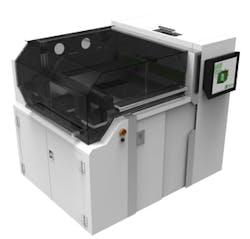
To address that at IMTS this year, ExOne is launching a new printing system, M-Flex, which will be capable of producing printed metal, tungsten, glass or ceramic parts at about 7.5 more volume per unit time than previous iterations of the technology.
"The trajectory remains almost geometric upwards in terms of productivity we're seeing out of additive manufacturing units," he said. "We don't really see the ceiling yet that we're going to get to. Because of that we believe we are prying open significantly more market opportunities every time we can offer higher volume per unit time to the market."
A Coming-Out Party for Additive Manufacturing
"Great strides in advancement have been made already. A lot of pioneers are to be thanked, a lot of folks who took personal capital and personal risk to get this stuff going to be congratulated," AMT's Shinbara said.
"AMT has realized the maturing of additive manufacturing and our membership who are now coming together," he added. "Now AMT is starting to consider how we will support our members who are in this ballgame."
That support is expected to come through at IMTS next week, where Burns says significantly more additive companies will be on hand than two years ago.
"It's going to be a great show. We believe that to some extent it is going to be a coming out party for additive manufacturing, especially for industrial users, which is something we really haven't had the stage for before," he explained.
"The combination of the announcement about NAMII and IMTS right on the backside of it getting the recognition for additive manufacturing implies that maybe this is the coming out party we've been looking for," he said.
"We're almost giddy with excitement about getting there and participating."
About the Author
Travis M. Hessman
Editor-in-Chief
Travis Hessman is the editor-in-chief and senior content director for IndustryWeek and New Equipment Digest. He began his career as an intern at IndustryWeek in 2001 and later served as IW's technology and innovation editor. Today, he combines his experience as an educator, a writer, and a journalist to help address some of the most significant challenges in the manufacturing industry, with a particular focus on leadership, training, and the technologies of smart manufacturing.