IMTS 2012: Signs of a Thriving US Manufacturing Base

Hotel rooms all across Chicago are filling up fast as the city prepares to host what is on pace to be one of the largest editions of the biannual International Manufacturing Technology Show on record.
With more than 1.2 million square feet of exhibiting space available at McCormick Place and some 1,800 exhibitors already registered, the estimated 90,000 attendees will have access to more than 13 miles of aisles showcasing all of the latest technology trends that will be driving the industry through the next decade.
To Douglas Woods, president of the Association for Manufacturing Technology, which is sponsoring the event, the record pace at which rooms and exhibitor spaces are filling up speaks not only to the success of the show, but also to the strength of U.S. manufacturing.
“Manufacturing has been the poster child of economic return in this country—the bright spot in the economy. All of our numbers continue to show that that is still the case,” he says. “You’ve got to feel good about manufacturing in the United States.”
The tens of thousands of attendees who will descend upon Chicago in September for the five-day show, he explains, are coming because they are looking for production solutions to help maintain that momentum.
“They want to buy this stuff and put it on their factory floors here in the United States,” he says. “These people are positive and excited about increasing their manufacturing capabilities.”
As the industry regains its strength after the 2008 downturn, IMTS is becoming the prime source for these solutions, he says.

-Doug Woods, AMT president.
“Everybody in the manufacturing sector got stung hard in the last recession. Those that survived and survived reasonably well were able to provide productivity or technology solutions that were different from their competitors.”
Armed with AMT’s insights and investments in the emerging technologies shaping the future, these solutions are what IMTS is best positioned to deliver to the industry.
“I think people are looking at IMTS as a way to see what those interesting or neat technologies are that will make a difference for their business—what new methodology for implementing capital equipment or software system, or automation, are they going to be able to put into their plant or factory that is going to differentiate them from their competitors,” Woods says.
Across the wide spectrum of metal cutting, tooling, forming and software offerings on exhibit, there will be no shortage of new technologies and novel solutions to give manufacturers this leg up. From basic machine tools to multifunction lasering and additive manufacturing, this 29th IMTS event will offer manufacturers a dense and diverse collection to survey.
To help make sense of these offerings and to lead our coverage of the event, IndustryWeek has identified some prominent trends that will be echoing throughout the show.
We will start the coverage here with three trends—hard-to-machine composites, sustainability and the IT/production merger—and continue the discussion on the IW website until the event begins on Sept. 10.
TREND #1: The Composite Problem
Boeing’s 787 Dreamliner represents one of those rare game-changing technology advances, at least in terms of its material construction. The fuselage is composed of an innovative composite fiber tape that is wrapped around the plane’s skeletal structure for added strength and durability with some impressive weight reductions.
This design—and all of the problems it presents—perfectly encapsulates one of the prevailing issues facing machine builders bringing products to IMTS this year: Aerospace companies are adopting newly engineered materials that are simply too hard and too resilient for traditional machine tools and traditional tooling processes to handle.
“It’s engineers gone wild,” says Scott Walker, president of machine tool builder Mitsui Seiki U.S.A. “They’re coming up with stuff that is extremely difficult to machine and grind and make into finished products.”
With the new generations of aircraft coming from Boeing (IW 500/16) and Airbus and the recent advances by the private space-transport sector, the demand for these difficult-to-machine materials is growing dramatically, he says.
As it does, it is driving advances in machine tool technology to provide precise, high-speed machining for parts built for unparalleled strength and durability.
“Customers are facing the fact that these materials are becoming harder to machine, harder to mill and grind,” says Patrick Redington, Saint-Gobain Abrasives director of application engineering, North America. “The issue we all face is that cutting tools grow dull very quickly when machining these harder materials, which can lead to part fracture and failure. It affects productivity and makes tooling costs go through the roof,” he explains.
Taking on this challenge, Mitsui Seiki will be exhibiting its HU100A-5XL HMS—a heavy-duty five-axis machine used for structural components on the Boeing Dreamliner and Airbus’s 320 and 340 jets, among other aircraft.
“The machine is designed for machining these hard, resilient materials,” Walker explains. It does this by emphasizing machine rigidity, stiffness and accuracy, three essential characteristics that machine builders require to compete in the growing aerospace industry.
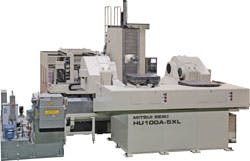
The Dreamliner illustrates this issue, too. The 787 fuselage comes in as eight very large, very expensive and very difficult to machine pieces. Machine tools lacking rigidity, stiffness and accuracy trying to process these pieces can result in some expensive mistakes.
“The fuselage for the 787 is a very costly part to scrap,” explains Mike Judge, vice president of Cryogenic Business Development at MAG. “Boeing is not necessarily interested in an increase in processing speed for these. They’re more interested in keeping the tool sharper longer to avoid scrapping their parts on the machine.”
To avoid those costs, he says, machines need to increase tool life to ensure sharpness and accuracy and increase processing speeds.
A prominent contributor to this field that will be appearing at IMTS this year is MAG and its Minimum Quantity Cryogenics technology.
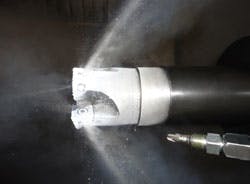
This emerging technology breaks ground in the hard-to-machine composite market by plumbing liquid nitrogen through its spindle and through the cutting tool itself to cool the machining process. The heat-sink effect in the cutting tool makes possible a rapid increase in processing speeds and dramatic extension in tool life when dealing with these composite materials—two reasons that Boeing uses cryogenic technology for trimming and drilling its Boeing 787 fuselage.
TREND #2: Green Machining
“There is an increased support for green engineering at IMTS this year,” says Tim Shinbara, AMT’s director of manufacturing technology. “From the controls perspective, they’re installing intelligence that allows you to really manage the energy you’re using. It’s all happening simultaneously, all behind the curtain on the controls.”
Rajas Sukthankar, business manager of machine tool segment at Siemens (IW 1000/34) Motion Control, is tracking this phenomenon, too.
“Energy efficiency is figuring more and more in the activities on the manufacturing floor,” he said. “Everybody is after consuming less energy and producing parts with less energy.” Successfully doing so provides manufacturers with a real competitive advantage because it reduces their overall manufacturing and energy costs and, more significantly, the overall cost of production per part.
Siemens will be on hand at IMTS, showcasing CNC controls designed to help companies tap into their hidden potential energy savings and take hold of these costs.
“There are certain key combinations that are defined in the new software generation of CNC that really help us conserve energy directly on the machine, behind the scenes,” he says.
One particular feature Siemens will showcase is an innovative energy feedback or energy regeneration system incorporated into drives for larger machines. These CNC drives are able to feed energy back into the line in a large part like a spindle.
“In the past, all of this energy was burned, generating heat either outside or inside the panel. No more,” he says. “We directly feed back all of this energy to the lines, making the machines more energy efficient.”
On the machine tool side, MAG’s cryogenic technology, while providing a strong answer to the composite issue, also contributes handsomely to this green initiative.
Specifically, it eliminates the problematic water-soluble coolant mechanisms running though traditional machines.
MAG’s Mike Judge explains that the majority of users of machining composites are still using that system, which floods composite parts with water-soluble coolants, creating a “nightmare” for machine tools in terms of maintainability, reliability and sustainability.
“Very simply, what cryogenics does is allow us to eliminate all water-soluble coolants,” Judge says. “It allows us to eliminate the energy consumption that comes with moving chips and filtration systems, and it allows us to eliminate the costs associated with raw materials for replenishment of water-soluble coolants.”
The technology represents the next phase of the development of an alternative system called MQL, or Minimum Quantity Lubrication, which uses an oil-mixed lubricating process as opposed to water-soluble coolants.
“All around the initiative of becoming more green, MAG has more MQL machines in the field than anybody else in the world,” claims Judge.
The next evolution of the MQL process is cryogenics, he says, which is where the term MQC derives.
“The liquid nitrogen totally eliminates the coolant system and the energy to run it,” Judge explains. It also cuts coolant disposal costs and potentially eliminates the need for in-process part washing after exposure to water-soluble or oil-based coolants during machining.
As a bonus, the system also radically reduces the cost and labor involved with chip reclamation and recycling.
“A lot of investment is made by our customers to reclaim and recycle their chips, and there are a lot of standards that are placed on them for a percentage of clean chips before it can be recycled and reclaimed,” he explains.
With cryogenic technology, the chips can move directly from the machine to reclamation and recycling without any end-process washing.
TREND #3: The Marriage of IT and Production
There was a time, not so long ago, when the IT and production sides of a manufacturing business were safely tucked away into their own departments. Just five to 10 years ago, AMT’s Woods reminds us, any notion of convergence between the two was a foreign concept—there simply wasn’t anywhere for the two to meet.
“Now,” he says, “not only are they coming together, but they’re starting to be woven seamlessly, and the tapestry that is coming out of it is going to start being the major differentiator in U.S. manufacturing.”
This trend will emerge clearly at IMTS 2012, demonstrated in hi-res visualization monitors, data displays and endless hardware and software offerings.
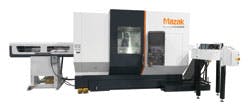
Mazak, for example, will be demonstrating 22 machines at IMTS and each one will be MTConnect-compliant, allowing them to capture, communicate and report vital production data that would have been lost in traditional machines.
MTConnect is the communication standard for equipment interoperability across all types of devices and equipment used in machining and manufacturing technology.
The potential for this marriage of IT and machine tools is evident in systems like Mazak’s Hyper Quadrex 250MSY multitasking turning center, which features a bar feeder that communicates as a united system using MTConnect’s open communication protocol.
“The whole machine and the bar feeder work together as an integral system,” says Brian Papke, Mazak president. “The whole package, the whole system is capable of being monitored for its utilization and productivity.”
As his machine offerings demonstrate, Papke says the MTConnect standard is gaining momentum among machine shops and manufacturers, regardless of the markets they supply.
“It really doesn’t know any boundaries in terms of industries,” he says. “Whether you’re in aerospace, defense, energy, automotive, medical, construction equipment or anything else, there is someone in each segment of these industries that has moved into MTConnect.”
The advantage for these companies, he says, is better access to critical performance data that can help increase productivity and lower costs.
“When you look at machine tools today, everybody focuses on uptime of machines,” he says. In the current state of the technology in terms of reliability, those uptimes can be over 98%. But that number doesn’t tell the whole story, he says.
“You’ve also got to consider how much time is actually available for chip cutting and how much is actually used for chip cutting,” he says. That time is a much smaller amount among most manufacturers. As much as 20% less.
MTConnect reveals those kinds of insights and can help machining operations keep their spindles turning more efficiently, and with greater yields, says AMT’s Vice President of Manufacturing Technology Paul Warndorf
“The average is about 20% utilization improvement for companies implementing MTConnect because now they have been able to actually understand what’s going on with the equipment and with their shop floor,” he says.
These kinds of results are pushing MTConnect compliance through the industry, with over 100 organizations already in the loop.
“From a builder’s standpoint, some of the largest machine tool developers in the world are making it a feature that is available in their machines,” he says. “There is a lot of new equipment coming out with it built in.”
To demonstrate this growing trend, the MTConnect booth at the IMTS Emerging Technology Center will feature a touch screen display to demonstrate how data are picked up from machines at the show, and will even incorporate a low level of reporting of that data.
In other words, Wardorf says, the touchscreen display will highlight not only the fact that you can get data, but what you can do with it.
“We’re trying now to say not only is the standard there and not only are there devices that can produce data, but now there are companies that utilize that data for reporting and monitoring purposes,” he says.
About the Author
Travis M. Hessman
Editor-in-Chief
Travis Hessman is the editor-in-chief and senior content director for IndustryWeek and New Equipment Digest. He began his career as an intern at IndustryWeek in 2001 and later served as IW's technology and innovation editor. Today, he combines his experience as an educator, a writer, and a journalist to help address some of the most significant challenges in the manufacturing industry, with a particular focus on leadership, training, and the technologies of smart manufacturing.