Insights at a Glance from the High-Tech Machine Shop
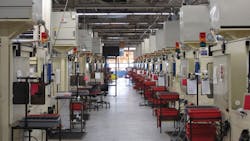
At the center of every neat, double row of CNC machine tools at Smith and Wesson’s Springfield, Mass., plant, a single worker controls the operations and output of as many as 10 simultaneously running machines. With 64 individual tools at work in each of them, this makes one operator responsible for monitoring the status, wear and efficiency of up to 640 tools as they process the ultra high-precision parts for the company’s iconic products.
Just a couple of years ago, says Mark Smith, vice president of manufacturing and supply chain management at Smith and Wesson, this kind of workload would have been impossible.
“The way our CNC process used to be, you had an operator working in a cell of just two or three machines because that’s all he could handle,” he explains. “Then, when a machine went down or when something happened and an adjustment needed to be made, he would need to go to that machine and address the issue while the other machines finished their cycles and went idle.”
Today’s CNC operator, however, works in an entirely different environment.
A quick glance down the line in a contemporary, high-tech machine shop tells the operators everything they need to know about each machine in the cell. Today’s lines are aglow with andon lights indicating the inner workings of every machine while on-board displays indicate the status of every tool in them.
This is the new era of the machine shop -- the era of visualization.
Information Age Machining
“The overall industry trend, from a visualization perspective, is an increased desire for information,” says Andy Balderson, division manager at motion control technology manufacturer Parker Hannifin Corp. “Whether it be for reducing the need for operator attention on an individual product or identifying shortages of components or nonconforming parts more quickly, a lot of what is driving the industry is information.”
Specifically, he says, manufacturers are demanding real-time access to information on how efficiently their machines are running and how they can continuously improve them. Moreover, they want this intelligence available on the floor, where and when they need it.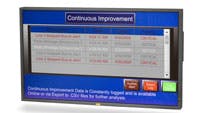
“They want to get the data and turn it into information at the point of consumption,” Balderson says. “Today, because the visualization products can capture and collect the information and immediately offer a degree of intelligence to it, they can finally do that.”
This new generation of visualization equipment is capable of showing overall equipment effectiveness, data on downtime, data on target production versus actual production, takt times and just about anything else critical to the day-to-day or project-planning side of operations, he says.
“The visualization tools have evolved from being just a tool to control the process into now a tool that allows you to evaluate how efficiently your process is running, to locate your overall production and to present that information in a way that you can positively impact those metrics on the plant floor,” Balderson says.
The New Smith & Wesson
At the renovated heart of Smith and Wesson’s Springfield plant, these advanced technologies are transforming the work flow into that of modern, highly efficient plant.
“The CNC operators have access to displays detailing critical production data with lights telling them what’s going on with every one of the machines—telling them where they are in their process and if there is an issue going on,” Smith says. “We’ve got automated, computerized tracking programs that help the operators understand where each machine is at and what tolerances are even coming close to falling out.”
This system incorporates two key visualization tools that provide critical machine and cycle information at a glance, even from across the floor. The first is a custom-engineered andon display configuration that goes far beyond the usual set-up.
“Typically with an andon machine, what you will see is a red light, meaning the machine is down, and a green light, meaning it is running. We’ve taken that a step further in each of our cells,” says Dan Fontaine, Smith and Wesson’s director of manufacturing.
To provide more information faster, the company’s team has developed a unique lighting system consisting of five different indicators that light up progressively as a program runs its cycle.
“You’re able to look at a machine and tell that you are 20% through that program or you’re 80% through another,” he says. This way you can look at the cell and determine where the operator has to move next to tend the machine.”
For a further productivity boost, each machine is equipped with a graphical user interface and touchscreen controls that allow operators to peg down into each tool to check the status, wear and efficiency of every component.
This, Smith says, has dramatically increased operator efficiency and has improved work flow scheduling.
“You can just walk past that display and glance in and you can see red, yellow or green. If it is yellow, you can hit that icon and it will tell you how many cycles are left on that tool, so you’re going to have to change that one in the next couple of hours,” he explains.
“This allows them to plan ahead as far as what work they are going to have to do throughout their shift, to make sure that if they have tools that are in the yellow, they will have replacements preset and ready to go in a timely fashion.”
Beyond the Shop Floor
The information in these visualization technologies has a reach beyond the shop floor, Smith says. It arms managers and executives with the information they need to better manage their tools and staff to increase efficiency plant-wide.
“What we do is cut metal; that’s our core competency,” Smith says. Because of its central role in the plant, taking control of operations in that department can have a profound impact on the total productivity of the company. This technology allows them to do just that.
“All of that data from the system is available to management,” Smith explains. “A manager can look at a certain cell and look at its performance and what it is producing in real time.”
This way it becomes apparent if, for example, a certain operator is changing out a tool too often or not often enough, or if a machine is wearing out a certain tool faster than the rest of the machines.
“It gives you information on tool numbers, on part numbers that you’re producing, on the machine platform, on the operators themselves,” says Smith. “It allows you to hone in on where a potential problem could be so you can take care of it before it affects your business.”
2. Use Internal Engineering: In today’s environment, plants are investing less on internal engineering, so a tool that is very easy to configure and intuitive in its configuration—one that allows you to add new screens, add new information, add and remove data collection and areas in the facility quickly and easily without having to hire an integration company to make that happen—is a critical piece to making the tools useful over the long term. The easier a tool is to self-maintain, the easier it is to have useful information coming out of it over the long term.3. Set Communication Protocols: You need communication protocols that enable you to gather data from the controller or the devices and/or databases where a data login system is already in place to communicate with the infrastructure that is in-plant already. You should find a product that is not vendor specific in that approach but is rather agnostic and doesn’t care what devices are on the plant floor. That let’s you integrate and gather the data so you’re not being forced to completely replace equipment and technology that is already in place. - Andy Balderson, division marketing manager, Parker Hannifin Corp.
About the Author
Travis M. Hessman
Editor-in-Chief
Travis Hessman is the editor-in-chief and senior content director for IndustryWeek and New Equipment Digest. He began his career as an intern at IndustryWeek in 2001 and later served as IW's technology and innovation editor. Today, he combines his experience as an educator, a writer, and a journalist to help address some of the most significant challenges in the manufacturing industry, with a particular focus on leadership, training, and the technologies of smart manufacturing.