Rapid Sourcing: The Key to Increasing Speed-to-Value

With the holidays over, your team is returning to work well-rested, energized and motivated to chase new opportunities and take on new challenges. This energy and motivation will be critical to their success as they realize that the executives of the company, including you, will be required to reduce budgets and achieve significant cost savings in 2013. Accompanying the corporate cost savings goal will be specific savings targets across many or all divisions, requiring all hands to be on deck.
Supply chain—more specifically the procurement/strategic sourcing team—will be integral to not only reducing supply chain’s internal costs but also proactively supporting and partnering with other organizations to identify and achieve their cost savings objectives. Given that cost savings need to be realized in 2013, cost savings activities will need to be completed and executed prior to the end of the year. Traditional category sourcing initiatives with longer timelines will not be optimal in these circumstances and may bog down the speed-to-savings mandate. In situations such as these, a rapid sourcing approach will be more effective at achieving and sustaining cost savings without undermining the company’s relationships with its suppliers.
Rapid Sourcing vs. Strategic Sourcing
Whereas strategic sourcing employs a more rigorous sourcing methodology that focuses on optimizing category strategies and maximizing savings, rapid sourcing is purposefully less rigorous in specific, strategically-selected steps of the methodology to increase speed-to-value. The definition of value can vary, which is why it’s critical to understand how to employ a rapid sourcing methodology.
In the example above, value is defined as speed-to-savings across all sourceable spend. In other scenarios, value can be category-specific, such as a reduction in suppliers, increased spend on contract, or more insight to the total cost of ownership (TCO). Given the inherent variability of a company’s category structure, a flexible rapid sourcing approach that is value-driven and accelerates the speed-to-value will reinforce supply chain’s criticality to the business.
The Art of Rapid Sourcing
Rapid sourcing may vary from one category to another even if there is an overall goal such as the speed-to-savings mandate above. The good news is that an entirely new framework for sourcing is not required for your sourcing managers to employ rapid sourcing techniques. In fact, a traditional strategic sourcing methodology such as the one shown below is exactly where to begin with a rapid sourcing initiative.
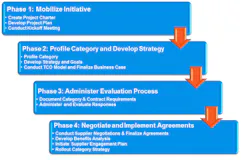
These steps should look familiar to your strategic sourcing managers. Generally speaking, when going through a traditional strategic sourcing initiative, the effort in executing each step in the methodology above is fairly uniform and almost always on the rigorous side. The art of rapid sourcing is taking into account the speed-to-savings mandate and determining how to optimize the investment of time and research within each step of the methodology to achieve the desired results. This may mean that certain steps of the methodology will be eliminated or dramatically reduced in terms of effort where the ROI is low.
Remember that the immediate goal is speed-to-savings, not optimizing the category and maximizing savings. Once the organization has achieved the cost savings goals, the strategic sourcing managers can always optimize/maximize in the future when the urgency has subsided.
At the end of the day, the primary differentiator with rapid sourcing is the flexibility of the approach used to execute each step of the methodology during the sourcing initiative. Below are some examples to demonstrate how a rapid sourcing approach changes the way a sourcing manager executes, operates and delivers value and savings to the organization.
Incumbent vs. New Suppliers
Administering and evaluating responses is a traditional step in any strategic sourcing initiative. It is generally a rigorous process that includes opening bids to new and existing suppliers, RFIs, short-listing suppliers, RFPs, creating scoring models, interviews and lengthy evaluations. A rapid sourcing methodology employs a more pragmatic approach to this step in the sourcing initiative.
For example, if the company already has established strategic suppliers, the effort in this step of the process can be drastically reduced by limiting sourcing activities to the incumbent strategic suppliers. It’s extremely beneficial to initiate this process by categorizing the suppliers into a continuum by relationship type. A determination is then made on whether the incumbent strategic suppliers plus any necessary incumbent emerging suppliers can meet the company’s needs going forward.
Once it is determined that the incumbent suppliers can meet the needs of the business, a benchmarking exercise can be substituted for the RFI/RFP process. Benchmarking will still require the creation of a common market basket of goods or services across your total existing supply base in order to quickly understand/confirm whether the incumbent suppliers’ pricing is competitive or whether further negotiations will be required. This being said, weeks to months of time and effort can be saved by employing this rapid sourcing technique.
Sole Source Categories
When there is only one supplier who can deliver a product or service, there are many steps in the traditional strategic sourcing approach that are no longer necessary. However, there are other steps where special attention should be given. A rapid sourcing approach would reallocate the time invested for this type of category to those steps that offer the highest return, while giving the company an opportunity to achieve savings in a situation where savings are often the most difficult to deliver given the lack of leverage and “power” to influence unit prices.
The key to success with sole source negotiations is gathering total cost of ownership (TCO) data. To that end, the sourcing manager should put significant effort into understanding the TCO of the product or service being purchased. In this case, most of the time and effort will go into profiling the category. This includes:
- Extensive supplier interviews
- Market research on the product’s component costs
- Customer interviews
- Assessing product and supplier satisfaction
- Service level performance metrics.
Understandably, much less time is needed to develop a category strategy as there is little room to maneuver from a strategic perspective when dealing with a sole source supplier. Likewise, the rapid sourcing approach would invest minimal to no time in administering and evaluating supplier responses which should already be known by the time the TCO analysis is complete.
Speed-to-Value Means Speed-to-Contract
Rapid sourcing gives sourcing managers the tools and techniques to be more flexible without undermining the relationship that the company has with its suppliers. The concept of rapid sourcing remains focused on a partnership between the company and its suppliers. In some cases, deviating from a rigorous and lengthy traditional strategic sourcing approach to a rapid sourcing model can be used to increase your leverage when negotiating with suppliers.
Most suppliers will prefer a process that focuses on “speed-to-value” because it means “speed-to-contract.” Encourage your sourcing managers to think outside the box and leverage rapid sourcing to the company’s advantage. Regardless of your company’s goals for strategic sourcing, leveraging rapid sourcing techniques is a great way for your sourcing managers to become more efficient and effective.
Cory Olson is the director of supply chain at RAS & Associates, a Denver-based strategy and management consulting firm. He has more than 17 years of supply chain management and global procurement expertise in both consulting and corporate settings, and is currently leading a supply chain initiative for a $10 billion energy company focused on strategic sourcing, capability development and procure to pay (P2P) process improvement.
Greg Tilley is a consultant at RAS & Associates with more than 18 years of experience working with companies around the world to streamline their supply chain and IT processes. He has extensive project and program management expertise and has developed and delivered training and education courses related to a range of topics including project lifecycle management, software training and rapid sourcing methodology and practices.