
California has long enjoyed a reputation for being on the leading edge of national trends, but many manufacturing leaders hope that's not the case when it comes to regulatory policy.
California manufacturers feel the pinch not only from national regulations but from expensive state-initiated rules such as AB 32, which requires the state to meet 1990 greenhouse gas emission levels by 2020. Manufacturers also face green chemistry requirements, complicated and litigious permitting procedures and high energy costs.
See Also: Global Manufacturing Economy Trends & Analysis
"We feel that the regulatory burden in California is at a higher level than the rest of the country and therefore makes us less competitive," says Gino DiCaro, vice president, communications for the California Manufacturers & Technology Association.
Over the last decade, he notes, California has experienced the loss of 634,000 manufacturing jobs. And just in the last two years, California has seen no gains in manufacturing jobs while jobs grew 4.2% in the sector nationally.
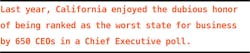
Last year, California enjoyed the dubious honor of being ranked as the worst state for business by 650 CEOs in a Chief Executive poll.
The problem is not so much companies picking up and leaving California, DiCaro observes, as it is companies simply deciding to scale-up or invest in other states.
There is recognition in the state of a competitiveness problem. Last year, state legislators passed SB 617, which requires economic analysis of any major new regulation before it is passed. Better economic analysis, DiCaro says, will help public and private parties understand the costs of regulations.
Silicon Valley's Manufacturing Hub
One California community for which manufacturing regulation is far from an academic subject is Fremont. The city of 217,000 was the site of the famous NUMMI automotive factory run by Toyota (IW 1000/8) and General Motors (IW 500/4). Today, Tesla is producing electric vehicles in the plant.
"We are Silicon Valley's technology manufacturing hub," says Kelly Kline, Fremont's economic development director. "We have dozens of contract manufacturers." The city has more than 30 clean technology and more than 80 biotechnology or biopharmaceutical firms.
As part of its effort to attract businesses in those two sectors, Fremont waives the business license tax for the first five years. Kline noted that some of these companies may not make money in the first few years because they are waiting for FDA approval or are in R&D mode. "It may not save them that much money, but it shows we understand their business and where they are in the cycle. We are making an investment in them so they will stay and grow with us," she said.
Kline says Fremont's proximity to Silicon Valley allows contract manufacturers located there, for example, to deal with client needs for fast turnaround of complex products. And she says there is growing evidence of reshoring as companies such as Apple (IW 500/9) indicate their desire to bring a portion of their manufacturing back to domestic facilities and contract manufacturers look for additional manufacturing space.
One way Fremont tries to help local manufacturers is by speeding up the permitting process, says City Manager Fred Diaz. The fire department, for instance, has considerable expertise in hazardous materials and can help manufacturers navigate those requirements.
Kline said the city's ability to serve as a facilitator for moving companies through the regulatory process has become as valued as any other incentive the city can offer businesses looking to locate or expand in Fremont.
"This is a community that experienced the closing of two major manufacturers in the period of a year and a half -- first NUMMI and then Solyndra. They understand how important those jobs are for the residents, for people they know, for the regional economy," she said, adding that there was "immense pride" in having the Tesla factory.
Diaz expressed frustration at state legislators who position themselves as champions of business in an economic downturn and then make things tougher on businesses to locate in California. "That has been happening at the state assembly and state senate for the last decade," he observed.
"I am not so worried about national regulations. They do push things offshore. I am more worried about our disadvantage as a state than about the national regulations. If I am competing for a business that can go to Alabama or North Carolina, I am more concerned about that because of the dysfunctional legislature we have in this state," said Diaz.
About the Author
Steve Minter
Steve Minter, Executive Editor
Focus: Leadership, Global Economy, Energy
Call: 216-931-9281
Follow on Twitter: @SgMinterIW
An award-winning editor, Executive Editor Steve Minter covers leadership, global economic and trade issues and energy, tackling subject matter ranging from CEO profiles and leadership theories to economic trends and energy policy. As well, he supervises content development for editorial products including the magazine, IndustryWeek.com, research and information products, and conferences.
Before joining the IW staff, Steve was publisher and editorial director of Penton Media’s EHS Today, where he was instrumental in the development of the Champions of Safety and America’s Safest Companies recognition programs.
Steve received his B.A. in English from Oberlin College. He is married and has two adult children.