Battle Commences for 'Mobile Money'
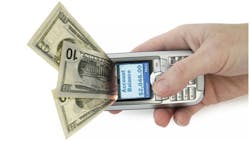
BARCELONA -- Global financial groups battled Monday to control the lucrative future of "mobile money," which will enable people to use a smartphone to go shopping instead of cash and credit cards.
MasterCard, Visa and online payments service PayPal struggled for a slice of the industry as the world's biggest mobile fair, Mobile World Congress, opened in Barcelona, Spain.
It is a market with potentially rich rewards.
The mobile money industry is expected to grow from $13.8 billion in 2013 to $278.9 billion by 2018, according to a study released this month by global research group MarketsandMarkets, which estimates there will be about 5.3 billion mobile phones worldwide this year.
MasterCard announced a new digital payment system that lets people use a wide variety of devices including smartphones.
The system, known as MasterPass, stores customers' banking and personal information in a "secure cloud" online where it is available for the moment of payment whether in a store on when browsing the Internet, the group said.
Banks and stores will be able to issue their customers with MasterPass-connected "digital wallets", which would accept credit and debit card information, including cards other than MasterCard's, the group said.
Shoppers would be able to use MasterPass on the web without having to key in their bank information and delivery address for each purchase.
But they also could make payments with the new system in other ways, including by waving a smartphone equipped with Near Field Communications, or NFC, technology near a special reader.
MasterPass will be launched in Australia and Canada by the end of March before expanding to other markets.
Samsung and Visa Make a Move
On the same day, Visa unveiled a global alliance with smartphone leader Samsung (IW 1000/25) to let people make payments with NFC-equipped Samsung smartphones.
Under the deal, Samsung will equip the next generation of its mobile devices with Visa payment technology, including by pre-loading Visa's contactless payment system -- Visa payWave -- in its mobiles with a mini-program known as an applet.
Samsung will let banks send payment account information over the airwaves to a secure microchip embedded in its devices. Banks in turn will use a secure system relying on Visa's so-called Mobile Provisioning Service and Samsung's digital key management system.
Visa said the deal had the potential to "significantly accelerate" the availability of mobile payments globally, noting a forecast by ABI Research that 1.95 billion NFC-enabled devices will ship in 2017.
But some in the industry are skeptical.
"I think NFC is just a technology in search of a problem to fix that does not exist because it is really easy to pay in the store," the president of eBay subsidiary PayPal, David Marcus, told journalists at the congress.
Five days before the World Mobile Congress, PayPal announced it was expanding its move into MasterCard and Visa's territory.
Marcus showcased a new PayPal device, which lets cash-based businesses accept PIN-number based "smart" debit and credit cards.
Merchants will be able to download a Paypal Here application for their Android or iPhone smartphone and then pair the handset with the new device, which they have to buy. The device can accept secure payments and issue receipts. For each transaction, whether by credit card, debit card or PayPal account, PayPal receives a "small fee".
Similar PayPal technology is already being used in the United States for payment cards that are swiped, but it was unable to handle cards with embedded microchips and PIN numbers.
- Emmanuelle Trecolle, AFP
Copyright Agence France-Presse, 2013
About the Author
Agence France-Presse
Copyright Agence France-Presse, 2002-2025. AFP text, photos, graphics and logos shall not be reproduced, published, broadcast, rewritten for broadcast or publication or redistributed directly or indirectly in any medium. AFP shall not be held liable for any delays, inaccuracies, errors or omissions in any AFP content, or for any actions taken in consequence.