The Dawn of the Smart Factory
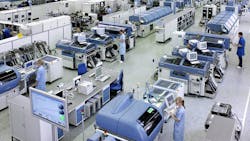
In the factory of the future, everything is illuminated.
It is gleaming white -- a shining, interconnected web of information and production. The whole facility hums in quiet efficiency as smart machines collaborate with each other, with a global team of savvy workers, with customers and clients, intelligent analytics and dynamic systems all across the farthest extremes of the supply chain.
The factory of the future -- the smart factory -- is a paradise of efficiency where defect and downtime, waste and waiting are long forgotten issues of a long forgotten age. In it, plant managers and CIOs scheme together in a seamless blend of data and production, of IT and manufacturing, to illuminate every turn of every machine, every cut of every blade, every move of every piece in its global dance to delivery.
See Also: Manufacturing Industry Technology News & Trends
That future factory represents the absolute pinnacle of technological and manufacturing development, a perfect integration of high-tech tools and high-tech workers that shines in stark contrast to the dark and dirty image of manufacturing in centuries past.
It’s a nice dream, that future. And it is a dream that, however fantastic, is much closer to reality than you think.
Siemens Electronic Works
The Siemens (IW 1000/34) Electronic Works facility in Amberg, Germany, is a plant straight out of that dream. The immaculate, 108,000-square-foot high-tech facility vibrates with efficient, digital wonder as its smart machines coordinate the production and global distribution of the company’s Simatic control devices -- a custom, built-to-order process involving more than 1.6 billion components for over 50,000 annual product variations, for which Siemens sources about 10,000 materials from 250 suppliers to make the plant’s 950 different products.
The endless variables and impossibly complex supply chain maze this production process requires far exceed the capabilities of a traditional factory. Just like organizing its material flow, sequencing its processes or even just intelligently scheduling its 1,100 employees to meet the requirements of an ever-changing job is beyond the capabilities of any single technology or any single tool.
And yet, according to a Gartner Industry Research study conducted on the plant in 2010, the Amberg factory only records about 15 defects per million and enjoys a 99% reliability rate and 100% traceability on its expansive lines.
The key to making this magic work, and the trick to making all future smart factories work, is creating a dense mesh of technologies that are integrated and cooperating into a smarter, more efficient whole.
The Technologies of Smart Integration
“The future of smart manufacturing is today,” says Helmuth Ludwig, CEO, Siemens Industry Sector, North America.
“Previously, the industrial value chain, including product design, production planning, production engineering, production execution and services were implemented separately,” he says. “Today, new technologies are bringing these worlds together in exciting ways.”
What has made the Amberg plant so successful, he says, is the integration of three specific critical manufacturing technologies: product lifecycle management (PLM), manufacturing execution systems (MES) and industrial automation.

“Whether you’re producing modern commercial aircraft, fuel-efficient cars or high-performance golf clubs, technology used in PLM, MES and industrial automation are helping manufacturers to realize and achieve top line growth by increasing productivity and minimizing risk,” he explains.
“By leveraging [these] systems, successful companies can focus on aspects like shortening their innovation cycles, getting transparency into their operations, raising individual productivity through knowledge sharing across their organizations and minimizing risk by building in more predictability into dynamic environments,” he adds.
More specifically, notes Raj Batra, president of Siemens Industry’s Automation Division, the future of manufacturing is in finding the perfect junction between these technologies and learning to wield them together as a complete system.
“The real issue is defining all of the meet points between those three technologies so you get the sum of that integrated whole,” he says. “And that is what is driving this major shift in manufacturing efficiency.”
Doing that, he says, requires manufacturers to pull together all of the high-tech tools at their disposal. Which is another trick in itself.
The Internet of Things
“There is a lot of embedded intelligence in the devices today. I’m talking down to the field device, motor starters and contacts and relays,” Batra says. “The question is, can you access that intelligence, can you drive further efficiencies of that intelligence so now things that were never available in terms of diagnostic data, the health of a contractor or relay, you can pull in real time?”
The answer to this question rests in the Internet of things -- a loose network of technology that has slowly crept into our personal and professional lives over the past decade, in what Anders Gustafsson, CEO of Zebra Technologies, calls “an exponential explosion of connected devices.”
The Internet of things, Gustafsson says, “basically gives a digital voice or a virtual voice to all of these assets, physical things. That digital voice enables them to communicate something about themselves. It can be what they are, where they are, their condition, their temperature and so forth.”
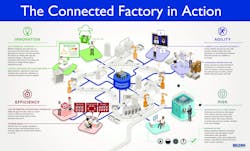
If properly employed, he says, these interconnected devices form a convergence point between the physical world and the digital world and enable software applications -- like the mesh Siemens’ Ludwig and Batra describe -- to take advantage of all of the information normally hidden in historians or databases or just lost in the digital ether. They enable the system to make smarter and more timely decisions about matters in the real world.
“It is precisely this kind of future-focused innovation and collaboration that is driving cutting-edge manufacturing today,” Ludwig says. “This is nothing less than a paradigm shift in industry: the real manufacturing world is converging with the digital manufacturing world to enable organizations to digitally plan and project the entire lifecycle of products and production facilities.”
In the Amberg plant, this merger between the digital and the real puts product and production at the center of the digital manufacturing process. As described in the Gartner report, “Within the facility are touchscreen human-machine interfaces (HMIs) that allow users to drill down from time-based performance trends to individual product lines, or even individual part levels. This allows tracking not only of performance but also in-depth root cause analysis of the over 400 points of automated data collection.”
This is the real value of the Internet of things, says Gustafsson. “It all comes back to the digital voice -- creating much more visibility into operations and the supply chain by providing a digital, virtual voice to assets that can communicate something about itself to the digital world and enable users to take smarter, timelier decisions.”
To employ that on the broad scale, though, for smart factories to really ramp up production in digital space, and to pull the innovation together and let that new cacophony of digital voices drive efficiency, will require a platform smart enough and robust enough to take on task.
Enter the industrial Internet.
The Industrial Internet
With its recent blockbuster report, “Industrial Internet: Pushing the Boundaries of Minds and Machines,” General Electric (IW 500/5) has found itself at the center of the smart factory discussion.
The interconnected network of industrial operations that makes up the industrial Internet, the report explains, “brings together the advances of two transformative revolutions: the myriad machines, facilities, fleets and networks that arose from the Industrial Revolution, and the more recent powerful advances in computing, information and communication systems brought to the fore by the Internet Revolution.”
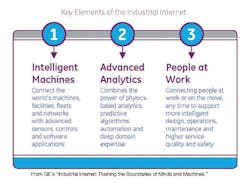
“Securing even part of these productivity gains could bring great benefits at both the individual and economy-wide level,” says GE chief economist and co-author of the report, Marco Annunziata.
“The full potential of the industrial Internet will be felt when the three primary digital elements -- intelligent devices, intelligent systems and intelligent automation -- fully merge with the physical machines, facilities, fleets and networks,” the report adds. “When this occurs, the benefits of enhanced productivity, lower costs and reduced waste will propagate through the entire industrial economy.”
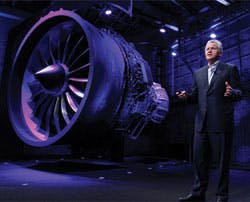
In San Francisco last November at an elaborate event kicking off the report, GE CEO Jeff Immelt introduced the industrial world to its new role in the future of manufacturing brought forth by the industrial Internet.
“The productivity era is alive and well,” he told the crowd. “Industrial companies, not just GE, but all industrial companies are no longer just about the big iron,” he said, gesturing to the massive jet engine balanced above him on the stage. “All of us are going to seek to interface with the analytics, the data, the software that surround our products.”
“This is today,” he added. “This is not about any future. The industry is moving forward.”
To Don Busiek, general manager of manufacturing software at GE Intelligent Platforms, Immelt’s presentation and the report itself are heralding a new age of manufacturing.
“There is a huge shift happening in manufacturing today,” he says. “With the advent of new technologies, smarter assets and smarter devices, today’s advanced factories have essentially become data centers driving intelligence across the enterprise.”
“Historically if you look at manufacturing software, it has been siloed systems; it has been systems that didn’t talk to each other,” explains Busiek. “They didn’t talk, they didn’t relate, so as a plant manager you couldn’t compare your performance against another plant.”
With the advent of the industrial Internet, he continues, suddenly plants have the ability to tie all of their data across multiple plants, even view it over the web on their handheld devices and finally be able to understand and compare their performance across the enterprise and the performance of equipment across different lines.
Doing so, “all of a sudden you can structure your schedule across your plant with more intelligence,” he explains. “You can schedule your shift, your personnel with more intelligence. You can even program the heating in your building with more intelligence.”
“To me, that’s where it’s going,” he says. “Toward that concept of a connected world, where all of your devices are rolling up data, but you’re slicing it. It’s not the thousands of pieces of data; you’re slicing it in such a way that it is presented to the right user at the right time based on their role.”
“To me,” he says, “that’s the smart factory of the future.”
About the Author
Travis M. Hessman
Editor-in-Chief
Travis Hessman is the editor-in-chief and senior content director for IndustryWeek and New Equipment Digest. He began his career as an intern at IndustryWeek in 2001 and later served as IW's technology and innovation editor. Today, he combines his experience as an educator, a writer, and a journalist to help address some of the most significant challenges in the manufacturing industry, with a particular focus on leadership, training, and the technologies of smart manufacturing.