Bernanke: US Economy Still Needs Fed Stimulus
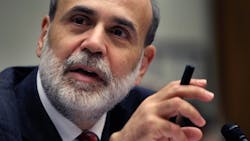
WASHINGTON — Federal Reserve Chairman Ben Bernanke said Tuesday that the U.S. economy still needs the Fed's stimulus, and warned that looming steep budget cuts could further slow growth.
Stressing that high unemployment remains the key challenge to the economy, Bernanke told a Senate panel that the central bank's extraordinary $85 billion a month bond-purchase program, aimed at holding down long-term interest rates and encouraging investment, was still merited.
The risks of the program -- igniting inflation, and spurring a new round of dangerously risky behavior in the financial industry -- were being monitored closely and were not significant enough yet to curtail stimulus, he said.
"Highly accommodative monetary policy also has several potential costs and risks," he said in prepared remarks.
But the Federal Open Market Committee, the Fed policy board, "remains confident that it has the tools necessary to tighten monetary policy when the time comes to do so."
Bernanke said the $85 billion a month quantitative-easing program, known as QE3, was "providing important support to the recovery" while keeping inflation at bay.
The program has boosted the housing market and the production and sales of automobiles and other durable goods, and stimulated the jobs market, he argued.
Unemployment Rate Remains High
But with the national jobless rate still at 7.9%, Bernanke said, "the job market remains generally weak, with the unemployment rate well above its longer-run normal level."
"High unemployment has substantial costs, including not only the hardship faced by the unemployed and their families, but also the harm done to the vitality and productive potential of our economy as a whole."
That harm, he stressed, included reduced government revenues and higher spending, adding to the country's deficit and debt.
He said the Fed was keeping a close eye on signs of risky behavior arising in the financial system due to the prolonged low interest-rate environment, a worry that was expressed in January by some members of the FOMC.
However, he said, "to this point we do not see the potential costs of increased risk-taking in some financial markets as outweighing the benefits of promoting a stronger economic recovery and more job creation."
Bernanke said economic growth remained uneven and could be further hurt by the government's steep budget cuts, or sequester, slated to take effect Friday if politicians cannot craft a more moderate compromise.
"The Congress and the administration should consider replacing the sharp, front-loaded spending cuts required by the sequestration with policies that reduce the federal deficit more gradually," he said in prepared remarks.
Bernanke cited data from the Congressional Budget Office projecting that the cuts, to be implemented over the remaining seven months of the fiscal year if no moderate substitute program is agreed, would reduce potential economic growth by 0.6%.
"Given the still-moderate underlying pace of economic growth, this additional near-term burden on the recovery is significant."
Bernanke sought to put a halt to speculation that the Fed could curtail the QE3 bond purchases this year, even before targets for cutting unemployment were achieved.
The minutes of the FOMC's January meeting showed some members worried about losing control of monetary policy if the high level of bond purchases continued.
Some FOMC members argued that the Fed could be headed toward a dangerous situation where, when it does decide to reel in the program, the move would have little impact on the markets and inflation could run out of control.
"Many participants... expressed some concerns about potential costs and risks arising from further asset purchases," the minutes said.
But others on the panel insisted that QE3 remain in place until there was substantial progress in reducing joblessness.
Paul Handley, AFP
Copyright Agence France-Presse, 2013
About the Author
Agence France-Presse
Copyright Agence France-Presse, 2002-2025. AFP text, photos, graphics and logos shall not be reproduced, published, broadcast, rewritten for broadcast or publication or redistributed directly or indirectly in any medium. AFP shall not be held liable for any delays, inaccuracies, errors or omissions in any AFP content, or for any actions taken in consequence.