Recently, I stood before a plant management team sharing labor strategies that could help resolve some serious cost problems associated with inefficient shift schedules. The plant manager talked about some of their greatest achievements. Number one was keeping their overtime below 5%. Corporate listed low overtime as a key performance indicator, and minimizing it was critical to plant bonuses.
In environments where demand is flat, overtime is rarely used, typically only to fill vacancies. However, seasonal and variable-demand profiles present a very different problem. Customers want their product or service on demand. However, the fear of excess overtime has led management teams to overlook this mighty tool and make less-strategic decisions. In today's world, cost competitiveness has magnified the impact of these shortsighted tactical decisions as more management teams are forced to reduce every unnecessary cost. The three most common errors are:
Peak demand staffing: Plant management teams can staff for peak demand and always have enough labor to get the job done on short notice. Additional full-time employees are expensive with all the fixed costs associated with health benefits, vacations and holidays, and taxes. Yet a common practice in today's environment is management teams carrying additional headcount to avoid what they assume are the high costs of overtime.
Disregarding customer service as a priority: This is not really an option because it results in lost opportunity and lost customers. Management teams can produce at a steady pace and sell out of items if production volumes cannot meet customer demand. This option is an automatic failure in today's on-demand world, because customers do not tolerate shortages.
Overstocking, high inventory levels: Overproducing to have a "cushion" of extra product in the warehouse to handle volume fluctuations is another option. But this has a variety of problems. Companies may meet customer demand but at a very high cost. The carrying cost of inventory can force charging higher prices and mean losing the competitive edge. Also, obsolescence costs become a reality in a world where tastes change quickly and product expiration is always a concern.
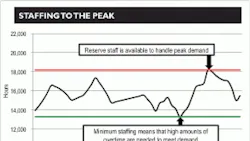
Think about how staffing can drive the low-cost solution while considering the chart on the next page. The data come from a food processor with 455 employees. The chart shows the extreme choices they can make to avoid either overtime or idle time. Their current staffing strategy is to staff to the peak (455 employees or 18,200 hours). They have seasonal and variable demand and accurate forecasting is difficult. They know they cannot afford to miss shipments, and staffing to the peak is their insurance policy that all work will be completed.
What are the True Costs?
To translate this into a discussion about cost, we must look at the true costs associated with being either understaffed or overstaffed.
The strategic use of overtime: Overtime, within reasonable limits, is a way to flex up to meet variable and seasonal demand. Companies carry only the headcount they need during low-volume periods and flex with overtime hours to meet customer needs. Because employees are already trained and benefits are already paid in the first 40 hours (assuming 100 percent absorption of those hours), the incremental or adverse costs associated with this strategy are very low.
Breaking down labor costs: Labor costs must be broken down into three key components to fully understand how they work during different modes of operation. An accurate understanding of these costs will lead management teams to make more-profitable decisions.
Average Wage: This is the base wage, not including benefits, typically paid to a particular group of employees within a plant. The average wage should be considered based on each department group -- maintenance, production, quality, sanitation and distribution as examples. Temporary, part-time and seasonal employees should also be considered.
Fringe Benefits (Burden): These benefits are typically fixed costs, including medical insurance, 401(k) plans and dental plans, to name a few. Other items such as FICA, FUTA and SUTA should also be included. They should be expressed as a percentage of the average wage.
Pay Ratio: This ratio represents the total hours an employer pays an employee over the course of a year divided by the hours the person actually works. This calculation incorporates costs including vacations, holidays, and other paid time off.
Once you have identified the average wage, fringe percentage and pay ratio, the three numbers should be multiplied together to get the fully loaded cost of one labor hour on straight time. For overtime, the numbers change. We assume full absorption of labor during the first 40 hours. Starting with the 41st hour, many of the costs go away because they are fixed and already covered in the first 40 hours. These costs include the entire pay ratio (vacations, holidays, and other paid time off are not typically increased based on overtime) and some of the burden associated with fringe benefits. Although health benefits are a fixed cost, taxes must always be paid on overtime, and some retirement benefits are often included as well. Below is an example of some typical numbers.
Considering the vast difference between the non-value-added cost impact of idle time ($23.29) vs. overtime ($1.46), making the wrong decision to overstaff, or underutilizing employees during the workday, can be very expensive. Idle time is more than 22 times more expensive than overtime when measured on an adverse cost basis. If we apply these numbers to the initial chart showing the workforce and the workload, we can see which decision has the lowest cost. However, as you can see on the chart on page 34, neither decision has the lowest overall cost.
The lowest-cost solution represents the line where the plant is understaffed approximately 22 times more often than it is overstaffed, reflecting our difference in adverse costs. In this case, avoiding overtime generates $3.1 million in additional labor costs. That alone should be a compelling argument to take a fresh look at strategic overtime usage. It should also convince management teams that idle time should be the main target when looking at labor cost reduction opportunities. This facility was able to capture the cost savings, and the management team was able to educate its own executive team on the truth about overtime.
Do not be fooled. The argument against excessive overtime is most logical when it relates to unnecessary overtime due to idle base hours -- when your first 40 hours of work are not absorbed by productive activity. Unplanned maintenance downtime, material shortages and quality issues can trigger overtime. In these cases where demand is not the driving factor, the lack of operational effectiveness is driving additional costs. This argument makes sense and should not be confused with overstaffing to manage seasonal or variable demand fluctuation. Overtime is an effective tool, assuming employees are effective during the first 40 hours paid.
So What is the Overtime Lie?
The overtime lie is what we have all been told and assume to be true. "Overtime is more expensive." "Keep overtime below 5%." This is clearly bad advice when we examine the facts. The fear of overtime has forced management teams to overstaff and overstock. Warehouses must shoulder the cost of inflated inventory levels to handle last-minute spikes in volume.
The effective use of overtime can create large amounts of flexibility in a plant when done correctly. Inventory levels can be kept low while not affecting customer service by creating a more on-demand environment. Overtime-savvy management teams can implement labor strategies that allow additional production to be completed on short notice. The workforce can flex up to handle these spikes, and product can be made on demand and delivered just in time. This can allow for better customer service and lower inventory levels, giving your company the ability to compete more aggressively. Overtime can translate into lower prices and shorter lead times.
Instead of overtime being a bad thing, it becomes an effective business tool that will help you achieve your goals.
How much is too much? Health and safety factors limit the amount of overtime an employee can work. Once management teams grasp the reality of the cost, it is easy for them to become too aggressive with the use of overtime. Experts agree that over an extended period of time, employees should limit the time they work each week to no more than 53 hours. Employee appetite for additional work hours may exist, but it is critical to balance employee preferences with healthy boundaries.
Trade-offs. Companies with seasonal or variable demand often are not sure how high the "highs" will be or how low the "lows" will be. The caution is that management teams can run too lean and end up not being able to satisfy their peak requirements. Although they are in the low-cost position, if too aggressive, it can hurt customer service if orders can't be met due to the orders' magnitude. Conversely, if management teams believe that high demand spikes are going to occur and those spikes do not materialize, they can end up with a staffing level that is too high. Accurate forecasting is always extremely difficult, and management teams should proceed cautiously.
So what does this mean for you?
Companies that have been trying to minimize overtime but are challenged with high levels of seasonal and/or variable demand can look forward to massive cost savings. Typical cost savings can range between 11% and 17% when coupled with proper change management strategies and the implementation of other operational best practices. Changing schedules is emotional and potentially disruptive. Management teams may only have one chance to get it right -- so they need to do their homework.
By blending good business strategy with employee preferences, management teams can achieve a real win-win situation. Overtime is not the problem. In fact, if you have seasonal or variable demand, it is probably the solution.
John Frehse is chief strategic officer for consulting firm Core Practice, New York and a frequent speaker and author on labor management topics