Are You Prepared for the Next Generation of Manufacturing? (Part One)

Since the downturn of 2008, the U.S. manufacturing economy has been making stellar yet uncharacteristic improvements.
Significant changes and transformations have taken place that has set the stage for a next generation of manufacturing.
Much of this next generation technology is centered on the rapid growth of products themselves as well as the manufacturing fabrication of those products.
The age of the ‘Industrial Internet’ has arrived and to be successful, companies will need to change the way they do business in the future.
Key factors of the future generation of manufacturing are as follows:
• Robotics and automation now will reach into the mid-market and become pervasive.
• Additive and 3-D manufacturing methods will enable rapid production of custom low volume products without the need for tooling and pre-production process.
• Software will become embedded into more products -- even ones that historically were just ‘parts.’
• Connected and sensor enabled machines will become more pervasive and generate more data than ever before.
• Analytics is going to continue to play an increasing role.
Robots for the Masses
The economic rebound has allowed the U.S. to become more productive than it has experienced in years; however, this has not led to a direct growth of jobs as it has in the past. This is due in part to a notable increase of automation and robotics, resources that are now becoming more accessible to smaller manufacturing entities.
In today’s market, robotics can be acquired for as little as $20,000 and provide up to 6,000 operating hours.
In a recent 60 Minutes interview, Rodney Brooks co-founder of iRobot Corp estimated that the average cost per hour is fewer than four dollars, which is less than that of overseas labor. This new benchmark could change the way products are fabricated and lead to a resurgence of manufacturing in the U.S.
Those that are familiar with the manufacturing industry are aware that robotics technology has long played a role within industrial manufacturing.
In 1985, technologies such as manufacturing automation protocol (MAP) were early experiments for implementing a common technology platform. Large automakers installed fully automated robotics lines and began building vehicles with less human labor.
The situation created a significant cost hurdle that was still more or less too high for a widespread rollout. The required amount of capital investment put robotics out of the reach of most mid market manufacturers.
To paraphrase an old Buick advertisement, the robots on the market today are ‘not your father’s robot’.
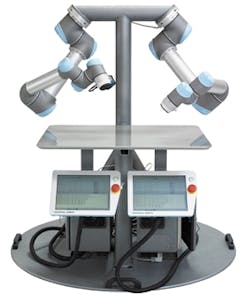
Robotics are now more affordable and within the economic reach of mid-market manufacturing. This means that the manufacturing masses can expect tremendous growth in the use of automation. The effectiveness of robotics is not just contingent on cost of ownership.
In order for this technology to become useful, business software systems must take wide scale automation into account.
Beyond low cost machine procurement, companies must invest in training for the machines with simple to use human processes and connect them to the business operating technology fabric.
While this sounds a bit daunting, it is all possible as the technology to accomplish this is available. technology systems that are designed with ‘industrial internet’ in mind are already on the market. The only thing standing between next-gen manufacturing through robotics is a bit of research and an education of what is available on the market today.
Manufacturing on Demand -- 3-D Printing and Additive Manufacturing
Stereo lithography and 3-D printing have made significant movement from prototype to volume production in the past couple of years.
The process of making a 3-D computer aided design (CAD) into a physical and fully operational product is a technology that can significantly change the way products are manufactured. For example, low volume aircraft turbine parts made from Inconel alloys tend to be dimensionally more accurate than traditionally machined parts.
Another prime example is medical prosthetics, which can be needed at a remote hospital where logistical constraints make the shipping of parts too difficult or costly.
Finally, consider parts for a machine that may no longer be in production; the cost to traditionally re-tool such a part is not economically feasible. These are all examples of where ‘production additive manufacturing’ can add substantial value to the market.
When evaluating manufacturing on demand, there are several factors to consider in order to properly utilize the technology:
The first is the intellectual property and design of your product, which becomes much more important. It must be controlled and protected, especially if end- users are permitted to fabricate parts on their own.
Enforcing the proper design controls is equally important when streamlining the development to production process. Less people and time will be required from initial design to production. Fewer steps can impact the internal review process; meaning that design errors which were once monitored by staff might go unaccounted for in the future. Controlled and systematic design and reviews must be in place.
Quality control regulations are especially needed for field production. The responsibility of design and specification extends to the actual part being produced in the field.
Lastly, a sound methodology is needed to manage the digital rights of the intellectual property. This includes control over accounting, sales production and all the metrics and data needed for business decision-making.
With knowledge of these challenges, a manufacturer looking to adopt this technology will discover that each of these points can be addressed. The ability to integrate CAD from production manufacturing flows is available -- as are design review and workflow, ranging to control product and design accuracy. Digital rights management for field-produced parts is available, as is the ability to collect the needed analytical data.
If a manufacturer makes an informed decision to embrace technology with a progressive, flexible architecture, that manufacturer is prepared to attain success.
For more next-gen manufacturing trends, see part two of the series.
Warren Smith is a senior industry consultant and business strategy architect for the automotive and aftermarket industries at Infor.