Snack-Sized EVs for DoorDash? Thanks, Rivian: So That Happened
Editor’s note: Welcome to So That Happened, our editors’ takes on things going on in the manufacturing world that deserve some extra attention. This will appear regularly in the Member’s Only section of the site.
Kraft Heinz Is New York-Bound
The Kraft Heinz Co. is moving to New York—the New York Stock Exchange, that is. The food manufacturer, whose brands include Velveeta, Jell-O and Lunchables, announced that it will transfer its common stock to the NYSE from the Nasdaq, with trading set to begin on Sept. 14. The ticker symbol will remain KHC.
“Our move to the New York Stock Exchange marks an exciting milestone in Kraft Heinz's transformation. We believe the NYSE is a natural home for Kraft Heinz as we enter our next chapter, reflecting the strength of our iconic portfolio, our global scale and our focus on creating long-term shareholder value,” Kraft Heinz CEO Steve Cahillane said in a news release.
Kraft Heinz, with headquarters in both Pittsburgh and Chicago, is the result of a merger between Kraft Foods Group and H.J. Heinz Holding Corp., which was completed in 2015. Kraft had traded on the Nasdaq for three years prior to the merger with then privately held Heinz.
Earlier this month, Kraft Heinz reported its 2026 second-quarter financial results, showing quarterly net sales of $6.26 billion, down 1.4% from the same period one year ago. Net income showed a loss of $5.46 billion, compared with a loss of $7.82 billion one year ago.
—Jill Jusko
Manufacturing Is Having a Protein Moment
All too often when people hear the word “manufacturing” they think of the discrete construction of larger goods like cars, refrigerators, or toys. Far fewer people think of the Chips Ahoy cookies sitting on their shelves, or the frozen pizzas in their freezer, or even the drugs on their nightstand. And fewer still think of manufacturing at the molecular level, either organic or inorganic.
One researcher who focuses on molecular manufacturing has won this year’s NSF Manufacturing Blue Sky competition, sponsored by the Society of Manufacturing Engineers and the U.S. National Science Foundation. Mostafa Bedewy associate professor of mechanical engineering and materials science in Pitt’s Swanson School of Engineering, developed Protein-Based Manufacturing, or ProMan, with Won Min Park, associate professor of chemical engineering at Kansas State University, and Meng Wang, associate professor of civil and environmental engineering at the University of Houston.
Their research focuses on textile manufacturing at the molecular level, and their presentation, “Protein-Based Manufacturing (ProMan): Programming Matter through Molecular Information,” outlines how engineers can gain more direct control over how proteins fold and assemble during processing to create that are as tough and flexible as those produced naturally by silkworms.
Bedewy’s approach departs from traditional processes that focus on imposing shape on matter. “It’s time to think about the next major shift in manufacturing with molecular information as a new control knob,” said Bedewy. “If we can design the amino-acid sequence, and then control how that sequence folds and assembles during processing, we gain a fundamentally new way to control material structure and function.”
The team also envisions proteins serving as materials themselves or as templates for metals, oxides, semiconductors, catalysts and devices.
Bedewsky, Park, and Wang’s presentation was selected to receive the SME’s 2026 David Dornfeld Manufacturing Vision Award. Applications for the 2027 award are open.
—Tom Wilk
Maine Shipyard Workers Win 17% Wage Increase
After months of negotiations, nearly 4,500 union shipbuilders at General Dynamics’ Bath Iron Works in Bath, Maine, have ratified a five-year contract with substantial wage increases, with locked-in healthcare benefits and improved 401k contributions.
International Association of Machinists workers will receive a 17% wage increase in the first year of the contract, with 4% increases in the following four years.
The agreement comes two weeks after President Donald Trump issued a memo calling for the Pentagon to source Navy ship vessels from foreign shipyards in light of “shipbuilding setbacks” for the Navy “stemming from overly complex designs and iterative design-change procedures.”
The memo stipulates that foreign shipbuilders would be required to build new shipyards in the United States, hire and train U.S. workers, source construction and training in the U.S. and license parent-company technology to those shipyards. It also calls for the launch of a fifth public Navy shipyard for “nuclear-powered submarine and aircraft carrier readiness.”
Bath Iron Works manufacturers surface combatants, which are named in the memo as underproduced for Navy needs.
—Laura Putre
Rivian Spinout Snags Second Funding Round Of 2026
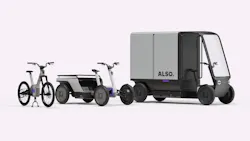
You may have heard of DoorDash’s Dot, a four-wheeled robot that can deliver up to six large pizza boxes to your door. But the company isn’t putting all its eggs (or pizzas or burritos) in that basket and earlier this summer invested in Also, which was spun out of Rivian last year to focus on small EVs, as part of a $200 million funding round.
Just a few weeks on from that headline, Also leaders – who, eh, “also” have secured a partnership with Amazon – have raised another $150 million from an investor group that will help them speed up work on the company’s electric bicycle and four-wheelers. Humans will drive some of those vehicles around cities and suburbs but Also is working on autonomous versions, too, with the goal of having them use bike lanes.
“The need to solve for congestion and cost per trip doesn’t change,” Co-Founder and President Chris Yu said in a statement. “I am thrilled by the incredible support of our partners and our ability to fast track the development of our autonomous vehicle platform.”
Among the investors in this latest financing for Also is Prysm Capital, which was an early investor in Rivian. Like the auto manufacturer (which still owns a chunk of Also), Yu and his team are looking to create a vertically integrated company. The goal: Be able to more efficiently – in terms of time and investment – trek across town to drop off dinner or a box of laundry detergent than a large delivery truck can.
—Geert De Lombaerde
Does AI Deliver ROI?
IT consultancy Infosys released a new report, “The AI ROI Gap: Turning Ambition Into Enterprise Value” that argues while companies generally agree that AI has value, pilots aren’t scaling and most companies can’t measure ROI.
Fortune last August ran a story about 95% of generative AI pilots failing. CNN last September ran a story about most companies not seeing returns on AI investments. Reuters last October reported on a study from EY that showed a $4.4 billion combined loss from companies that rolled out AI. This new report tracks the narrative.
According to the Infosys report, 80% of respondents said that AI is a “critical driver of new revenue opportunities,” but 25% of respondents said the ROI is below expectations and another 15% say it’s too early to decide whether investments in AI create value at all.
Many organizations—67% of respondents—haven’t figured out how to measure ROI from AI, while 46% of respondents lack a formal KPI framework.
Less than a quarter of all AI pilots scaled successfully and delivered the intended return on investment. According to the report, these pilots fail because business cases and ROI targets are both unclear.
If companies have a plan in advance for how to deploy AI and why they should bother, rather than building the infrastructure and deploying the tech without a crystal-clear plan, AI might pay off. Otherwise, it could become an expensive boondoggle.
—Dennis Scimeca
About the Author
 Jill Jusko
Jill Jusko
Bio: Jill Jusko is executive editor for IndustryWeek. She has been writing about manufacturing operations leadership for more than 20 years. Her coverage spotlights companies that are in pursuit of world-class results in quality, productivity, cost and other benchmarks by implementing the latest continuous improvement and lean/Six-Sigma strategies. Jill also coordinates IndustryWeek’s Best Plants Awards Program, which annually salutes the leading manufacturing facilities in North America.
Have a story idea? Send it to [email protected].
Geert De Lombaerde
Senior Editor
A native of Belgium, Geert De Lombaerde has been in business journalism since the mid-1990s and writes about public companies, markets and economic trends for Endeavor Business Media publications, focusing on IndustryWeek, FleetOwner, Oil & Gas Journal, T&D World and Healthcare Innovation. He also curates the twice-monthly Market Moves Strategy newsletter that showcases Endeavor stories on strategy, leadership and investment and contributes to other Market Moves newsletters.
With a degree in journalism from the University of Missouri, he began his reporting career at the Business Courier in Cincinnati in 1997, initially covering retail and the courts before shifting to banking, insurance and investing. He later was managing editor and editor of the Nashville Business Journal before being named editor of the Nashville Post in early 2008. He led a team that helped grow the Post's online traffic more than fivefold before joining Endeavor in September 2021.
 Laura Putre
Laura Putre
Senior Editor, IndustryWeek
As senior editor, Laura Putre works with IndustryWeek's editorial contributors and reports on leadership and the automotive industry as they relate to manufacturing. She joined IndustryWeek in 2015 as a staff writer covering workforce issues.
Prior to IndustryWeek, Laura reported on the healthcare industry and covered local news. She was the editor of the Chicago Journal and a staff writer for Cleveland Scene. Her national bylines include The Guardian, Slate, Pacific-Standard and The Root.
Laura was a National Press Foundation fellow in 2022.
Got a story idea? Reach out to Laura at [email protected]
 Dennis Scimeca
Dennis Scimeca
Dennis Scimeca is a veteran technology journalist with particular experience in vision system technology, machine learning/artificial intelligence, and augmented/mixed/virtual reality (XR), with bylines in consumer, developer, and B2B outlets.
At IndustryWeek, he covers the competitive advantages gained by manufacturers that deploy proven technologies. If you would like to share your story with IndustryWeek, please contact Dennis at [email protected].
Thomas Wilk
Editor-in-Chief
LinkedIn: linkedin.com/in/wilkt
Bio: Thomas Wilk joined IndustryWeek as editor in chief in May 2026, following nearly 12 years as chief editor for Plant Services. Previously, Wilk was content strategist / mobile media manager at Panduit. Prior to Panduit, Tom was lead editor for Battelle Memorial Institute's Environmental Restoration team, and taught business and technical writing at Ohio State University for eight years. Tom holds a BA from the University of Illinois and an MA from Ohio State University.