Ohio Manufacturing Extension Partnership Audit Highlights Errors—and Raises Questions of Unfair Targeting
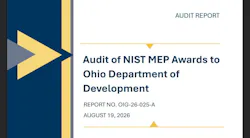
After three years of auditing the Ohio Manufacturing Extension Partnership—a program that helps small and medium-sized manufacturers in the state modernize and improve their business practices—the Department of Commerce’s Office of the U.S. Inspector General released its findings last week.
The OIG audit, covering the years 2017 to 2024, found $2.76 million in underreported program income and questioned $20.9 million in misreported expenses over 10 years. It faulted the Ohio Department of Development (the state’s grantee for the MEP award) for reporting inaccurate financial results, ineffectively monitoring expenses for the six satellite offices of the state’s MEP program, not doing due diligence on conflicts of interest and overestimating economic impact data.
Podcast: What's Ahead for Manufacturing Extension Partnerships?
Immediate blowback to the audit has been harsh. Headlines in local media upon its release last week called the audit “scathing” and said the Ohio MEP program’s existence is at risk.

Yet some familiar with the MEP program say the audit lacks context and question whether the punishment—abruptly cutting off federal funding for the Ohio MEP program a full seven months before the audit was even released—fits the mistakes in reporting and expense approvals that do not rise to the level of fraud. The Trump administration has been trying since 2017 to eliminate the national MEP program, as did the George W. Bush administration in the early 2000s.
“It’s a tiny program. Its budget is under $200 million. It costs way less than an aircraft carrier,” says Susan Helper of the national MEP program. Helper is a manufacturing researcher who served as chief economist of the U.S. Department of Commerce from 2013 to 2015.
“The MEP is kept on this very short leash with very small budgets and no real ability to plan. So it’s this scrappy program that finds programs to offer manufacturers. I feel like they’ve done a good job, but they’ve been hamstrung because of this excessive scrutiny.”
And at least one Ohio center is fighting back.
Audit Findings
The audit’s findings range from minor to embarrassing to concerning. Unallowed expenses include money spent on events promoting manufacturing in the state, reimbursing manufacturers for interns’ wages through a state internship program and not receiving a refund for almost $16,000 paid to a sitcom star to speak at a manufacturing event.
The items the audit highlighted include using the state MEP award for building expenses yet not reporting rent income from sublease tenants in a business incubator, misreporting $35,000 in client fees and not reporting revenue from nonmanufacturers that benefited from federal funds.
The full audit is available online.
OIG audit findings include:
Misreporting of $2.7 million in program income across the six nonprofit Ohio MEP offices over the eight years of the audit, including $2.3 million in income the Center for Innovation Food Technology—Toledo, Ohio’s MEP—received from nonmanufacturing clients because CIFT billed some expenses for generating that revenue to the MEP award.
Expenses for hosting and sponsoring events promoting manufacturing that were technically unallowable under federal guidelines but deemed allowable by the state under NIST MEP awards guidelines. (After OIG evaluations of NIST practices and outcomes in 2023 and 2024, NIST award guidelines became more detailed, expanding from 16 to 36 pages.)
A potential conflict of interest in which a board member of MAGNET, Northeast Ohio’s MEP, worked as a contractor through Ohio State University for a state study paid through NIST MEP funds. MAGNET CEO and President Ethan Karp provided documentation that MAGNET was directed by the state to administer the funds for the project, NIST approved the contractor before MAGNET had any involvement and MAGNET had no role in the board member’s selection for the grant.
$6.6 million in program income for an early COVID program manufacturing PPE that MAGNET failed to report to the MEP award. Karp says that MAGNET did not report the PPE sales to the MEP award because it paid out all revenue from the program to the 35 Ohio manufacturers that made the PPE.
A state-funded internship program inappropriately used nearly $1.8 million in MEP funds for intern wage reimbursements to manufacturers. MAGNET, an administrator of the internship program on the state’s direction, says that the program was not a federal program and was funded through “state grants unrelated to NIST MEP.”
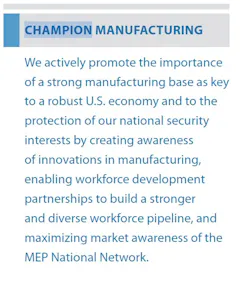
$400,000 in MEP funds MAGNET spent over eight years to hire an outside public relations firm to ghostwrite articles for Forbes magazine promoting MAGNET, the Ohio MEP and NIST. Karp shared a page from NIST’s 2023-2027 Strategic Plan (that has since been taken down from NIST’s website) calling on MEP programs to “champion manufacturing” by “providing insight, at the local and national level, on the current ‘State of Manufacturing’ by telling the stories about the people, companies and products made in the U.S. that support the economy and help protect our national security interests.” In addition, the report directs MEP offices to “become a major voice and thought leader for manufacturing in the state. Karp also shared emails between MAGNET and NIST in which NIST officers encourage MAGNET to collaborate with Forbes and a PR firm hired to produce such articles.
$4,500 for MAGNET to purchase two years’ rights to use a LeBron James photo on the cover of its Blueprint Report for Manufacturing in Northeast Ohio. The state of Ohio approved the purchase as allowable under NIST guidelines.
$15,954 billed through MAGNET for the state for "Cheers" actor John Ratzenberger to appear virtually at a state manufacturing event in 2020. Ratzenberger’s appearance was cancelled but neither the state nor MAGNET pursued a refund until the audit came out and highlighted the error. MAGNET’s response: “This was an administrative mistake, and MAGNET takes responsibility for refunding this amount to the state.”
Of the $20.9 million the OIG questions in the report, the OIG attributes $4.6 million of those costs to MAGNET. MAGNET accepts $122,000 of the administrative errors and disputes the rest. In addition, MAGNET discovered $97,000 in additional errors not found by OIG audits that it plans to rectify.
Ohio MEP Funds Suspended
The Ohio MEP’s nearly $6 million annual federal award—distributed across six regional Ohio MEP offices in Toledo, Columbus, Dayton, Cleveland/Northeast Ohio, Cincinnati and the Youngstown/Mahoning Valley areas—was suspended in December 2025 pending results of the audit.
The abrupt suspension of the grant in December—along with matching state funds—resulted in four of six Ohio MEP offices closing down in the weeks that followed. Northeast Ohio’s MEP office, MAGNET, has remained open with reduced services after laying off nearly half its staff, while Toledo’s Center for Innovation in Food Technology (CIFT) laid off all but two of its employees while it put its startup incubator on life support.
NIST said it would consider answering IndustryWeek questions on the audit findings but has not yet responded to the questions or agreed to an interview. The Ohio Department of Development released a public statement acknowledging the audit findings and committing to working with NIST but declined to answer any questions from IndustryWeek or allow IndustryWeek to interview grant director Aaron Patrick.
What the MEP Program Does and Its History
The Hollings Manufacturing Extension Partnership program is a national network of centers established in 1988 as part of the Omnibus Trade and Competitiveness Act, signed into law by President Ronald Reagan. The program was established to address the challenges of small and medium-sized manufacturers. (Nearly 75% of U.S. manufacturing companies have under 20 employees and 93% have fewer than 100 employees, according to NIST.)
Currently, 48 states and Puerto Rico have MEP centers; Ohio has one of the largest centers. The national program’s $175 million annual budget is distributed across the 49 centers, with the grant recipients in each state committing to provide 1-1 matching funds. Ohio is somewhat unique in that its federal grant, although administered by the state’s Department of Development, is shared between six MEP offices, which are grant subrecipients. Most states have only a single MEP office.
A 2023 NIST-commissioned study conducted by an independent third party found that every $1 the federal government invests in the MEP program generates $18 into the economy overall.
Years of Trying to Shut Down the MEP Program
President Trump sought to eliminate the MEP program beginning with his proposed 2018 budget in his first term in office that offered only $6 million for the program to “wind down operations.”
NIST told state MEPs in April 2025 that “as part of President Trump’s efforts to streamline and reduce the cost and size of the Federal Government and in accordance with the priorities to ‘secure its position as the unrivaled world leader in critical and emerging technologies such as artificial intelligence, quantum information science,’ NIST is reprioritizing its funding and staff to support efforts in research and programs targeting emerging technology priorities. As such, the funding of MEP centers is no longer in alignment with advancing the priorities of NIST.”
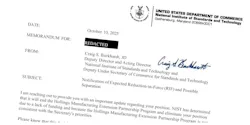
In October 2025, Craig Burkhardt, then acting director of NIST, stated in a letter that the agency has decided to end the federal MEP program because “it is not consistent with the Secretary’s [Secretary of Commerce Howard Lutnick’s] priorities.”
The MEP program has bipartisan support in Congress, however, and every year Congress has voted to fund it. Four senators—Republican Sens. Bernie Moreno and John Husted from Ohio, Democratic Sen. Adam Schiff of California and Democratic Sen. Andy Kim of New Jersey—introduced the Defend American Manufacturing Act in July designed to protect the MEP program. (Among its provisions: that within 30 days of a suspension of a state MEP center, the Secretary of Commerce must initiate a competition to select a new operator for that center.)
‘Should You Crank It Down That Hard?’
Robert Eger, an emeritus professor of accounting and former U.S. Navy accountant who has expertise in federal grants, said that whatever NIST guidelines have advised for MEP financial reporting over the years, state grant recipients and subrecipients still are ultimately bound to the federal grant guidelines outlined in the Code of Federal Regulations subsection 200.
“Economic development money tends to pass through from federal to the state,” and in the case of the MEP program, “the state passes that through to an economic-development-style industrial agency,” he says. “That agency is still obligated to follow the rules.”
In this case, he says, “the agency [MAGNET and other Ohio MEP offices] probably didn’t do anything really wrong, but they didn’t follow federal cost accounting rules. That’s what got it in trouble. … It sounds to me like the federal government is being picky as sh**, but I don’t know how [the MEPs] can get around it.”
“The question is, ‘Should you crank it down that hard?’ Or did this agency do what it’s been doing for years—benefit the state of Ohio, benefit the federal government. That federal money helps small to medium-sized manufacturers. That helps everyone in Ohio.”
‘Nickel-and-Diming and Nitpicking’
The private consulting services that advise multibillion-dollar corporations are out of smaller manufacturers’ price range, making the subsidized services MEPs provide valuable, Helper says.
“There’s a lot of potential new technology that if we could get it adopted would really make manufacturing competitive globally in a way that it hasn’t been for a while. So yeah, it seems a particularly bad time, not just for Ohio but also for the nation to be kind of nickel- and -diming and nitpicking this program to death.”
Small Manufacturers Value MAGNET, MEP Program

Rich Gent is co-owner with his brother of Gent Machine Co., a 100-year-old family business that makes precision-machined parts at high volume. The $10 million company has 55 employees and a 64,000-square- foot manufacturing facility on Cleveland’s East Side. Gent has worked with MAGNET on various projects for eight years. Early on, he used MAGNET’s iterator program to test out a product idea that MAGNET’s team then helped research and test. Recently, when Gent Machine needed to upgrade its machine troubleshooting, MAGNET helped it with an AI project that allows operators to problem-solve by searching maintenance guides and manuals by chatbot.
Gent also benefits from MAGNET’s continuing education program. “I don’t have a lot of people to bounce ideas off of, but there are 20 different manufacturers, owners and CEOs, they put on classes, and speakers talk about all the current things that manufacturers can do. I got the AI idea from a class I went to. You need help and support from others, and that’s what MAGNET does. I’m sure I could go out there and pay different companies to do that—probably overpay—but this is right here down the road in Cleveland.”
Gent said he is “very nervous” about possibly losing MAGNET’s services. “I don’t really think there’s a lot of places that are equal to what MAGNET does,” says Gent. “There are government agencies who can help you with talent acquisition, with fancy job searches, and trade schools teaching and trying to train up employees, but there aren’t other partners or entities in Cleveland that can do what I’m talking about doing, like building an AI chatbot. We go to trade shows but we’re not paying consultants $350 an hour to do these things. It doesn’t work out for a business our size.”
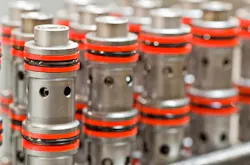
Recently, MAGNET helped Eagle Elastomer engineer a custom machine to pull a cord through a measuring device, to free up an employee for more challenging tasks. “I think they have big value,” says McHale. “Small businesses like ours, we’re not privy to the technologies that are coming out. They’re coming out really fast nowadays. We’ve got turnover with a bunch of people retiring and people coming in that lack certain skills. MAGNET has been very helpful, especially in a climate where manufacturing is growing considerably in the U.S.”
What’s Next for Ohio’s MEP Program?
The OIG audit was released on August 19, one day before the deadline for Ohio to apply for the next round of annual NIST MEP funding. The state of Ohio did not apply for the funding, but a large state organization reportedly has sent in a request for proposal in the hopes that the state can retain some federal funding.
MAGNET’s Karp has been fighting hard to clear his organization’s name, releasing a 112-page response to the audit with documentation attached. He says the way forward is to “accept responsibility for the things that we believe are mistakes and fight back to set the record straight. Be available to share any of this information with whomever would like to see it, so they can judge for themselves. And we stay open.”
MAGNET, unlike some other MEP-affiliated organizations, receives other grants and has other income streams unrelated to the MEP award. MAGNET in 2024 neceived approximately $2.4 million annually from NIST and $3.5 million matching money from the state, both of which were suspended in December. About 70% of its $20.4 million revenue in 2024, however, came from other grants, income from programs and client services and a small amount from investments.
“We are still serving clients. We have our mission. We are working to make sure that those services are more sustainable. They’re certainly cut back from where they were, but we are still functioning.
“We are not going to shut down. We are going to go forward and continue serving manufacturers.”
About the Author
 Laura Putre
Laura Putre
Senior Editor, IndustryWeek
As senior editor, Laura Putre works with IndustryWeek's editorial contributors and reports on leadership and the automotive industry as they relate to manufacturing. She joined IndustryWeek in 2015 as a staff writer covering workforce issues.
Prior to IndustryWeek, Laura reported on the healthcare industry and covered local news. She was the editor of the Chicago Journal and a staff writer for Cleveland Scene. Her national bylines include The Guardian, Slate, Pacific-Standard and The Root.
Laura was a National Press Foundation fellow in 2022.
Got a story idea? Reach out to Laura at [email protected]