Ford Scales Back EV Ambitions, Forecasts $19.5 Billion Write-Down
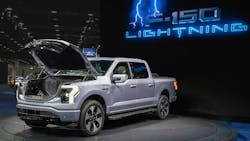
Ford on Monday announced a major retreat from large electric vehicles, planning a write-off of about $19.5 billion over several years as it pivots toward hybrids, gas-powered trucks and a new battery storage business.
The Detroit automaker said it will cancel plans for select larger EVs -- including its F-150 Lightning -- due to weak demand, elevated costs and regulatory changes, marking a significant shift in strategy as the industry grapples with slower-than-expected electric vehicle adoption.
"This is a customer-driven shift to create a stronger, more resilient and more profitable Ford," CEO Jim Farley said.
"The operating reality has changed, and we are redeploying capital into higher-return growth opportunities."
The shift by Ford comes just days after President Donald Trump moved to revoke tougher fuel-economy standards put in place by his Democratic predecessor, Joe Biden, which had prompted U.S. companies to embrace a transition to electric vehicles.
Farley at the time praised Trump for "aligning fuel economy standards with market realities," calling it "a win for customers and common sense."
Trump has railed against what he calls an EV "mandate," while Republicans in Congress have repealed clean-energy tax credits that had also stoked demand for EVs.
Focus on Power Storage
Part of Ford's announcement was its plan to shift its investments in batteries from vehicles to static units used to store electricity at data centers. With cloud computing and AI growing rapidly, data center construction has been a major economic driver for the past two years with hundreds of billions of new investments coming online in the next few years. At EnergyTech, a publication owned by IndustryWeek parent company Endeavor B2B, Managing Editor Rod Walton details some of Ford's plans to build a new business serving the data center world.
Remaining EV efforts at Ford will now concentrate on a family of smaller, affordable electric vehicles, instead of higher-cost larger vehicles.
Ford said it had halted production of the current F-150 Lightning electric pickup, which it once hoped would spearhead a transition to EVs.
Instead, the next-generation Lightning will be hybrid, combining battery power with a gasoline engine, offering an estimated 700-plus mile range, the company said.
Ford also canceled plans for new electric commercial vans in Europe and North America, replacing them with gas and hybrid models to be manufactured at its Ohio assembly plant starting in 2029.
In the shift, the company will repurpose its Tennessee facility, renaming the Tennessee Electric Vehicle Center to Tennessee Truck Plant, to build new affordable gas-powered trucks beginning in 2029 instead of electric vehicles.
Ford said it was also launching a battery energy storage business, converting a Kentucky plant to manufacture products for data centers and power companies.
For that business, the company plans to invest roughly $2 billion over two years and is targeting a supply of 20 gigawatt-hours of annual capacity by late 2027, enough to make it a major player in the fast-growing market.
All rights reserved ©2025 Agence France-Presse
FleetOwner's Take on the News
Another Endeavor B2B partner, commercial trucking publication FleetOwner, also wrote about Ford's decision to dramatically scale back its EV business. Editors Kevin Jones and Jade Brasher discuss how Ford's actions tie in to the rest of the industry and what's next for the EV market in their article.
About the Author
Agence France-Presse
Copyright Agence France-Presse, 2002-2026. AFP text, photos, graphics and logos shall not be reproduced, published, broadcast, rewritten for broadcast or publication or redistributed directly or indirectly in any medium. AFP shall not be held liable for any delays, inaccuracies, errors or omissions in any AFP content, or for any actions taken in consequence.