Solstice CEO: ‘We Might Move Faster’ on M&A Than is Typical
Solstice Advanced Materials Inc., which was spun out of Honeywell Inc. in late October, could step into the acquisition arena faster than a company in its situation might ordinarily would, President and CEO David Sewell said last week.
Speaking after the fourth-quarter earnings report from Solstice, which is home to about 4,000 people and books about $4 billion in annual sales, Sewell told analysts he’s “really grateful” that the company’s balance sheet wasn’t loaded up with debt during its spinoff from Honeywell and that his team has quickly built a pipeline of potential purchases.
“We do want to ensure it fits our strategy, it fits our return profile and the markets we serve. But we do feel like with our balance sheet, we are well positioned,” said Sewell, who joined what is now Solstice almost a year ago after being CEO of WestRock Co. “If there’s a very attractive bolt-on asset that’s available at the right price, I think it would be fair to say we might move faster than in typical circumstances.”
Getting into the M&A game would be something novel for Solstice, which is now headquartered in New Jersey but does business with more than 3,000 customers in more than 120 countries and territories. Speaking at a Barclays conference a few days after reporting earnings, Sewell noted that the businesses that make up Solstice haven’t acquired another company in 10 years. And M&A ranks third on the list of strategic priorities behind organic growth investments and preserving its strong balance sheet.
Solstice’s perhaps atypical appetite for M&A reflects a broader market that is picking up steam: EY Parthenon researchers recently updated their 2026 forecast for deal activity in the United States to 8% above last year from their previous 3% outlook. Helping drive that bump is that 62% of CEOs such as Sewell told EY Parthenon they plan to get in the game in the next 12 months. Last September, that figure was just 35%.
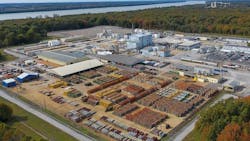
While Sewell and his team parse through acquisition opportunities, they’re putting to work more than $200 million in Virginia to grow Solstice’s military-focused business and looking to build on projects that have cleared production bottlenecks at a Southern Illinois plant making uranium hexafluoride, which is used to enrich uranium for reactors.
Solstice announced earlier this month that the Metropolis facility is on pace to produce more than 10 kilotonnes of uranium hexafluoride this year, which is 20% more than its planned capacity in 2024, a year after Honeywell restarted it. The plant has $2 billion worth of business in its backlog that will cover most of its production through 2030 and Sewell told analysts on Feb. 11 that Solstice has hired an engineering, procurement and construction firm to look into how to further expand its capacity.
In the fourth quarter of last year (which included nearly one month under Honeywell’s umbrella), Solstice booked a net profit of $41 million and adjusted standalone EBITDA of $189 million on revenues of $987 million. The latter was an 8% increase from late 2024. Sewell and his lieutenants are forecasting adjusted EBITDA of roughly $1 billion for 2026.
Shares of Solstice (Ticker: SOLS) jumped more than 17% on executives’ earnings report and commentary and have since climbed another 5%, closing at $79.09 on Feb. 24. The company now has a market capitalization of more than $12.5 billion.
About the Author
Geert De Lombaerde
Senior Editor
A native of Belgium, Geert De Lombaerde has been in business journalism since the mid-1990s and writes about public companies, markets and economic trends for Endeavor Business Media publications, focusing on IndustryWeek, FleetOwner, Oil & Gas Journal, T&D World and Healthcare Innovation. He also curates the twice-monthly Market Moves Strategy newsletter that showcases Endeavor stories on strategy, leadership and investment and contributes to other Market Moves newsletters.
With a degree in journalism from the University of Missouri, he began his reporting career at the Business Courier in Cincinnati in 1997, initially covering retail and the courts before shifting to banking, insurance and investing. He later was managing editor and editor of the Nashville Business Journal before being named editor of the Nashville Post in early 2008. He led a team that helped grow the Post's online traffic more than fivefold before joining Endeavor in September 2021.