3M and GE Vernova CEOs Talk Up Data-Center Growth
Speaking at investment bank conferences this week, the leaders of 3M Co. and GE Vernova Inc. outlined the growth they are seeing and targeting when it comes to working with data centers, illustrating how the red-hot artificial-intelligence sector is powering growth in manufacturing as well as the energy space.
GE Vernova CEO Scott Strazik and his team sit astride the intersection of energy and manufacturing and have been committing capital globally to grow the company’s capacity to make switchgear and other electrification equipment. Supplying solid-state transformers to data-center owners looks like another growth opportunity, Strazik said at the Bank of America Global Industrials Conference in London. Beyond that, though, GE Vernova teams are “getting under the tent with the hyperscalers in a very intimate way on how they want to run the operating parameters of the data centers.”
Driving that approach, Strazik explained, is that GE Vernova’s manufacturing of many of the gas turbines powering data centers—more on that shortly—has given it visibility into the need for what the company is calling “stability blocks” that would be installed just outside facilities.
“That can include medium-voltage transformers attached to storage in different ways with controls and software,” Strazik told the BofA audience. “We can provide an ability for them to run their data centers in a fairly aggressive way up and down following the load and we’re working on a product in that regard.”

Switching to gas power, Strazik (pictured at right) put the following perspective on GE Vernova’s pipeline of orders from AI hyperscalers: Today, data centers account for about 15% of a turbine backlog that totals roughly 40 gigawatts of capacity. (GE Vernova’s power division finished 2025 with a total backlog worth $94.4 billion, up $21 billion from the year before.) But roughly one-third of its slot reservation agreements—essentially down payments to get in line for future turbines that haven’t been formally moved into the backlog—are with data-center owners.
“So would I expect in orders in 2026 […] to be closer to one-third? Yes,” Strazik said. “Do I, based on all of our discussions with the hyperscalers on their needs, expect it to stay at that proportion for a reasonable number of years? Yes, based on all discussions.”
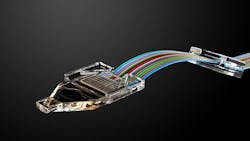
Bill Brown and his team at 3M aren’t yet dealing with billions of dollars of data-center sales but they also see opportunities to ride the sector’s growth wave. To that end, they announced this week that they’ll double the company’s capacity to make its Expanded Beam Optical interconnect technology, which Brown told the JPMorgan Industrials Conference is “starting to get some traction” with operators.
“We have a foothold, a toehold, within a data center through copper-based [twinaxial] interconnects,” Brown said. “The world is going to move to ceramics and on-chip optical connections. We’ve got a pretty good path on how to develop that over time.”
3M’s sales to data centers are worth about $100 million today, Brown said, but the company’s opportunity in the market is in the multiple billions.
“We do see a lot of upside,” he added. “But you start and you build over time and that’s the way we’re going.”
About the Author
Geert De Lombaerde
Senior Editor
A native of Belgium, Geert De Lombaerde has been in business journalism since the mid-1990s and writes about public companies, markets and economic trends for Endeavor Business Media publications, focusing on IndustryWeek, FleetOwner, Oil & Gas Journal, T&D World and Healthcare Innovation. He also curates the twice-monthly Market Moves Strategy newsletter that showcases Endeavor stories on strategy, leadership and investment and contributes to other Market Moves newsletters.
With a degree in journalism from the University of Missouri, he began his reporting career at the Business Courier in Cincinnati in 1997, initially covering retail and the courts before shifting to banking, insurance and investing. He later was managing editor and editor of the Nashville Business Journal before being named editor of the Nashville Post in early 2008. He led a team that helped grow the Post's online traffic more than fivefold before joining Endeavor in September 2021.