EV Notes: Uber Commits to Rivian Robotaxi Investments
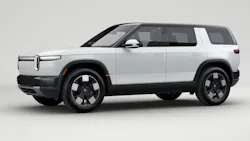
Ride-hailing market leader Uber Technologies Inc. has committed to investing up to $1.25 billion in Rivian Automotive Inc. between now and 2031 in return for building a fleet of 10,000 fully autonomous R2 robotaxis.
The partnership between Uber and Rivian gives the electric automaker’s push into autonomous driving a big shot in the arm. Uber will initially buy $300 million of Rivian stock following regulatory approval of their plans and then add to that amount if the R2 hits certain autonomous milestones by specific dates. The companies are targeting a 2028 rollout of the R2 robotaxi in San Francisco and Miami and plan to grow their network to 25 cities by early next decade. Uber also has the option to buy another 40,000 R2s starting in 2030.
“The scale of Rivian’s growing data flywheel coupled with RAP1, our state of the art in-house inference platform, and our multi-modal perception platform make us incredibly excited for the rapid advancement of Rivian autonomy over the next couple of years,” Rivian CEO R.J. Scaringe, who in December rolled out the company’s third-generation autonomy platform, said in a statement.
Rivian’s deal with Uber—whose CEO Dara Khosrowshahi called the companies’ targets “ambitious but achievable”—comes with a reset of its profitability target timeline. In a filing with the U.S. Securities and Exchange Commission, Rivian leaders said they no longer expect the company’s adjusted EBITDA to turn positive in 2027 “due to an expected increase in R&D spend associated with the acceleration of its autonomy roadmap.” Scaringe and CFO Claire McDonough last month said they expect Rivian’s adjusted EBITDA loss to be between $1.8 billion and $2.1 billion this year.
Still, word of the Uber link-up was lauded by several analysts as a validation of Rivian’s autonomy plans. At Morningstar, Seth Goldstein raised his fair-value estimate for Rivian shares to $20 from $15.
“We think the firm’s software will improve enough for it to successfully run a geofenced robotaxi operation within a city,” Goldstein wrote on March 19. “This will open a new revenue and profit stream.”
Shares of Rivian (Ticker: RIVN) were changing hands around $15.10 in afternoon trading on March 20, down about 6% and erasing the boost they got from the Uber news. The stock has risen slightly over the past six months, growing the company’s market capitalization to about $18.6 billion.
Lucid Targets 20% Cost Gains in ’26
Lucid Group Inc. teams have found a “secret sauce” of sorts when it comes to cutting the expenses of making its new midsized vehicle, CFO Taoufiq Boussaid said at a recent investment bank conference. That will help the EV maker take 20% out of its production costs by late this year after a 2025 in which the company cut spending on logistics, labor and overhead per car by 27%.
Lucid is following a path that’s very similar to Rivian’s in many ways. The company, which has until now focused on the high-end market with its Air and Gravity models, is preparing to launch midsized models—eyeing the same space as Rivian’s R2—that it aims to sell for about $50,000. And it last year partnered with Uber (as well as Nuro Inc.) on a robotaxi project, a deal that includes Uber committing to investing $300 million in Lucid and buying 20,000 cars.

Executives also are looking to further drive down their costs with the goal of starting to generate cash by late this decade. At the 2026 Cantor Fitzgerald Global Technology & Industrial Growth Conference, analyst Andres Sherppard-Slinger probed into Lucid’s projections that it can grow margins while rolling out the cheaper midsized models and asked if the company had “found some secret sauce.”
“I think we did,” Boussaid said. “Starting with the philosophy of designing a car, having the cost in mind and leveraging the things that we do well—the efficiency, the great engineering that we have, simplifying the way we design the car—has really led us to a very sweet spot. We’re confident that at the $50,000 or below dollars price mark, we can deliver a very good level of margin.”
Part of Lucid’s cost-cutting this year will come from the laying off last month of 12% of the company’s U.S. workforce, a move that will save it about $170 million versus last year. Those cuts didn’t include production, logistics and quality workers in Arizona, but company officials haven’t disclosed the number of people who were affected. Lucid finished 2025 with about 9,000 employees globally and plans to grow its workforce in Saudi Arabia this year as it expands its production base there.
Lucid’s leaders are forecasting that the company will make between 25,000 and 27,000 vehicles this year, up from 7,840 in 2025—a year in which executives had initially targeted 20,000 units. Boussaid last month told investors and analysts that last year “represented a clear step change in scale and unit economics” that the company is now building on.
Shares of Lucid (Ticker: LCID) were changing hands around $10.15 on the afternoon of March 20. Over the past six months, they have lost roughly half their value, which has cut the company’s market value to $3.3 billion.
About the Author
Geert De Lombaerde
Senior Editor
A native of Belgium, Geert De Lombaerde has been in business journalism since the mid-1990s and writes about public companies, markets and economic trends for Endeavor Business Media publications, focusing on IndustryWeek, FleetOwner, Oil & Gas Journal, T&D World and Healthcare Innovation. He also curates the twice-monthly Market Moves Strategy newsletter that showcases Endeavor stories on strategy, leadership and investment and contributes to other Market Moves newsletters.
With a degree in journalism from the University of Missouri, he began his reporting career at the Business Courier in Cincinnati in 1997, initially covering retail and the courts before shifting to banking, insurance and investing. He later was managing editor and editor of the Nashville Business Journal before being named editor of the Nashville Post in early 2008. He led a team that helped grow the Post's online traffic more than fivefold before joining Endeavor in September 2021.