Alcoa Adding Aluminum Capacity to Offset War Outages
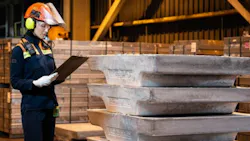
The leaders of Alcoa Corp. have been increasing smelting capacity at several of the company’s plants around the world to meet demand from customers who have been left hanging by war-related curtailments in the Middle East.
Speaking to analysts and investors April 16 after reporting Alcoa’s first-quarter results, President and CEO Bill Oplinger said disruptions in the Middle East, the world’s largest primary aluminum-exporting region, have given prices a big boost and pushed higher regional premiums in North America, Europe and Asia. Those price increases will more than offset a slightly slower pace of 2026 growth than previously expected, he added, as well as rising production costs.
To capitalize, Alcoa teams have been adding smelting production capacity at facilities in Portland, Australia, as well as São Luís, Brazil, and in Norway and northwestern Spain—the last of those at the San Ciprián plant that has been resuming operations since being curtailed five years during an energy-price crisis.
Oplinger also told analysts that Alcoa has been able to put to work excess capacity for value-added products such as billet and slab in Quebec and some of its other plants in Europe. That was possible because the company moved around some North American inventory in the first quarter, a move that pushed out the sale of about 30,000 metric tons but which Oplinger said “is looking smarter today than it did even when we did it.”
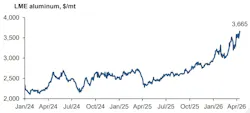
Demand for Alcoa’s billet, slab and foundry product is increasing, Oplinger and CFO Molly Beerman said, as users look to replace supply lost elsewhere. As has been the case with other commodities and certain intermediary and finished goods since the United States and Israel attacked Iran in late February, many buyers are now more focused on certainty than price.
“We are seeing a lot of spot order requests coming to us based on the fact that there is disruption,” Oplinger said. “Both in Europe and North America, our commercial teams have been extremely busy.”
Still waiting on Warrick
Not (yet) adding capacity is Alcoa’s Warrick smelter in southern Indiana. The company once ran a five-line operation there and at one point cut that number to two. Today, it runs three and the option to return to four has been on the minds of analysts since the Trump administration’s tariffs began pushing up prices in early 2025.
Asked late last week about ramping up at Warrick and adding roughly 50,000 tons of capacity, Oplinger again said that Alcoa would need to invest about $100 million to do so and that the project would require a lot of electrical equipment upgrades and take the better part of two years. And he noted that there are longer-term factors to consider.
“Now, on paper, the restart of Warrick looks pretty positive at this point. However, what we’re trying to really weigh is availability of short-term electricity, the availability of long-term electricity and our ability to successfully run that plant as a four-unit operation,” he said. “We have good stability, good safety there today. So we’ll factor that into an analysis of a potential restart.”
In the first three months of this year, Alcoa produced a net profit of $417 million on sales of nearly $3.2 billion. Those numbers were down from $548 million and $3.37 billion, respectively, in early 2025. The company shipped about 580,000 tons during the quarter versus 567,000 in Q1 of last year and 625,000 in the fourth quarter and its aluminum segment adjusted EBITDA jumped to $694 million from $134 million a year earlier. That offset a good chunk of the nearly $700 million year-over-year drop in adjusted EBITDA from Alcoa’s alumina business, which was disrupted both by the Iran war and severe weather in Australia.
Shares of Alcoa (Ticker: AA) fell nearly 7% to 65.62 after executives’ earnings report. But they closed April 20’s regular session at $66.53 and are still up 70% from six months ago. The company’s market capitalization is now about $17.5 billion compared to $6.1 billion this time last year.
About the Author
Geert De Lombaerde
Senior Editor
A native of Belgium, Geert De Lombaerde has been in business journalism since the mid-1990s and writes about public companies, markets and economic trends for Endeavor Business Media publications, focusing on IndustryWeek, FleetOwner, Oil & Gas Journal, T&D World and Healthcare Innovation. He also curates the twice-monthly Market Moves Strategy newsletter that showcases Endeavor stories on strategy, leadership and investment and contributes to other Market Moves newsletters.
With a degree in journalism from the University of Missouri, he began his reporting career at the Business Courier in Cincinnati in 1997, initially covering retail and the courts before shifting to banking, insurance and investing. He later was managing editor and editor of the Nashville Business Journal before being named editor of the Nashville Post in early 2008. He led a team that helped grow the Post's online traffic more than fivefold before joining Endeavor in September 2021.