Manufacturers Need Faster Permitting, More Practical Trade and Immigration Policy
Key Highlights
- NAM President Jay Timmons called for policy certainty, especially in permitting and trade, to foster investment and growth in manufacturing sectors.
- Panelists stressed that investments in energy infrastructure and renewable sources are vital to meet the sector's increasing energy demands and reduce waste.
- Timmons also emphasized that reforming the immigration system is crucial to filling workforce gaps, with bipartisan support for pathways to legal status for STEM workers.
- Streamlining federal and state permitting processes to accelerate manufacturing projects and reduce delays is another NAM priority.
Rock 'n' roll songs about manufacturing tend to be more about sticking it to the man or lamenting lost jobs than about steady pay and clean, well-lit, technologically advanced factories.
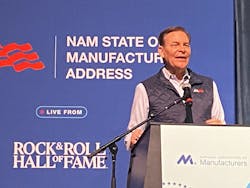
So rather than invoking Billy Joel's "Allentown," or maybe a tune from Bruce Springsteen's blue-collar songbook, National Association of Manufacturers President and CEO Jay Timmons, delivering his State of Manufacturing address Feb. 19 at Cleveland's Rock and Roll Hall of Fame, drew analogies between the artistry of musicians and the creators and innovators of manufacturing (and joked about his lack of air-guitar skills).
Speaking to a theater full of manufacturing business leaders and officials, Timmons emphasized the importance of certainty in U.S. policy and urged policymakers to "end the volatility." He praised the Trump administration's tax code reform and legislation in the works to streamline permitting, while stressing the need for the federal government to invest in the manufacturing workforce, encourage innovation and improve the immigration system to help manufacturing employers.
The day's events included a panel discussion with NAM board members and a tour of Cleveland State University's TransDiGM Advanced Manufacturing Center, where engineering students quizzed NAM leaders on how they should be preparing for the job market.
Here are some policy points that emerged throughout the day, from Timmons and others:
Energy
Timmons: Manufacturers use a third of the nation's energy, and that demand is growing. NAM advocates for investing in modernizing the grid and "opening more pathways to renewable energy," including wind and solar.
"We have always supported an all-of-the-above energy strategy," Timmons added in an interview later. He criticized both former President Joe Biden's pause on natural gas export permits, which the Trump administration ended, and President Trump's stop-work orders on offshore wind projects.
Ryan Augsburger, president of the Ohio Manufacturers' Association, said in an interview that the manufacturers he represents "have seen significant spiking in electricty [costs], and customers are not getting any offsetting benefits. Electricity and energy regulation are very important because it's done almost exclusively at the state government level, and so we're very invested in studying what's driving up the recent spike."
Blake Moret, NAM chair and CEO of Rockwell Automation said that 30% of the energy used in U.S. manufacturing facilities is wasteful. He spoke of the need for manufacturers to use technology to optimize energy usage and avoid energy-intensive processes during peak times.
Toby Rice, NAM board member and president of natural gas provider EQT, said that to accommodate the "AI revolution" and meet manufacturing and other power needs, the U.S. needs to generate an additional 100 gigawatts of energy—enough to power 20 New York cities.
Talent/Immigration
"We need an immigration system that works," Timmons told the assembly. "We need talent now." The current immigration system, he said, "is not designed to help manufacturers."
Timmons later added that "we're working with [U.S. Rep.] Maria Salazar [R-27] on her Dignity Act that has bipartisan support, and it focuses on the economic needs of the country and provides a pathway for legalization so that we can fill some of these jobs in our sector and other sectors as well. It doesn't cover all of the issues that NAM Supports, but it covers a broad swath."
The Dignity Act has some similarities with Trump's immigration policy, including increasing border security and completing the border wall. It also would broaden work visas for immigrants in STEM fields and provide clearer paths to legal status in the U.S., though not citizenship.
To qualify, indiviuals would pay $5,000 over seven years to the U.S. government, learn English, volunteer, check in regularly with the Department of Homeland Security, pay taxes and not receive any government benefits. Employers would be required to use the E-Verify System to authorize workers.
Permitting
"America's permitting system is broken," said Timmons, claiming that on average with federal, state and local regulations, it takes 80% longer in the U.S. than in other nations to get manufacturing projects going.
"We need certainty in the process," he said in a follow-up interview with IW. "We don't want to stop anybody from their right to challenge any project, but let's streamline it. Let's try to make sure that we can come to a yes or no decision quickly, so that communities know what's on the horizon, and so that businesses and investors know or don't continue to spend money for a project if it's not going to launch.
"In addition to that, especially at the federal level, a lot of agencies have purview over pieces of permitting. We want to see a streamlined process so that things can happen simultaneously, instead of basically shifting from one inbox in one building to another inbox in another building."
Right now there are five permitting bills that have passed the U.S. House of Representatives, awaiting further action. They are:
The SPEED Act: Proposes major changes to the National Environmental Policy Act, including reducing environmental review requirements and limiting legal review of agency decisions.
PERMIT Act: Makes more than a dozen changes to the Clean Water Act, ending protections for ephemeral streams that take in runoff water after storms and limiting states' ability to block projects because of water-quality concerns. NAM says the act would "clear bottlenecks that are slowing job-creating projects."
Electric Supply Chain Act: Would require periodic Department of Energy review of the nation's electric supply chain, looking for vulnerabilities and barriers to domestic manufacturing.
Improving Interagency Coordination for Pipeline Reviews Act: Would fast-track pipline infrastructure, reducing the review process.
ePermit Act: Would establish an interagency digital permitting system and unified portal to share data and documentation for environmental reviews.
Tariffs and Trade
Timmons' speech came a day before the U.S. Supreme Court invalidated Trump's global tariffs under the International Emergency Economic Powers Act [and Trump responded with an executive order declaring 15% tariffs on all imports].
Timmons said that while U.S. energy dominance lowers U.S. manufacturers' costs, tariffs increase their cost of doing business. Manufacturers know that Trump is going to impose tariffs; "what they want to see is predictability and certainty. That means nailing down the agreements that he's trying to effectuate and ensuring that the USMCA [trade agreement with Mexico and Canada] is renewed and can move forward."
Negotiations on the USMCA's six-year renewal begin in July. A priority for NAM in those negotiations, said Timmons, is to address Chinese transatlantic shipments into Mexico and Canada that surreptitiously avoid tariffs and claim North American origin.
Manufacturing Extension Partnerships
Timmons weighed in on the historical importance of Ohio's Manufacturing Extension Parntership program, which late last year lost its federal funding pending the completion of a yearslong audit, forcing layoffs and several regional offices to close their doors.
"Ohio is best in class when it comes to workforce development and their programs," he said. "I know that there's some consternation right now with the MEP program. We support the MEPs. I wish that we didn't have this challenge. Hopefully, it can work out in the future.
Augsburger worried that the damage from federal cuts has already done to Ohio's MEP program may not be reversable.
"Several of the MEPs in Ohio have already shut their doors," he said. "We continue to engage with policymakers to restore the funding stream so that those organizations can be reopened, but the longer that they're shuttered, the less optimistic we are about that prospect."
About the Author
 Laura Putre
Laura Putre
Senior Editor, IndustryWeek
As senior editor, Laura Putre works with IndustryWeek's editorial contributors and reports on leadership and the automotive industry as they relate to manufacturing. She joined IndustryWeek in 2015 as a staff writer covering workforce issues.
Prior to IndustryWeek, Laura reported on the healthcare industry and covered local news. She was the editor of the Chicago Journal and a staff writer for Cleveland Scene. Her national bylines include The Guardian, Slate, Pacific-Standard and The Root.
Laura was a National Press Foundation fellow in 2022.
Got a story idea? Reach out to Laura at [email protected]