We Reshored Long Before Tariffs and Never Looked Back
Key Highlights
- We prioritized domestic manufacturing despite higher costs to ensure quality, accountability, and supply chain control.
- Reshoring provided stability against tariffs, port delays, and geopolitical risks, safeguarding production schedules and customer relationships.
- Our bet on U.S. manufacturing turned competitive advantage as global supply chains faced disruptions and increased costs.
- What we did early is now part of a broader reshoring shift.
In 2013, I made a decision that many people told me didn’t make a lot of financial sense.
At the time, sourcing overseas was standard practice in manufacturing. Components were cheaper. So were raw materials and labor. If you wanted to maximize short-term margins, the path was obvious: Build it somewhere else and ship it back.
But I chose a different path.
As a manufacturer of industrial abrasive blasting rooms—systems that are used to process aerospace components, nuclear motors, military hardware and other mission-critical equipment—I believed that where and how we built our products mattered just as much as what we built. So we made a deliberate decision to become a full USA company.
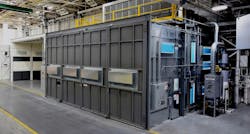
Not partially domestic. Not “assembled in America.” Not engineered here and fabricated overseas. Fully sourced. Fully manufactured. Fully assembled in the United States. Steel. Structural components. Electrical systems. Controls. Fabrication. Assembly.
At the time, there were no tariff advantages. No policy tailwinds. No incentives. In fact, our production costs increased. But we did it anyway.
Why We Did It
The first reason was pride. I believe American manufacturing still stands for something powerful: craftsmanship, accountability, durability and innovation. I wanted our company to be associated with that standard.
The second reason was control. When your supply chain spans multiple countries and oceans, you sacrifice visibility. You’re dependent on shipping schedules, customs processing, currency fluctuations and international politics.
When you manufacture domestically, you know your suppliers. You can visit them. You can audit them. You can solve problems in days instead of months.
And there was our customer base. We serve industries where failure cannot be tolerated. Aerospace contractors. Defense manufacturers. Energy producers. These companies operate in highly regulated environments. They care about traceability and documentation. What’s more, they care about long-term reliability and supply continuity. Long before it became “fashionable,” I believed that these customers would increasingly value domestic manufacturing. That belief turned out to be right.
That’s when the ground shifted.
Over the past decade, the global manufacturing landscape has changed dramatically. Trade tensions intensified. Tariffs were introduced on steel and industrial components. Freight costs surged. Ports backed up. Shipping containers became scarce. Geopolitical risk moved from theoretical to very real.
When tariffs expanded during President Donald Trump’s second term, many manufacturers suddenly found themselves exposed. Companies dependent on overseas fabrication saw material costs spike. Lead times stretched unpredictably. Quoting projects became a huge gamble.
For many in our industry, it created instability. And in heavy industrial markets, instability is expensive.
For us? Very little changed. Our suppliers were already domestic. Our fabrication was already domestic. Our materials were already domestic. We weren’t scrambling to redesign supply chains or renegotiate contracts halfway around the world.
That’s when I realized something important: The decision we made years earlier—the one that seemed expensive at the time—had quietly become one of our strongest strategic advantages. Today, when customers ask how tariffs are affecting us, I can honestly reply, “Tariffs? What tariffs?”
The Reshoring Movement Is Real
What we did early is now part of a broader shift across American manufacturing. According to data from the Reshoring Initiative and multiple industry surveys, hundreds of thousands of U.S. manufacturing jobs have been announced in connection with reshoring and foreign direct investment in recent years. Manufacturers across sectors, from heavy equipment to semiconductors to aerospace, are rethinking global supply chains.
Recent surveys show that a majority of U.S. manufacturers have either reshored or are actively evaluating reshoring portions of their production. The reasons are consistent:
- Supply chain resilience
- Reduced geopolitical exposure
- Freight and logistics stability
- Quality control
- Proximity to engineering and customers
Reshoring isn’t just about patriotism; it’s about risk management. There’s a persistent belief in manufacturing that the lowest unit cost always wins. But in mission-critical industrial markets, that’s rarely true: Risk management is what our customers prioritize. Our customers are evaluating total cost of ownership, not just purchase price. They want:
- Predictable lead times
- Stable pricing
- Compliance traceability
- Reduced risk exposure
- Domestic accountability
When a blasting room is part of an aerospace production line or used in the refurbishment of high-value rotating equipment, delays are not minor inconveniences. They can halt production schedules worth millions of dollars. By investing early in a fully domestic model, we insulated ourselves from many of the disruptions that have affected globally dependent manufacturers. No port delays. No surprise tariff surcharges. No last-minute component substitutions because a shipment got stuck overseas. That stability is something procurement departments, engineers and risk managers all appreciate.
The Intangible Benefits
What we didn’t fully anticipate were the secondary advantages.
Faster iteration and innovation. When engineering wants to refine a system, we can collaborate directly with domestic suppliers and fabricators in real time.
Stronger supplier partnerships. We’re not just buyers; we’re partners with other American manufacturers. That collaboration strengthens both sides.
Brand differentiation. In industries like aerospace, defense and energy, domestic sourcing carries weight. It signals accountability and long-term commitment
Perhaps most importantly, when something goes wrong, there’s no finger-pointing across time zones. We own it, and we fix it quickly.
When we shifted to fully domestic production, it wasn’t a reaction to policy. It was a philosophy. We asked ourselves: “Do we want to chase the lowest short-term cost? Or do we want to build a resilient company designed to withstand volatility?”
Manufacturing cycles are long. Capital equipment projects span years. Customer relationships span decades. You can’t build that kind of business on unstable foundations.
Today, as more manufacturers reevaluate offshore dependency, we find ourselves in a position of strength: not because we predicted specific tariff policies, but because we invested in resilience before resilience became necessary. What once looked like a higher-cost decision now looks like strategic foresight. And that’s why when someone asks how tariffs have impacted our business, I can confidently answer: “They haven’t.”
About the Author
 Brandon Acker
Brandon Acker
Brandon Acker is president of Titan Abrasive Systems in Ivyland, Pennsylvania, one of the leading designers and manufacturers of blast rooms, blast cabinets and abrasive blasting equipment.
Brandon purchased Titan Abrasive from his uncle and Titan founder, Bruce Maurer, in 2013 after spending five years learning the ins and outs of the business. He and Vice President of Engineering Brian Fox have completely redesigned the entire product line to solve the dozens of challenges that have plagued the blasting industry for decades.
Brandon is passionate about American manufacturing, the jobs it creates, the quality produced, and the bright future that lies ahead. He’s a frequent guest on manufacturing podcasts where he shares his deep industry expertise. Brandon holds a Bachelor of Science degree from Arizona State University.