Stop Cutting People. Start Cutting Complexity.

Companies are rushing into AI with great expectations. Some executives see a productivity revolution. Others see a convenient justification for abruptly reducing headcount. That is the wrong starting point.
Companies should not deploy AI primarily to explain layoffs. They should use it to remove the unnecessary and inherent complexity that has accumulated across products, processes, systems, meetings, reports and decision rights.
If AI simply automates a broken operating model, the company will become faster at doing the wrong things.
Manufacturers have spent decades adding reports, approvals, dashboards, technologies, committees and exceptions. People are buried under reports, meetings, emails, slacks, dashboards. Together, they created an expensive organizational fog. They slow down the organizational bandwidth. People now spend enormous energy navigating the company instead of serving customers, solving problems and improving operations. The first job of AI should be to expose that complexity, challenge it and help eliminate it. That means freeing people from low value tasks to high value outcomes.
Complexity Is the Cost Nobody Owns
Headcount is visible. Complexity is not, especially inherent and unnecessary complexity.
A plant manager can point to labor hours and overtime. A CFO can see salaries in the budget. But who owns the cost of five systems containing the same customer information? Who measures the hours lost reconciling conflicting reports? Who calculates the cost of low-volume product versions, obsolete specifications, duplicated inspections, endless approval loops and recurring meetings that produce no decisions? Who counts the cost of useless reports, meetings, dashboards, tracked KPIs, initiatives and pet projects that lead to nothing?
It is time for a purge.
These costs are scattered across functions, so they rarely appear as one line item. Yet they consume engineering capacity, planning time, inventory, working capital, service resources and management attention. In industrial companies, complexity travels through the entire value chain. A seemingly harmless product option can create new drawings, parts, routings, quality checks, inventory positions, supplier requirements, service procedures and pricing exceptions.
This is why traditional cost cutting often disappoints. The company removes people but the complexity remains. The remaining employees inherit the same reports, systems, approvals, product proliferation and project load. They are expected to do more with less inside an operating model that was never simplified. Morale declines, response times increase and hidden costs return.
Use AI as a Complexity Detector
AI can help industrial firms see patterns that are difficult to detect manually. It can identify reports that are generated but rarely opened, meetings that recur without decisions, approvals that add delay without reducing risk, product variants that create cost without meaningful revenue and overlapping applications that support the same workflow. It can analyze email traffic, process logs, engineering changes, service records, quote histories and product profitability to show where complexity is accumulating.
That is a much more strategic use of AI than asking how many positions can be eliminated. The better question is: How much non-value-added work can we remove so our people can focus on customers, innovation, quality and speed?
In a factory network, this could mean finding duplicate maintenance routines across plants, identifying engineering changes that add no customer benefit, comparing local specifications that prevent common sourcing or showing which quoting exceptions repeatedly delay orders. AI can surface the evidence, but leaders still have to make choices. Technology can expose complexity. It cannot substitute for the courage required to stop work, retire a product or eliminate a favored project.
Manufacturing leaders should begin with a complexity inventory. I love complexity audits! Examine the product portfolio, customer exceptions, pricing rules, IT landscape, governance structure, KPI library, project pipeline and meeting architecture.
Then ask three basic questions. Does this activity create customer value? Does it reduce meaningful risk? Does it improve economic performance? If the answers are no, it is a candidate for elimination, consolidation or automation.
Do Not Automate the Mess
There is a dangerous sequence emerging in many AI programs. A company buys new technology, connects it to fragmented data, adds agents to existing workflows and then celebrates faster processing. But faster is not always better. An AI agent that accelerates an unnecessary approval process does not create value. A copilot that summarizes a report nobody needs is still supporting waste. A new dashboard layered on top of thirty old dashboards makes the problem worse.
The sequence should be reversed. Simplify first. Standardize second. Automate third. Apply AI where judgment, prediction and pattern recognition can improve the redesigned process. This discipline is especially important in industrial markets, where legacy ERP systems, customized products and highly local practices make complexity difficult to unwind.
Simplification Is a Growth Strategy
Complexity reduction is often described as a cost program, but that framing is too narrow. Simplification improves speed. It makes quoting easier, launches faster, service more consistent and decisions clearer. It frees technical experts from administrative work. It reduces the friction customers experience when they buy, configure, receive and maintain industrial products.
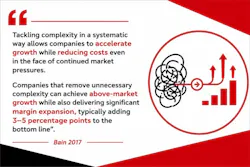
Bain has argued that companies tackling complexity systematically can achieve above-market growth while expanding margins. That is the real prize. The goal is not a smaller organization for its own sake. The goal is an organization that can move faster, make better decisions and direct more resources toward differentiated value
A Better Leadership Question
The AI conversation in the boardroom should not begin with, 'How many jobs can we remove?' It should begin with, 'Why does this work exist in the first place?' That question is more uncomfortable because it challenges years of accumulated decisions, internal politics and management habits. It is also far more valuable.
Industrial companies do not need another indiscriminate cost-cutting cycle. They need a disciplined attack on complexity. Use AI to reveal waste, simplify the operating model and strengthen the people who remain closest to customers, machines and value creation. Cut the complexity before you cut the capability.
About the Author
Stephan Liozu
Pricing Thought Leader
Stephan Liozu, Ph.D. (www.stephanliozu.com) is a Pricing & Value thought leader with 20 years’ experience in value-based pricing, pricing transformations and pricing technology. An expert in the global pricing landscape, he is the author of 17 books, including The AI Mindset Layer (2026), Organizing the Pricing Function (2025) and Value-based Pricing: 12 Lessons to Make your Transformation Successful (2024).