Everyone Has the AI Playbook. Not Everyone Can Make ‘The Odyssey'
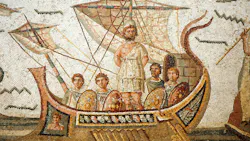
Christopher Nolan’s "The Odyssey" is an interesting business story for reasons that have little to do with Hollywood.
At a time when consumers can stream almost anything from home, Nolan continues to persuade audiences to leave the couch, buy a ticket and experience a movie in a theater. He does that while embracing choices that, viewed narrowly through an efficiency lens, can look almost irrational. He shoots extensively in IMAX, a format that brings large, noisy cameras, frequent film changes and considerable logistical complexity. He favors practical sets and effects when easier digital alternatives exist. He assembles accomplished actors, distinctive scores and enormous physical environments around a very specific creative vision.
Anyone can study those choices. Another director can use an IMAX camera. A studio can build a large set, hire recognizable actors and commission an impressive score. Artificial intelligence can increasingly analyze the formula, benchmark the approach and suggest ways to reproduce the visible pieces. Yet the ingredients alone do not produce a Christopher Nolan film.
Manufacturing leaders should pay attention. AI is making information, analysis and best practices easier than ever to access and imitate. But simply asking AI to reproduce what has worked somewhere else will not create a durable competitive advantage. The advantage increasingly lies in knowing what to do with that information, and in building the judgment, systems and execution capability required to turn it into sustained performance.
The Shrinking Half-Life of Best Practices
Consider football. Every serious team has a playbook. Teams study film, analyze competitors, practice against the offensive and defensive schemes they expect to face and use sophisticated technology to evaluate performance. Coaches move between teams, strategies spread and successful formations get copied. In many cases, the other team knows a great deal about what you intend to do before the game even begins.
Performance still varies dramatically. Give two teams the same playbook and you will not get the same result. Someone still has to execute the plays.
Business has always worked this way, but AI is speeding up how quickly knowledge spreads. A leader can now request an industry benchmark, strategic analysis, process map, KPI tree, operating model, standard work, market assessment or transformation roadmap and receive a credible answer in minutes. AI can compare approaches, customize recommendations and help build the supporting materials.
That is an enormous capability. It also shortens the time between innovation and imitation.
A visible best practice once might have differentiated a company for years. Competitors needed time to recognize the practice, understand what they were seeing, find expertise, benchmark it, translate it into their own environment and build the supporting systems. AI compresses many of those steps.
Innovation has always invited imitation. AI shortens the distance between the two. As that distance shrinks, so does the half-life of a visible best practice as a competitive differentiator. The practice may still create tremendous value, but simply possessing it becomes less distinctive when competitors can understand and reproduce the visible elements quickly.
That leaves leaders with two important questions:
- What do we currently consider a competitive advantage that AI may make much easier for competitors to copy?
- What are we building underneath those visible advantages that competitors cannot reproduce nearly as quickly?
When everyone has access to the playbook, advantage starts moving toward the capabilities that take longer to build.
The Artifact Is Not the Capability
We have spent decades benchmarking companies we admire. We study Toyota, Danaher, Amazon and other high-performing organizations, identify what they do and try to learn from it. That is useful. We should borrow good ideas. The trouble starts when we confuse the visible practice with the capability that makes the practice work.
Walk through enough plants and you will see many of the same artifacts: QDIP boards, daily management systems, kaizen events, A3s, value-stream maps and standardized work. In some companies, those systems expose problems, drive meaningful conversations and improve performance. In others, the boards are wallpaper.
We can copy the board, the template and the terminology. We can even give the whole system our own name. None of that means we know how to run it.
What matters is what happens around the artifact. Do teams solve the problems surfaced by the board? Are people held accountable for following the process? Do leaders ask questions, model the expected behavior and follow through? Do the processes ultimately produce results?
AI makes the visible pieces even easier to reproduce. It can write standard work, construct an A3, suggest countermeasures, create dashboards, develop training and package the whole system professionally. Companies may soon find it easier than ever to look well managed, while actual capability still shows up in whether people can recognize problems, think through causes, make sound decisions and execute.
The same distinction applies to technology itself. The current urgency to “do something with AI” is understandable. Boards are asking questions, competitors are experimenting and leaders do not want to be left behind. My first question would still be: What problem are we trying to solve?
What is affecting the customer? Where is work taking too long? Where are people spending time on tasks that add little value? Where could faster analysis improve a decision? What should the future-state process accomplish?
I once watched two companies implement essentially the same ERP platform. One largely adopted the standard architecture where its existing processes offered little meaningful differentiation, and the project proceeded relatively close to plan. The other customized extensively so the new system would reproduce many of the processes it was replacing. Timelines stretched, costs grew dramatically and, at one point, a significant restart became a real possibility.
Both had the same basic technology, but leaders made very different judgments about where customization created value.
That distinction will matter even more with AI. Simply having AI will not distinguish one company from another for very long. Knowing where and how to apply it may.
Nolan offers the same lesson from another angle. Other filmmakers can acquire IMAX cameras, build practical sets and hire excellent actors. His differentiation seems to come from how those choices fit together around the experience he wants to create. Competitors can copy an isolated practice. Reproducing a coherent system of capabilities is much harder.
What Does Real Capability Look Like?
AI also changes how we recognize genuine capability.
A polished strategy deck once provided at least some indication that thoughtful work had occurred behind it. A sophisticated A3 suggested that someone had worked through the logic. A professionally documented operating system implied considerable effort in its development.
Those signals are becoming less reliable. AI can create the language of leadership, generate the visual management system, produce the transformation roadmap and summarize the latest management thinking in a polished package. As the cost of producing the artifact falls, the artifact tells us less about what sits behind it.
So how do you know whether an organization can actually perform?
Walk the floor with the leader.
Watch whether operators engage with that person. See whether the leader understands the process, whether management systems are actively used and whether people surface problems openly. Listen to the questions leaders ask. Look for clear expectations and real accountability. Then compare what you observed with the operating results.
You can learn a great deal from the numbers. Then go inspect the culture firsthand. As polished outputs become easier to manufacture, behavior and sustained results become stronger signals of capability. Those are harder to fake.
AI may also widen the gap between finding an answer and building the capability to act on it. A leader can increasingly develop a credible diagnosis, benchmark, roadmap and communication plan in hours. The organization still has to understand the change, test the logic, build confidence in the direction and learn how to execute.
That work does not always accelerate at the same rate. Trust develops through experience. Capability develops through practice. Alignment develops through dialogue and shared understanding. AI can dramatically compress the time required to generate an answer, while the organization still has to build the ability to execute it.
That distinction matters because capabilities that take time to build are also harder for competitors to copy.
What Takes Time to Build Becomes More Valuable
If AI continues to make information, analysis and best practices more abundant, differentiation will increasingly reside in capabilities that cannot simply be prompted into existence.
Judgment develops through experience. Trust develops through repeated interactions. Customer understanding deepens through relationships. Problem-solving capability develops through practice. Culture develops through thousands of leadership behaviors, decisions, expectations and shared experiences. Talent develops through learning and opportunity.
All of those capabilities take time, and that should influence how we think about people.
People are expensive, which makes it important to use human capability wisely. Unsafe, painfully repetitive and low-value administrative work should be automated when possible. There is little value in assigning expensive human capability to work that requires almost no judgment, learning or adaptability.
People also have an unusual characteristic as an organizational resource: Human capability can appreciate.
People learn, gain experience, build relationships and recognize patterns. They adapt when circumstances change, connect ideas that initially appear unrelated, develop judgment and help develop it in others. Many physical assets lose value as they age. Good people can become substantially more capable.
The best organizations will use AI to change the allocation of that human capability. They will remove work that does not justify significant human effort while investing in the learning, customer interaction, problem-solving, collaboration and leadership that competitors cannot easily reproduce.
If we are going to invest heavily in talented people, the work should be worthy of that investment.
Competitive Advantage Migrates
Anyone can study Christopher Nolan and identify the cameras, practical effects, casting, music and marketing associated with his movies. Increasingly, anyone can ask AI to analyze those ingredients and suggest how to reproduce them.
The same dynamic is coming to business. Competitors can study our tools, benchmark our processes, hire consultants, buy the same software, replicate our dashboards and copy the language of our operating systems. AI will make all of that easier and shorten the time between innovation and imitation.
The implication is clear: we need to know which advantages are visible and increasingly easy to reproduce, while deliberately building capabilities underneath them that accumulate through experience and become embedded in the organization.
Judgment, customer understanding, problem-solving, trust, leadership and culture all take time to build. So does the ability to develop talented people and bring those capabilities together into sustained performance. Competitors can copy tools and practices far more quickly than they can replicate that kind of organizational depth.
AI will continue making information cheaper, analysis faster, best practices easier to find and imitation easier to accomplish. The half-life of visible advantage will continue to shrink.
Competitive advantage will migrate toward what takes time to build and discipline to execute.
The playbook is getting cheaper. Execution is not.
About the Author
 Eric Lussier
Eric Lussier
Assistant Professor of Practice, Industrial & Systems Engineering, University of Tennessee; Senior Operating Advisor, NEXT LEVEL Partners
Eric's forthcoming book is "The Lean Lens: Seeing Systems, Making Better Decisions, and Balancing People and Performance."
Eric is a hands-on practitioner of lean and operational excellence with over three decades of experience building problem-solving cultures that drive performance and value creation. He is a full-time assistant professor of practice in the Industrial & Systems Engineering Department at the Tickle College of Engineering at the University of Tennessee, where he teaches, mentors and bridges industry practice with engineering education. Eric also serves as a senior operating advisor at NEXT LEVEL Partners, where he supports business development and strategic client engagement.
Before his academic and advisory roles, Eric held executive and leadership positions across public and private equity-backed companies, applying continuous improvement principles across diverse industries to accelerate operating and financial results.
"The Lean Lens" explores how leaders can improve decision-making by learning to see systems, relationships, and organizational dynamics more clearly.
Eric holds an MS in Industrial and Systems Engineering from the University of Alabama in Huntsville, an MS in Industrial Engineering/Engineering Management from the University of Tennessee, and a BS in Industrial Engineering, also from the University of Tennessee.