Memory Chips Are in Short Supply. Why Isn't the US Ramping up Production?
Artificial intelligence data centers are popping up across the country. The AI infrastructure buildout is critical to our economy, our technological leadership and our national security, and the Trump administration is right to encourage historic investments in America’s future.
But as we build, Washington and industry need to address a fast-emerging constraint that could slow that progress and raise costs for American families: a shortage of memory chips.
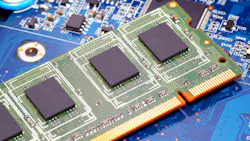
Graphics processing units (GPUs) and central processing units (CPUs) from Nvidia and other chipmakers are the central brains of an AI system. But they need to be surrounded with large volumes of memory chips to do their work. Memory chips are also used in virtually every piece of electronics, including laptops, smartphones, home routers and of course the large servers that go into AI data centers. The shortage of memory chips has emerged as the largest bottleneck for the AI buildout.
The AI boom has triggered an explosion in demand for memory chips, and in their price. According to industry publications, a basic 64 gigabyte memory pack that would have sold for $200 a year ago is getting $1,100 today, a 450% price increase in a year. Tech industry analysts expect the semiconductor industry to generate $1.3 trillion in revenue in 2026, with the memory sector accounting for as much as $800 billion, well over half of that total.
AI data center operators can absorb those prices more easily than the makers of consumer electronics and other everyday products. That is where the policy challenge comes in. America should not have to choose between the memory needed to power AI innovation and the memory needed for the devices, vehicles and services consumers depend on every day.
The answer is not to slow AI infrastructure. The answer is to expand capacity fast enough to support both.
That starts with an America-first strategy that builds more capacity here at home while working with close allies who share our security interests. The U.S. interest is in supporting the continued existence, growth and success of the four major memory chipmakers: Micron of the U.S., Samsung and SK Hynix of South Korea, and Kioxia of Japan.
Micron won $6.165 billion in support from the 2022 CHIPS Act to support building new fabs in Idaho and Clay, New York, and has since increased its investment in new and existing fabs and R&D to $200 billion. When complete, the company will be able to produce 40% of its worldwide output of DRAM memory chips in the U.S.
Meanwhile, South Korean companies are expanding rapidly in the United States. Samsung is investing $17 billion, supported by CHIPS Act funds of $6 billion, to build a new fab in Taylor, Texas. SK Hynix is investing $4 billion in a combined advanced packaging facility and R&D operation in West Lafayette, Indiana, that is projected to create over 1,000 jobs. The highest-performance memory chip, known as high-bandwidth memory or HBM, is manufactured primarily in Korea. The new Hynix facility will bring packaging of these chips, a complex, high-value operation, to Indiana.
These domestic investments are a step in the right direction, but they won’t come online immediately. These U.S. fab expansions will take years to build and operationalize, while the memory chip crisis is here now. The U.S. and its allies must come together to manage this transition. The best way to ensure continued supply while promoting further U.S. investment is to maintain access to overseas fabs of trusted partners, while capacity continues to grow domestically.
A new element in the market this time around is the entrance of two new Chinese companies, ChangXin Memory Technologies (CXMT) and Yangtze Memory Technology Company (YMTC). Both have been heavily subsidized by the Chinese government and, despite U.S. export controls on key components, have developed products that are competitive with those of the western chipmakers. Apple said recently it is considering using CXMT memory chips in the iPhones it sells in the Chinese market. It’s no surprise that Trump administration is opposed to this, seeing it as the thin end of the wedge for Chinese companies in yet another sector where China is seeking global domination.
Put simply, U.S. companies should not be using Chinese companies. In the long term, the U.S. should aim to be completely independent of Chinese chipmaking, since China has proven time and again its desire to impose its global domination on critical industries.
However, this will take time. In the short-term, the U.S. should be using infrastructure of trusted partners overseas until more capacity comes online domestically. The U.S. and its closest allies, including South Korea and Japan, need to increase memory chipmaking as rapidly as possible to meet the needs of the AI data centers, consumer electronics and other industries. Until the new U.S. fabs are open and fully operational, we will not be able to have confidence in a global chip industry that can meet the ever-growing needs of the world with a significant share of output produced in the U.S.
The good news is that China is a generation or two behind the U.S. in most forms of chipmaking. But with tens of billions of government subsidies for chips, it’s prudent to assume China will eventually catch up to the West. At the same time, the U.S. and its allies must invest, develop and expand our own chip industries, and drive technological advances relentlessly.
The goal should be clear: an America-led, allied supply chain that is strong enough to power the next generation of AI, resilient enough to reduce dependence on China, and competitive enough to keep prices in check. That is a win-win—for American leadership, American security and American consumers.
About the Author
Jeff Ferry
Jeff Ferry is chief economist emeritus at Coalition for a Prosperous America (CPA).