You're Drunk, According to AI: So That Happened
Editor’s note: Welcome to So That Happened, our editors’ takes on things going on in the manufacturing world that deserve some extra attention. This will appear regularly in the Member’s Only section of the site.

Joby Aviation to Double Monthly Air Taxi Production… to 4 Per Month
With recent investments in Ohio and California, electric air taxi manufacturer Joby Aviation plans to double its capacity for the helicopter-like vehicles – from 24 vehicles per year today to 48 by 2027.
Long timeframes and low capacity numbers like that are common in the highly regulated aerospace sector. Still, with about four seats per air taxi, we’re talking about the capacity to create space for fewer than 200 travelers (one Boeing 737 can seat 230), so it’s hard to square those numbers with the rhetoric coming out of executives.
“We are entering the next golden age of aviation,” JoeBen Bevirt, founder and CEO, Joby Aviation, said of plans to make four vehicles per month. “From factories in California and Ohio, we plan to redefine how people travel across the world.”
Bevirt praised Toyota, a company that has invested nearly $1 billion into Joby, for its guidance and support in launching its business.
Joby officials recently told investors that it has potential orders worth $1 billion for air taxis and services, and it expects further growth as the Trump administration has pushed for policy changes to support technology development. Announced in September, the Federal Aviation Administration’s eVTOL (electric vertical take off and landing) Integration Pilot Program will allow some eVTOL vehicles to begin operating in U.S. airspace in certain areas as early as next year.
—Robert Schoenberger
Upgrading Uranium Capacity in Ohio
The nuclear-energy renaissance is coming to a town near you. Utilities around the country are extending the lives of some plants or preparing to restart mothballed units, including the Duane Arnold Energy Center in Iowa and the facility former known as Three Mile Island, to feed the demand from data centers and other heavy energy users.
That means the infrastructure to support those plants also needs some TLC. In Southern Ohio, nuclear fuel supplier Centrus Energy Corp. (Ticker: LEU) is obliging with a helping hand from the U.S. Department of Energy. In late September, executives announced plans to over time add 300 operations jobs to their uranium enrichment plant in Piketon, about 90 miles east of Cincinnati. Last week, they followed up that news with word that they’re preparing to start construction on a 150,000-square-foot training, operations and maintenance center at the site of the former DOE Portsmouth Gaseous Diffusion Plant.
The new center will renovate an existing and largely vacant building on the 640-acre site starting early next year. It’ll help tee up an expansion of Maryland-based Centrus’ plans to ramp up production of enriched uranium. Just how large will that expansion be? That depends on just how much funding DOE officials steer toward Centrus.
— Geert De Lombaerde
Manufacturer Provides Holiday Helping Hand
During its annual employee appreciation event known as GRIT Day, material-handling equipment manufacturer American Crane & Equipment Corp. employees packed and donated more than 27,000 meals to support people facing food insecurity across Berks County and Schuylkill County in Pennsylvania. The meals will be distributed through Helping Harvest Fresh Food Bank.
The team-building activity was part of the company’s Hoist Up! Outreach Initiative, which encourages community engagement through volunteerism, advocacy, donations, scholarships and sponsorships. American Crane says the teamwork, service and the chance to make a difference during GRIT Day reflect the company’s workplace culture.
"We are immensely proud of our employees' dedication and impact they have made at GRIT Day," says Jeff Griesemer, president of American Crane. "This initiative is a powerful reflection of our values and our ongoing commitment to making a positive difference in the communities we live in."
—Anna Smith
Kraft Heinz Names New CEO in Advance of Split Into Two Companies
Can you specialize in splitting food companies into bite-sized pieces?
Steve Cahillane is back in a familiar role. On Dec. 16, the Kraft Heinz Co. tapped Cahillane as its next CEO, effective Jan. 1, in advance of the food manufacturer’s split into two separate, independently traded companies.
Cahillane was most recently CEO of Kellanova. Kellanova, if you remember, was one of two companies spun out from Kellogg Co. in 2023, the other being WK Kellogg Co. Cahillane ushered through that separation as Kellogg CEO and remained as the leader of Kellanova until recently, when it was acquired by Mars Inc.
Now it seems he’ll do the same at Kraft Heinz, which announced its decision to split up in September. That deal is expected to close in the second half of 2026. Upon completion, Cahillane will serve as CEO of Global Taste Elevation Co., the current but perhaps temporary name of one of the stand-alone companies. Its roster will include Heinz and Kraft Mac & Cheese, among others. The other company, for now called North American Grocery Co., will include brands such as Oscar Mayer and Lunchables.
It's not yet known who will lead North American Grocery Co. Carlos Abrams-Rivera, CEO of Kraft Heinz had been identified for this role back in September. However, Tuesday’s announcement introducing Cahillane also reported that Abrams-Rivera would serve as an advisor through March 6, while the board of directors initiated a CEO search for North American Grocery Co.
—Jill Jusko
Does the AI Drunk Driver Detector Take Your Keys, Too?
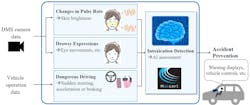
Mitsubishi Electric yesterday announced new technology based on its Maisart2 AI platform that can detect a drunk driver behind the wheel. The system looks at driver monitoring system (DMS) data like pulse-rate and eye-movement information, and steering and acceleration inputs to make the determination that a driver is intoxicated.
The system, according to the statement from Mitsubishi Electric, then issues driver alerts and vehicle-control interventions to intervene as needed.
“Vehicle-control interventions.” That feels like that needs clarification, doesn’t it?
If you have a few free hours, we could discuss everything that could possibly go wrong with AI that tries to change how a vehicle functions based on whether the AI thinks the driver is under the influence.
“Even if alcohol-induced facial changes are subtle, variations in pulse rate caused by drinking can be used to detect intoxication with high accuracy,” reads the statement and, oh boy, when the word “subtle” gets introduced in conversations about AI registering and correcting for human behavior, we better hope Mitsubishi Electric does a lot, lot, lot of testing before trying this system in the wild.
—Dennis Scimeca
About the Author
 Robert Schoenberger
Robert Schoenberger
Robert Schoenberger was chief editor of IndustryWeek from 2021-2026, and has been writing about manufacturing technology in one form or another since the late 1990s. He began his career in newspapers in South Texas and has worked for The Clarion-Ledger in Jackson, Mississippi; The Courier-Journal in Louisville, Kentucky; and The Plain Dealer in Cleveland where he spent more than six years as the automotive reporter. In 2014, he launched Today's Motor Vehicles (now EV Manufacturing & Design), a magazine focusing on design and manufacturing topics within the automotive and commercial truck worlds. He joined IndustryWeek in late 2021.
Geert De Lombaerde
Senior Editor
A native of Belgium, Geert De Lombaerde has been in business journalism since the mid-1990s and writes about public companies, markets and economic trends for Endeavor Business Media publications, focusing on IndustryWeek, FleetOwner, Oil & Gas Journal, T&D World and Healthcare Innovation. He also curates the twice-monthly Market Moves Strategy newsletter that showcases Endeavor stories on strategy, leadership and investment and contributes to other Market Moves newsletters.
With a degree in journalism from the University of Missouri, he began his reporting career at the Business Courier in Cincinnati in 1997, initially covering retail and the courts before shifting to banking, insurance and investing. He later was managing editor and editor of the Nashville Business Journal before being named editor of the Nashville Post in early 2008. He led a team that helped grow the Post's online traffic more than fivefold before joining Endeavor in September 2021.
 Anna Smith
Anna Smith
Senior Staff Writer
Senior Staff Writer
LinkedIn: https://www.linkedin.com/in/anna-m-smith/
Bio: Anna Smith joined IndustryWeek in 2021. She handles breaking news of interest to the manufacturing industry and the cross-publication newsletter Quick Manufacturing News. Anna was previously an editorial assistant at New Equipment Digest, Material Handling & Logistics and other publications.
 Jill Jusko
Jill Jusko
Bio: Jill Jusko is executive editor for IndustryWeek. She has been writing about manufacturing operations leadership for more than 20 years. Her coverage spotlights companies that are in pursuit of world-class results in quality, productivity, cost and other benchmarks by implementing the latest continuous improvement and lean/Six-Sigma strategies. Jill also coordinates IndustryWeek’s Best Plants Awards Program, which annually salutes the leading manufacturing facilities in North America.
Have a story idea? Send it to [email protected].
 Dennis Scimeca
Dennis Scimeca
Dennis Scimeca is a veteran technology journalist with particular experience in vision system technology, machine learning/artificial intelligence, and augmented/mixed/virtual reality (XR), with bylines in consumer, developer, and B2B outlets.
At IndustryWeek, he covers the competitive advantages gained by manufacturers that deploy proven technologies. If you would like to share your story with IndustryWeek, please contact Dennis at [email protected].