Fed Investigates UAW's Fain; Spot Aims to Deliver: So That Happened
Editor’s note: Welcome to So That Happened, our editors’ takes on things going on in the manufacturing world that deserve some extra attention. This will appear regularly in the Member’s Only section of the site.
UAW’s Fain Faces Federal Investigation
The U.S. Department of Justice has launched a grand jury investigation into allegations that United Auto Workers President Shawn Fain misused his position to seek benefits for his fiancée and her sister, according to several outlets, including Bloomberg Law and Reuters.
The allegations, outlined in a status report by the union’s court-appointed monitor Neil Barofsky, claim that Fain attempted to secure a financial bonus for his fiancée and sought to intervene in a workers’ compensation claim involving her sister. The allegations also include the claim that Fain retaliated against UAW Vice President Rich Boyer for refusing to approve the benefits by removing Boyer from his role overseeing Stellantis negotiations.
Fain and Boyer are among the candidates for the UAW presidential election later this year, with Fain seeking a second term. In a statement to Bloomberg, Fain denied the allegations and accused Boyer of attempting to use them to influence the upcoming election.
In a statement, Fain claimed the monitor’s report was politically motivated, saying, “Neil Barofsky has a political grudge against me because the UAW took an anti-war stance about what was happening in Gaza.”
Bloomberg Law reports that an attorney with a law firm that represents the UAW stated that the union itself is not the subject of the grand jury investigation.
—Anna Smith
Spot Isn’t Just for Factories Anymore
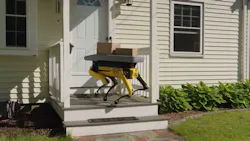
Boston Dynamics is testing its quadruped robot, Spot, as a “last-mile delivery solution” to bridge the “porch gap.”
In other words, they’re testing using Spot to get the package out of the truck and walk it up to the recipient’s front door.
We here at IW usually cover Spot as a remote monitoring tool, one of the most popular industrial applications for the robot. Why send someone walking around the plant reading gauges if you can have a robot with a camera do it for you?
Boston Dynamics likes to tour Spot’s customization options and wide utility. So, here we go. Maybe Spot will ring your doorbell sometime soon and ask in a synthesized voice for you to sign for the package.
— Dennis Scimeca
Amazon Buying More Batteries for Material Handling Gear
In a world of rapidly growing automation, it pays to keep your friends close and your battery suppliers closer.
That’s the message from Amazon Inc., which has expanded its partnership with lithium-ion battery maker Electrovaya Inc. On July 15, leaders of the latter said they’ll ramp up work with the retail and technology giant, which already is the company’s largest customer. The companies’ new deal calls for more batteries to power electric forklifts and material handling fleet across Amazon’s warehouse network while also setting the stage for Electrovaya to help power Amazon’s push into the energy-storage and robotics spaces.
Financially, the multi-year deal is a big shot in the arm for Electrovaya, which is based near Toronto and has a manufacturing plant in Jamestown, New York. The company’s 2026 revenues are on pace to hit around $83 million (up from $64 million last year) but Amazon has committed to buy up to $280 million in batteries.
In addition to meeting its operational goals, the Amazon team also has a financial incentive to make the deal work as well as possible: Should the company spend that $280 million, warrants to buy nearly 14 million Electrovaya shares will fully vest. Those warrants have an exercise price of $8.56 and are already nicely in the green: Shares of Electrovaya (Ticker: ELVA) were up more than 40% to $11 and change shortly after the news was announced.
— Geert De Lombaerde
'Cast In Steel' Manufacturing Reality Show Launches On YouTube
If you're tired of reality shows that focus on dating or survival, there's a new series in town that might be for you.
The show is "Cast in Steel," named after the national competition that challenges university teams to design, cast, and test a fully functional metal tool or weapon that is crafted entirely from scratch. The competition has been hosted by the Steel Founders’ Society of America (SFSA) every year since 2019, and it brings together students, faculty, and industry professionals to celebrate the art and science of metal casting.
The competition culminates in a live, high-energy showdown, similar to BattleBots, where the university teams put their cast creations to the test in a series of physical and performance challenges. (Unlike BattleBots, there are no head-to-head battles, which is probably a good idea when it comes to a weapons-casting competition.)
The first episode of Cast In Steel premiered last week on YouTube, and this year's series showcases the 2025 competition where teams of engineers did their best to replicate a sword owned by President George Washington. Previous competitions have included replicating items such as Thor's hammer, Viking axes, and a Bowie knife. The 2026 competition, focusing on manufacturing a horseman's axe, was won by the Mad Badger MetalCasters team at the University of Wisconsin - Madison.
There will be five episodes in the 2025 TV season, dropping one per week until the finale on August 6.
Watch Episode 1 here:
—Thomas Wilk
How Is Your Plant Dealing With Rising Temperatures?
A neighbor works third shift in the mixing room of a large paint manufacturing facility. The facility dates to the early 1900s and lacks air conditioning in the manufacturing areas, a phenomenon I’ve come upon at older plants of manufacturers large and small.
At night, temperatures in his workplace have hit 113 degrees in the past week. At least three co-workers in his area have required medical attention from heat exhaustion during that time. The mixing equipment is temperature controlled, but not the plant floor.
The solution? Right now, it’s 20-minute breaks after an hour of work in the heat, negotiated by the union (the company initially offered 10-minute breaks). Each employee is allocated four bottles of Gatorade per shift.
Data collected on air conditioning in U.S. manufacturing facilities is hard to come by. Outdoor workers who face different and often more intense exposure from the elements tend to be the focus.
A report from the AFL-CIO, using OSHA data, estimated that in 2024 530 U.S. workers in the died from heat on the job, with about 1/7 of those being industrial workers. It also noted the numbers were likely underreported, with symptoms being attributed to other conditions like heart attacks.
I’m interested in hearing from manufacturing leaders on what you are doing to address the problem of rising temperatures in the workplace. Have you added air conditioning to your manufacturing facility recently, or is financing such an improvement part of your planning? Are there grants available that you’ve tapped into? What other measures have you (whether you’re an executive, a safety leader or a line worker with initiative) taken to deal with extreme heat?
And, plant-floor employees, I’d like to hear your perspective on working conditions in the heat.
Email me at [email protected]. I won’t identify you in any way unless you give me the OK.—Laura Putre
What Good Is an MES If You Don’t Actually Use It?
Rockwell Automation and Plex released on July 15 a new report titled “Scaling MES Across the Enterprise” that states 93% of manufacturers have a manufacturing execution system (MES) in place but only 23% say their MES is fully integrated across their operations, integrated with enterprise resource management (ERP), product lifestyle management (PLM), quality and OT systems.
Half of the respondents reported scaling MES across multiple locations with standardization while 33% cited MES as a top data integration challenge.
The report also delves into operational readiness for AI, and the news isn’t good. By 2030 more than half of all manufacturing processes will be supported by AI but only 43% of manufacturers effectively use their data, according to the report.
Manufacturers that do have a handle on their data use for it for AI and machine learning (38%), quality (36%) and process optimization (35%).
If you’d like to read the full report, you can download it here.
— Dennis Scimeca
About the Author
 Laura Putre
Laura Putre
Senior Editor, IndustryWeek
As senior editor, Laura Putre works with IndustryWeek's editorial contributors and reports on leadership and the automotive industry as they relate to manufacturing. She joined IndustryWeek in 2015 as a staff writer covering workforce issues.
Prior to IndustryWeek, Laura reported on the healthcare industry and covered local news. She was the editor of the Chicago Journal and a staff writer for Cleveland Scene. Her national bylines include The Guardian, Slate, Pacific-Standard and The Root.
Laura was a National Press Foundation fellow in 2022.
Got a story idea? Reach out to Laura at [email protected]
 Anna Smith
Anna Smith
Senior Staff Writer
Senior Staff Writer
LinkedIn: https://www.linkedin.com/in/anna-m-smith/
Bio: Anna Smith joined IndustryWeek in 2021. She handles breaking news of interest to the manufacturing industry and the cross-publication newsletter Quick Manufacturing News. Anna was previously an editorial assistant at New Equipment Digest, Material Handling & Logistics and other publications.
Thomas Wilk
Editor-in-Chief
LinkedIn: linkedin.com/in/wilkt
Bio: Thomas Wilk joined IndustryWeek as editor in chief in May 2026, following nearly 12 years as chief editor for Plant Services. Previously, Wilk was content strategist / mobile media manager at Panduit. Prior to Panduit, Tom was lead editor for Battelle Memorial Institute's Environmental Restoration team, and taught business and technical writing at Ohio State University for eight years. Tom holds a BA from the University of Illinois and an MA from Ohio State University.
Geert De Lombaerde
Senior Editor
A native of Belgium, Geert De Lombaerde has been in business journalism since the mid-1990s and writes about public companies, markets and economic trends for Endeavor Business Media publications, focusing on IndustryWeek, FleetOwner, Oil & Gas Journal, T&D World and Healthcare Innovation. He also curates the twice-monthly Market Moves Strategy newsletter that showcases Endeavor stories on strategy, leadership and investment and contributes to other Market Moves newsletters.
With a degree in journalism from the University of Missouri, he began his reporting career at the Business Courier in Cincinnati in 1997, initially covering retail and the courts before shifting to banking, insurance and investing. He later was managing editor and editor of the Nashville Business Journal before being named editor of the Nashville Post in early 2008. He led a team that helped grow the Post's online traffic more than fivefold before joining Endeavor in September 2021.
 Dennis Scimeca
Dennis Scimeca
Dennis Scimeca is a veteran technology journalist with particular experience in vision system technology, machine learning/artificial intelligence, and augmented/mixed/virtual reality (XR), with bylines in consumer, developer, and B2B outlets.
At IndustryWeek, he covers the competitive advantages gained by manufacturers that deploy proven technologies. If you would like to share your story with IndustryWeek, please contact Dennis at [email protected].