
Civil Reserve Manufacturing Network Wants You; Where the Robots Reside: So That Happened
Editor’s note: Welcome to So That Happened, our editors’ takes on things going on in the manufacturing world that deserve some extra attention. This will appear regularly in the Member’s Only section of the site.
Who Had the Most Industrial Robots in 2025?
The Brazilian robotics market saw a 38% increase in industrial robot installations for a total of almost 4,300 units sold, according to The International Federation of Robotics (IFR) and its World Robotics 2026 Report released in late September.
The report suggests that investment from Chinese car manufacturers likely drove the uptick.
Last year saw a record-setting 5 million industrial robots in global operation, driven by an 11% jump in annual installations.
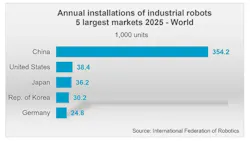
China, named by the report as the world leader in robot adoption, saw year-on-year robot installations grow by 20%, for a total of 354,000 robots installed in Chinese plants last year.
Japan experienced a 19% decrease in installations for around 36,000 units total. Korea installed 30,000 robots last year and India installed almost 10,500.
The United States installed 38,500 units last year. Mexico saw only 5,200 robots installed.
In Europe, robot sales fell 8% for fewer than 25,000 units sold.
- Germany accounted for 41% of total installations in 2025.
- Italy came in second with 7,800 installations, an 11% drop.
- France took third with 4,500 installations, an 8% drop.
Even with some negative numbers last year the IFR predicts a 9% increase in global industrial robot installations this year, for a total of 655,000 units sold.
Head over to the IFR website to read the entire report.
— Dennis Scimeca
New Civil Reserve Manufacturing Network Seeks to Expand Peacetime US Defense Manufacturing Capacity
A few weeks ago at the IMTS trade show in Chicago, I attended a learning session that was a real eye-opener.
For context: Much of the conversation at the show centered on defense contract work that manufacturers were picking up in the past 18 months. For example, one major manufacturer who had contracted to make parts for military drones made it a point to mention 2026 was a year spent working on how to reduce delivery times by locating their production facilities closer to the final delivery site. In another session, where panelists were asked what they were proud to have worked on recently, one panelist shared the work she had done on designing and producing shell casings for the military.
So when someone pointed out a session to me titled “Civil Reserve Manufacturing Network (CRMN) Information Session 1, 2, and 3,” I immediately added it to my schedule. Turns out it was the same session repeated three times over several days, organized by the CRMN and designed to be a series of roundtable discussions with manufacturers (Tier 1, 2, and 3) on how best to tap into unused production capacity in U.S. factories.
This program is different from mechanisms that have been built under the Defense Production Act of 1950, which would help identify production capacity under a wartime footing. This new program was created last December under Section 1841 of FY26 National Defense Authorization Act, and is intended to mobilize the commercial industrial base in the U.S. to provide distributed, on-demand manufacturing capacity.
To quote from the CRMN’s website: “This initiative is built specifically for commercial manufacturers. Rather than relying solely on traditional defense primes, the [DoD] is treating ‘the factory as the weapon’ and partnering with the commercial sector to identify manufacturing capability and capacity relevant to defense demands. We want to partner with patriotic business who are willing to say, ‘I will convert my production capacity for defense needs and support the warfighter when called to do so.’ The Network will also include existing defense businesses that have existing capacity currently used for other purposes that can be converted to defense production.”
The roundtable was led by Amanda Hawkins, CRMN Senior Advisor for Industrial Mobilization, and was about 20% informational about the new Network and about 80% roundtable discussion, as manufacturers shared their thoughts on how best to report extra capacity as well as how to organize manufacturers who volunteer to be part of the CRMN program. Her presentation slides further clarified that "CRMN is designed as a contingency plan for expanding defense production when national security needs exceed existing capacity."
Any organization that is interested can visit the CRMN website or register their interest directly on the CRMN Interest Pathway deployed via lynxconnect.io.
— Thomas Wilk
Training for Tomorrow: DOL Invests $43 Million in Skilled Workers
The U.S. Department of Labor (DOL) on Sept. 30 announced $43 million in awards through the second round of Industry-Driven Skills Training Fund grants administered by the DOL’s Employment and Training Administration. The funds will support employer-driven skills training programs for current employees and newly hired workers in manufacturing, shipbuilding, aerospace, construction and other industries poised for growth.
"As we continue to see growth in the construction and manufacturing sectors, these grants ensure that American workers have the skills necessary to fill the high-skilled and high-paying jobs that are driving our nation into a new era of industrial might,” says Secretary of Labor Keith Sonderling.
Seven states have been named as recipients of the second round of grants: Colorado, Indiana, Montana, Nebraska, Oregon, Pennsylvania and Washington.
The first round of grants, awarded in September 2025, provided over $86 million to 14 states for skills training in emerging and in-demand industries.
— Anna Smith
Cat Commits to Compact Growth
We all like to spotlight giant manufacturing expansion plans and the knock-on investments (we hope) they spur in communities around the country. Executives of equipment giant Caterpillar last week reiterated they’re also paying close attention to smaller-scale work that’s often handled by smaller firms.
Caterpillar, which is now headquartered in Irving, Texas, said it will spend about $1 billion in the near future to expand its Cat Compact business, which focuses on smaller loaders and telehandlers used in construction, landscaping, infrastructure work, and more. The centerpiece of this initiative is a new plant in Sanford, North Carolina, that will feature lots of automation and digital systems and include an integrated logistics department.
“As demand for compact equipment continues to increase, we’re investing to better serve this growing segment of customers,” Rod Shurman, president of Caterpillar Construction Industries Group, said in a statement. “This investment is another way we are solving our customers’ toughest challenges by expanding access to the products, solutions and services they need to work more efficiently.”
Cat’s broader Construction Industries division rang up $25.1 billion in revenue last year and has more than 700,000 customers across the globe. Shurman and his team early this year launched the Cat Compact brand aimed at small contractors with the promise of better connecting online research on small equipment with dedicated dealership sites.
“There were some parts of the construction industry that, frankly, we were maybe not paying as close attention to or underserving or our strategy maybe wasn't lined up to meet those customer needs,” Chairman and CEO Joe Creed said last month during an investor day where he specifically mentioned Cat Compact. “We’re really excited about being a little more retail-friendly for that small customer who owns one or two pieces of equipment and buys every few years. It’s a very fast-growing part of the construction industry for us.”
— Geert De Lombaerde
New Year Welcomes New CEO at General Mills
A new but familiar name will be at the helm of General Mills Inc. come Jan.1, 2027. The food giant announced last week that Dana McNabb will be stepping into the role of chief executive officer in January, succeeding Jeff Harmening, who will become executive chair of the board of directors.
McNabb’s face is a familiar one. Currently serving as chief operating officer, her time at the Minneapolis-based manufacturer spans 27 years in multiple senior leadership roles.
“Following a robust, multi-year succession planning process, the board is confident that Dana is the right executive to lead the company through its next chapter of growth and value creation,” said Maria Henry, the board’s independent lead director, in a statement.
Harmening, a 30-year veteran of General Mills, has been CEO since 2017.
General Mills, whose brands include well-known names such as Cheerios, Nature Valley, and Totino’s, had fiscal 2026 net sales of $18 billion. Last month it reported fiscal 2027 Q1 net sales of $4.4 billion, down 3% over the same period a year earlier, and pointed to the divestiture of its U.S. yogurt business as the reason for the decline.
—Jill Jusko
About the Author
 Dennis Scimeca
Dennis Scimeca
Dennis Scimeca is a veteran technology journalist with particular experience in vision system technology, machine learning/artificial intelligence, and augmented/mixed/virtual reality (XR), with bylines in consumer, developer, and B2B outlets.
At IndustryWeek, he covers the competitive advantages gained by manufacturers that deploy proven technologies. If you would like to share your story with IndustryWeek, please contact Dennis at [email protected].
Geert De Lombaerde
Senior Editor
A native of Belgium, Geert De Lombaerde has been in business journalism since the mid-1990s and writes about public companies, markets and economic trends for Endeavor Business Media publications, focusing on IndustryWeek, FleetOwner, Oil & Gas Journal, T&D World and Healthcare Innovation. He also curates the twice-monthly Market Moves Strategy newsletter that showcases Endeavor stories on strategy, leadership and investment and contributes to other Market Moves newsletters.
With a degree in journalism from the University of Missouri, he began his reporting career at the Business Courier in Cincinnati in 1997, initially covering retail and the courts before shifting to banking, insurance and investing. He later was managing editor and editor of the Nashville Business Journal before being named editor of the Nashville Post in early 2008. He led a team that helped grow the Post's online traffic more than fivefold before joining Endeavor in September 2021.
Thomas Wilk
Editor-in-Chief
LinkedIn: linkedin.com/in/wilkt
Bio: Thomas Wilk joined IndustryWeek as editor in chief in May 2026, following nearly 12 years as chief editor for Plant Services. Previously, Wilk was content strategist / mobile media manager at Panduit. Prior to Panduit, Tom was lead editor for Battelle Memorial Institute's Environmental Restoration team, and taught business and technical writing at Ohio State University for eight years. Tom holds a BA from the University of Illinois and an MA from Ohio State University.
 Jill Jusko
Jill Jusko
Bio: Jill Jusko is executive editor for IndustryWeek. She has been writing about manufacturing operations leadership for more than 20 years. Her coverage spotlights companies that are in pursuit of world-class results in quality, productivity, cost and other benchmarks by implementing the latest continuous improvement and lean/Six-Sigma strategies. Jill also coordinates IndustryWeek’s Best Plants Awards Program, which annually salutes the leading manufacturing facilities in North America.
Have a story idea? Send it to [email protected].
 Anna Smith
Anna Smith
Senior Staff Writer
Senior Staff Writer
LinkedIn: https://www.linkedin.com/in/anna-m-smith/
Bio: Anna Smith joined IndustryWeek in 2021. She handles breaking news of interest to the manufacturing industry and the cross-publication newsletter Quick Manufacturing News. Anna was previously an editorial assistant at New Equipment Digest, Material Handling & Logistics and other publications.