2026 IndustryWeek Best Plants: L.B. Foster Burnaby Is a Small Plant Punching Above Its Weight
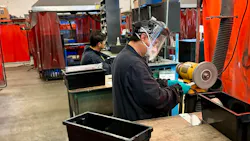
At L.B. Foster Rail Technologies in Burnaby, British Columbia, the path between the research lab and the production floor is actually a bustling mini-highway for questions to find answers, ideas to crosspollinate and specialized knowledge to be brought in to problem-solve.
Workers at the plant, which is located about 20 miles outside of Vancouver, Canada, near the international ports of Vancouver and Seattle, walk the path often. They understand the importance of reaching out to their colleagues in other departments to innovate and solve problems, and, more importantly, are comfortable doing so.
A culture of innovation and collaboration among Burnaby’s staff of 39 leads to results enviable at much larger manufacturing facilities. Burnaby’s operation, which manufactures lubricants, application hardware and friction management products for rail customers around the world, is itself a well-oiled machine. Its commitment to lean excellence at all levels has made L.B. Foster Burnaby a 2026 IndustryWeek Best Plants winner.
About the Plant
L.B. Foster Co., headquartered in Pittsburgh, is an international manufacturer of products for the rail and infrastructure industries. The company’s Burnaby plant is focused on manufacturing solid-stick thermoset products for use in rotational steel-on-steel motion to create or reduce friction, depending on the job, using hardware also manufactured at Burnaby. Customers include major metro transit systems all over the world and large freight systems in North America, Asia, Europe, South America, Australia and New Zealand. Each customer needs products of different viscosity, form, shape and temperature.
L.B. Foster Burnaby
Vancouver, British Columbia, Canada
Employees: 39 (7 production)
Total Square Footage: 45,000 square feet
Primary Product: Steel-on-steel friction control technology
Start-up Date: 1994
Achievements: ISO 14001, ISO 45001, ISO 9001 certified. IndustryWeek Best Plant in 2014. L.B. Foster corporate Best Plant seven times in the past 10 years.
Burnaby is a workhorse plant in L.B. Foster’s global operations, receiving the company’s internal Best Plant award seven times in the past 10 years, and is considered a model of continuous improvement enterprise-wide. In addition to its demanding daily production schedule, the Vancouver team fabricates custom test equipment not only for its own plant, but other plants in the company, including wheel sensor testing equipment, spray testing apparatus, grease and bar testing and twin disc stick applicators to verify new lubricants.
Looking at L.B. Foster Burnaby’s numbers is one way to tell the excellence story. Plant volume has increased 20% in the past three years with a small reduction in staff due to attrition, while profitability (EBIT) has increased 18.57%. Orders are delivered 98% on time, with an average lead time of two to three days, reduced 10% in the past three years. Average machine availability rate clocks in at 99%, with an overall equipment effectiveness rate of 85.7%.
But what really makes this plant punch above its weight is an organizational structure that encourages regular interaction between people of different areas of expertise and a culture that bakes continuous improvement into the daily routine. Cross-trained production workers are accustomed to traveling between stations, jumping in where needed and anticipating their next task. Though his home base is in the research lab, Engineering Lead Darren Loo does a daily gemba walk in production.
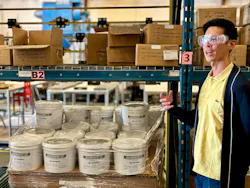
“Every morning, I’ll make a point to start my day meeting up with Nigel [Plant Manager Nigel Davis] and doing a walk, just talking about some of the things that we might need to work on,” he says. “I find that’s something that’s really helpful, just to have that quick catch-up in the morning.”
On Thursdays, Loo comes in early to join the production team on their daily stretching exercises led by Production Manager Christian Apanay. “Part of it is to get the stretches. Part of it is to participate in Nigel’s daily huddle,” acknowledges Loo, who started at a co-op at Burnaby and returned after graduation. “We encourage a lot of face-to-face communication, especially when you’re doing this sort of custom design work, because you can show each other physical products or photos or models. And it gives you a lot more efficiency and effectiveness in being able to provide constructive criteria when you’re doing the design.”
Early in the COVID pandemic, the five-person engineering team was on site every day, working with the production team. “Part of that was because of the value that it brings to have that in-person interaction with each other,” says Loo. “We can do design work on the computer at home, but it only provides so much value, right?”
Visual Clarity
Because Burnaby’s workforce is multilingual and English is a second language for many employees, visual displays throughout the plant are especially clear and immediate: from color-coded charts showing progression toward production goals, to the magnetized shipping board with a laminated truck cutout for each carrier plotted out on its journey, to the training board that shows every employee’s picture and notes their progress and where they’re headed next.
Sometimes a very literal 3D display gets the message across best: a mannequin dressed in safety gear, repurposed from a local Sears department store that closed, holds a screen with the number of days without a safety incident: 1,136. A red-dot sticker on the mannequin’s finger shows the location of the injury. Tap the screen and you can see details of the incident.
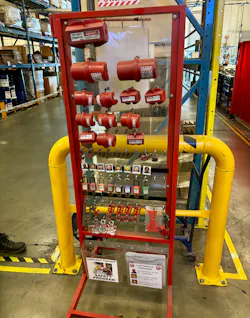
Clarity and organization are also essential because there is so much to keep track of. L.B. Foster Burnaby manufactures over 400 bracket designs and nearly 800 designs and configurations of applicators, plus the lubricants themselves.
Since no two rail systems are the same, the engineering team and two lab chemists, including Formulations Leader Aryan Houshmand, work closely with customers and production to bring new products online that fit with clients’ specs. During a plant visit in August, the team met with representatives from Dehli Metro in India to develop a new formulation of solid-stick applicator.
“The chemistry group is always conducting R&D work to see how they can innovate and create new formulations,” using materials that are cheaper without sacrificing quality, longer-lasting, more effective at retaining magnetism or some combination of the three, says Loo.
On the hardware side, no two train systems are alike, so the brackets and applicators are bespoke depending on the customer.
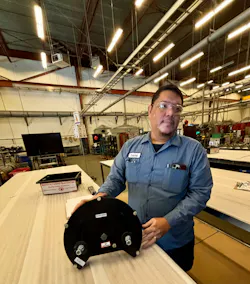
Working with a train system in Australia required the Burnaby team to design entirely new rounded hardware to fit larger quantities of solid-stick lubricant for long journeys without maintenance. They are engineered using stronger steel to withstand extreme weather. “These are the big boys,” says Davis, holding up an applicator wheel. “Those trains are out of service for quite a while, out on the tracks. They need 800 millimeters worth of lubrication, and you can’t get that size applicator under the train. So we made a circular applicator, with eight sticks that interlock into there.”
The Burnaby team also develops products for a robust list of adjacent markets: torpedo cars that move molten metal in steel mills, roller coasters, port cranes, stadium roofs, industrial telescopes, trunnions (pivots on rotating drums). “Any sort of rotational steel-on-steel contact is where our product can help,” says Loo.
“The Burnaby engineering group, we’re a little bit unique in the sense that we act almost like a consulting body, instead of just pure engineering,” adds Loo. “We work closely with different potential customers looking for custom solutions for all types of products.”
Sustainability Is Part of Doing Business
Tour the plant, and Davis will point out specialized equipment in every work area that he and his team have built, with engineering and verification assistance from Loo. Sometimes the parts are recycled from other equipment, in keeping with Burnaby’s commitment to recycle 100% of plant waste, “from stainless steel to soda bottles.” But it’s not just a fun exercise. For customers in Europe and the UK, the team has to trace their use of raw material, packaged material, water used in manufacturing, what forests they cut from and where they recycle. “If we tender for new contracts, especially in Europe, they start asking those questions, and then we’ve got all the proof,” says Davis.
The team is always on the lookout for creative ways to recycle. For instance, the timber packing frames that transport fluid bags are reused as dunnage to secure shipping containers. “It’s all heat-treated, so it’s allowed anywhere in the world,” Davis says of the timber.
The plant’s commitment to sustainability has brought in customers who need to meet rigorous environmental requirements. Of special interest are solid sticks made from biodegradable materials, a product now in development in Burnaby’s lab. Being thermoplastic, rather than thermoset, the product will require injection molding and new processes in the plant, which are integrated into the design and planning.
“Collaboration with the production team is quite important because from an engineering perspective, you can design anything you want on 3D CAD software,” says Loo. “While maybe you have cost considerations to consider, manufacturing constraints, welding criteria. And so being able to work with Nigel gives us that opportunity to be able to optimize all those things and make sure that we’ve got the best-designed custom product.”
Innovating New Equipment
To test temperature ranges of products and materials in-house, Davis fashioned a scaled -down cold chamber by outfitting a recycled grease machine tank with a pump and motor unit that they use on one of their products, then installing the assembly inside a small medical freezer.
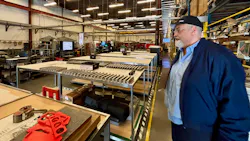
To build a pump used to distribute grease, the team repurposed parts from an out-of-service hydraulic injection pump originally used to pump product into solid-stick applicators.
The team’s adaptability and creative thinking are helped by their past experience. Two production workers originally from the Philippines have ship maintenance experience. Their mechanical knowledge translated well to production roles at Burnaby. “Most of our guys, we retrain them all internally,” Davis adds.
A native of Zimbabwe, Davis earned United Kingdom certification in four trades—metal fabricator, construction boiler maker, millwright and welder. There, he worked in a civil and structural engineering company, in machine maintenance for a tobacco processor and built machinery to process and blend sugar cane and gasoline into ethanol. He earned recertification for his skills after he immigrated to Canada.
Recently, the plant’s general manager, John Cotter (who retired in June), challenged the team to make a low-cost lubrication stick for the freight industry. The results were a true cross-functional effort. Production worker Joemar Fortaleza suggested using coffee grinders to grind down leftover material from other solid-stick products. To try out the idea, Davis’s team procured a few used coffee grinders off Facebook Marketplace and milled the material back into powder form. They then developed trial batches of different ratios of reclaimed material and new lubricant in liquid form, casting them into molds to make prototypes to hand off to R&D.
After Houshmand conducted performance validation testing showing the recycled material met performance requirements, the lab took over development and commercialization. The first order produced from the coffee-grinder project was shipped in January and in the first four months netted more than $100,000 Canadian.
A fertile culture of innovation and collaboration at L.B. Foster Burnaby leads to outstanding results from a small but optimized workforce. Production workers are partners not just in making sure a quality product gets out the door safely and on time, but also in creating new products, finding new ways to reduce waste and recycle materials, engineering better processes and building custom equipment in-house.
“It’s quite fast-paced,” says Loo. “You might be working on multiple different projects with different customers at the same time. In addition to the custom nature of it, it makes things a lot less repetitive. There’s always new challenges, and I think that makes the work here a lot fresher.”
About the Author
 Laura Putre
Senior Editor, IndustryWeek
As senior editor, Laura Putre works with IndustryWeek's editorial contributors and reports on leadership and the automotive industry as they relate to manufacturing. She joined IndustryWeek in 2015 as a staff writer covering workforce issues.
Prior to IndustryWeek, Laura reported on the healthcare industry and covered local news. She was the editor of the Chicago Journal and a staff writer for Cleveland Scene. Her national bylines include The Guardian, Slate, Pacific-Standard and The Root.
Laura was a National Press Foundation fellow in 2022.
Got a story idea? Reach out to Laura at [email protected]