How Manufacturing Lighter and More Durable Building Materials Translates into Better Climate Outcomes
Key Highlights
- Today, sustainability and climate outcomes are front-of-mind for many property owners, investors, insurers and regulators — and builders are making changes at both the process and the product level to respond.
- Fortunately, advancements in materials science and manufacturing technology have enabled the climate advantages of lightweight products without sacrificing durability.
- Product weight, and the ripple effects it has on energy consumption during transportation, is one of the single biggest factors lowering greenhouse gas emissions in the construction supply chain.
Several decades ago, USG Corporation pioneered the manufacturing of a revolutionary new drywall product: lightweight wallboard.
This was not simply innovation for the sake of innovation; this was a manufacturer deeply in tune with the needs of the market and its customers and developing a novel product in-house to meet those needs. USG has always held product advancement as a key pillar of its strategy.
But the demands and needs of builders, and the crews installing and finishing the drywall, have shifted over the past decades. Today, sustainability and climate outcomes are front-of-mind for many property owners, investors, insurers and regulators — and builders are making changes at both the process and the product level to respond. Building more sustainably is a joint effort and building materials manufacturers have a crucial role to play.
How USG Approaches the Challenge
As North America’s leading building materials manufacturer, USG has nearly 50 facilities across the United States that translate raw materials like gypsum rock into finished building products like wallboard, ceiling tiles, roofing board and much more. Over its nearly 125-year history, product innovation has been a continuous focus.
Today, that focus is driven by its Corporate Innovation Centre (CIC) in Chicagoland: an industry-leading R&D lab where product formulators conceive of new ways to make simple building products, such as drywall, more fireproof, water-resistant, durable, sound-proof, sustainable and lighter.
The latest innovation to emerge from the CIC recently hit the market: USG Sheetrock® Brand UltraLight Tough Panels. True to its name, this next generation of wallboard is lighter and tougher than traditional drywall, which translates to better climate outcomes for builders.
How does it all come together?
The Correlation Between Weight, Durability and Emissions
Let’s zoom out and consider the realities of the building materials supply chain. Nearly all wallboard in North America is transported one of two ways: by truck or by rail. A handful of facilities manufacturing the materials builders need are serving the entire United States. USG’s facilities are serving multiple states at a time and even moving product across international borders. Products like drywall travel countless miles before they even reach store shelves.
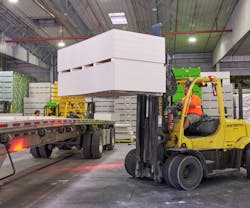
Transporting lighter-weight products like wallboard produces lower greenhouse gas emissions at every stage. The trucks and trains are not using as much fuel during transport and the same goes for the lifting machines on building sites and in warehouses.
Unfortunately, construction and manufacturing have always had a reputation for being high-emissions industries, which has led to increased scrutiny. Today, regulations are shifting so that construction companies not only have to track emissions from their own vehicles and equipment but also have to pay attention to Scope 2 and Scope 3 emissions — meaning they need to pay closer attention to the products they buy and the partners they do business with.
Of course, these benefits on the emissions side could be offset if the product itself was less durable. If being lightweight meant more breakage during transport or installation, then a new climate challenge emerges: more wasted product going to landfill.
Fortunately, advancements in materials science and manufacturing technology have enabled the climate advantages of lightweight products without sacrificing durability. Builders are not forced to choose one or the other.
Sustainable Materials Manufacturing: The Bigger Picture
When most people think of manufacturing more sustainable products, the first thing that jumps to mind is usually how the products themselves are made differently. Are they made from different raw materials? Are they manufactured with renewable or energy-efficient power sources?
While all these steps are important and are being implemented by manufacturers across the country, one should not forget to see the whole picture of the supply chain. Product weight, and the ripple effects it has on energy consumption during transportation, is one of the single biggest factors lowering greenhouse gas emissions in the construction supply chain.
Manufacturers are playing their part to help the United States build more sustainable homes, workplaces and infrastructure. And as they do, everyone wins.
This content is sponsored by: