How 3-D Printing Could Disrupt Your Supply Chain
A quick search on Google Trends will reveal the meteoric rise in interest the world has in 3-D printing—and for good reason. 3-D printing is truly innovative with endless product design possibilities. While current media coverage tends to focus on the benefits of prototyping, we believe its greatest potential lies beyond this, in its capability to challenge many traditional supply chain constraints and open up new opportunities.
From a supply chain perspective the Big Picture question is whether 3-D printing has the potential to become a disruptive technology, or will it be just another incremental step in the supply chain evolution?
What is clear from the outset is that 3-D printing is not the solution to all manufacturing problems and consideration needs to be given to each company’s operating environment, manufacturing capability and product portfolio.
Since 3-D printing is still early in its evolution, we thought it worthwhile to explore some supply chain issues it could address and situations where investigation of its use may be appropriate.
Reduced Inventory via Reduced Lot Sizes
One of the more apparent ways that 3-D printing technology could be used to transform supply chains is by reducing manufacturing lot sizes, that is, by enabling smaller—even discrete—manufacturing runs. This could allow companies to reduce inventory holdings by being able to better match supply to demand. Naturally, this may not be an appropriate solution for all companies and all items. The sweet spot for this technology would appear to be where volumes are low and the level of manufacturing complexity is low to moderate—for example, where there are a variety of customized, low-volume finished products such as medical devices.
An initial assessment of demand could indicate the suitability for consideration of this technology. In weighing up the value of this approach, it would be worthwhile to weigh up the total inventory savings of smaller batch sizes, including lower working capital and obsolescence risk vs the costs of the 3-D printing capability. These could be significant.
Improved Responsiveness via Shorter Lead-times
Another way we may see 3-D printing change supply chains is by challenging the traditional view of the distribution network—specifically, by being used to decentralize manufacturing. As 3-D printers are able to provide the flexibility required to produce a higher variety of end products than traditional manufacturing lines with less overhead, by developing 3-D printing capability closer to customers, companies may be able to reduce reliance on traditional capital intensive manufacturing lines in centralized locations.
This has significant potential for countries or regions where increased responsiveness traditionally comes with a requirement to have a fully stocked DC in each major city. With 3-D printing, not only would the manufacturing lead-time be reduced, the distribution lead-time could also be reduced by situating operations close to customer demand—with the added benefit of transport savings.
One of the best examples of a company utilizing this technology is the Maersk shipping line. In 2014, Maersk began installing 3-D printers on their ships in order to print spare parts as required. By taking this initiative, Maersk has transformed the need for spare parts to be available at the nearest port and replaced it with rapid spare parts responsiveness that also helps to remove the risk of a disruption to service.
In exploring this option, consideration again needs to be given to demand volumes and unit costs. In particular, it is worth noting the 3-D printing process is currently significantly slower than traditional mass production. However, for companies with appropriate demand and product characteristics, this technology could be well worth pursuing.
It is also worth noting that this solution does not require companies to acquire 3-D printing capability themselves, as we are already seeing the appearance of companies like Amazon, Shapeways and more localized companies providing 3-D printing as a specialty service. We expect these services to grow and become more specialized over coming years as the commercial application becomes more widespread.
Improved Range Management via Customization
A decision trade-off often faced by many companies relates to managing the range of products on offer to customers while maintaining costs associated with holding more inventory. This is particularly troublesome for industries where they offer a long list of low-volume and potentially slower moving items, like customization and spare part providers.
For many companies, products like these are usually the first put forward for SKU rationalization, and rightly so. However, with 3-D printing, businesses could support a wider range of products, and therefore appeal to more customers, without the need to hold extra inventory. 3-D printing could enable manufacturing on-demand, effectively allowing companies to manage higher product ranges at a competitive cost level. Hasbro is a great example, as the company has integrated 3-D printing into its strategy, offering a wide range of co-customizable 3-D printed toys, allowing consumers to choose readily-available toy options, or further customize to their liking.
Evaluating Appropriateness
As most supply chain professionals understand, it is often simplistic to assume a single technology investment will solve all supply chain issues. In reality, identifying supply chain opportunities is a difficult task with many moving parts, and there is little change here. Given the investment required, as well as the imperative to not disrupt supply to customers, it is important that this technology is applied to the right situation. This requires an evaluation of the potential impact of this technology on a company’s supply chain strategy, planning and execution.
To help with this, the following chart offers an indication of where this technology may be most appropriate. Reflect on where your company or operating environment fits in the chart:
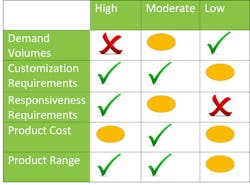
As you can see, we believe 3-D printing is ideally suited to low-volume, moderate valued products that require high customization on a short lead-time. If in assessing your company you have more than a couple of ticks, it could be well worth investigating the option of 3-D printing.
Many Possibilities
3-D printing lends itself to many possibilities for companies looking to transform how their supply chain operates. As the discussion above shows, it can be applied in different ways, to solve different business problems. Yet 3-D printing is not the golden bullet that will resolve all supply chain problems by revolutionizing the manufacturing landscape. In addition, it will not negate the need for traditional supply chain disciplines, such as demand planning or inventory management, while issues with energy usage and suitable materials also need to be addressed.
However, as 3-D printing evolves, it will become a more feasible option with greater possible applications. For this reason, should any of the above issues sound familiar, it is well worth keeping the option of 3-D printing on the table and consider how it could change how you tackle supply chain improvements.
Adam Kidd is a senior consultant with GRA, a consulting firm specializing in supply chain strategy, planning and execution. He has over 10 years of experience in supply chain planning, inventory optimization, and sales & operations planning, with a particular focus on consumer goods, pharmaceutical and manufacturing organizations. Jamie Sciacchitano is a supply chain consultant with GRA. He has a strong background in manufacturing improvement, learning facilitation and supply chain challenges present in consumer goods. He has experience in training and implementing Lean principles and supply chain excellence programs at all work levels, as well as deciphering business problems and tailoring specific manufacturing solutions.