Building Teens a Training Factory of Their Own
Key Highlights
- The 12 For Life program combines classroom education with manufacturing floor experience.
- Since the program began, high school graduation rates for economically disadvantaged students in the surrounding Georgia county have risen from 65% to 97%.
- Public-private partnerships like 12 For Life serve as scalable models to address manufacturing workforce shortages and foster community development.
- Georgia AIM connects AI and smart technologies with workforce training, supporting innovative programs to prepare students for future manufacturing careers.
To train the workforce of the future, we need to think outside the box.
Across the country, career academies, dual-enrollment programs and partnerships with technical colleges and four-year universities offer high school students a range of career-path options. But sometimes, it takes deeper public-private partnerships to create truly innovative solutions.
This is why last fall, Georgia Tech’s Georgia Artificial Intelligence in Manufacturing (Georgia AIM) initiative launched its second annual Georgia AIM Week at Southwire in Carrollton, Georgia. Here, an innovative program, 12 For Life, connects school and career pathways through a true public-private partnership that should be replicated across the country.
We’re already deep into a manufacturing workforce shortage. Programs like 12 for Life—which combine real-world work experience, above-minimum-wage pay and traditional high school classes in a wraparound program that benefits the larger community—are a real solution for manufacturers looking to solve their own workforce challenges.
Connecting education and career pathways in manufacturing is foundational for Georgia AIM. While Southwire’s program is not one of our programs, we support a variety of initiatives across the state to inspire innovation in K-12 students, connect new graduates to our Technical College System of Georgia and universities and support efforts that foster apprenticeships, fellowships and internships.
A Holistic Approach
Launched in 2006 by executives at Southwire, one of the world’s largest manufacturers of cable and wire, 12 For Life was created out of concern about the then-high dropout rate at Carroll County High School and the impact it was having on Southwire’s ability to hire employees at its local manufacturing facilities.
Working with Carroll County school officials, Southwire later invested $2.5 million to build a factory to address both issues. This meant providing school-district-run classrooms where students would spend part of their day catching up on credits needed to graduate. Then, they would shift to the manufacturing floor, where they learned how to roll and package wire sold in home-goods stores across the country.
To qualify for the program, students are selected based on student interest, parental approval, financial need, poor grades and poor attendance.
Students in the 12 For Life program spend four hours a day in the classroom and four hours on the factory floor, primarily packaging wire into the 15- to 100-foot consumer products you can find at retail stores. They are paid between $12 and $14 an hour and also receive bonuses for obtaining good grades in school and are eligible for scholarships to college or technical school.
A Remarkable Turnaround
In the nearly two decades since, the results have been nothing short of remarkable. Today, students in the program can earn a range of technical certificates and attend innovative classes, such as an introduction to robotics course in the facility’s new mechatronics lab. This specialized training will help them land full-time jobs after graduation at Southwire and other manufacturers, with salaries starting at $50,000 to $60,000 and up.
The community also benefits from the program. Since 12 for Life began, the high school graduation rate for economically disadvantaged students like those participating in the program has increased from 65% to 97%, according to Carroll County school officials. And Southwire found 12 For Life students were 30 to 40% more productive than other workers on a 12-hour shift. The facility turned a profit three months after it opened—it had been expected to break even in five years—and is an ongoing case study conducted by Harvard Business School.
But just as important is the shift in the students served by 12 for Life. Talk with any student there, and you will hear a similar story: My confidence has grown; my skills have grown; I can see my career path more clearly. That’s because students at 12 for Life are held to a high standard, and they learn to expect that of themselves. Their supervisors not only teach on-the-job skills but include financial counseling and life-skills coaching as part of training.
Replicating the Model
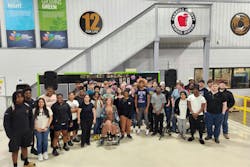
During the Georgia AIM Week stop at the facility, 12 For Life students hosted 200 Carroll County middle schoolers who toured the factory, classrooms, labs and the Georgia AIM mobile studio in hopes of inspiring the next generation of 12 For Life participants. So far, more than 2,500 students have participated in the program, and Southwire has launched a similar partnership with schools near its facility in Florence, Ala.
The success of this program shows how public/private partnerships can benefit entire communities when local leaders collaborate to solve problems.
Georgia AIM’s mission is to connect AI and smart technologies to manufacturers and the workforce, including K-12 programs. Funded by a $65 million U.S. Department of Commerce Economic Development Administration grant with state and private support, Georgia AIM is leading 15 projects across the state, all working to develop a manufacturing workforce skilled in smart technologies and to deploy innovation in the manufacturing industry. Georgia AIM is one of the largest federally funded initiatives of its kind in the country connecting economic development with AI in manufacturing to foster advancements in innovation and workforce development.
But for Georgia—and the nation—to excel in advanced manufacturing, we need a ready workforce. While our schools are learning that AI and manufacturing play a crucial role in the future, we also need businesses to recognize the gaps and opportunities in their own workforce. The 12 for Life program offers an exciting, proven way for manufacturers to connect with their communities, lift up at-risk students and thrive with a future-ready workforce.
The 12 for Life program combines education with the practical, hands-on experience of working, which is a recipe for success. And it’s a model worth replicating.
About the Author

Donna Ennis
Associate Vice President, Community-Based Programs, Georgia Tech Enterprise Innovation Institute
Donna M. Ennis provides leadership across all Georgia Tech Enterprise Innovation Institute units to develop collaborative funding opportunities and provide support and services to ensure the integration of communities into programs and operations. She co-directs Georgia Artificial Intelligence in Manufacturing (Georgia AIM), funded by the U.S. Economic Development Administration. Georgia AIM leverages a statewide network of dozens of partners for the development and deployment of talent and innovation in AI for all manufacturing sectors.