Manufacturing Day Lets Us Show How the Work Has Changed
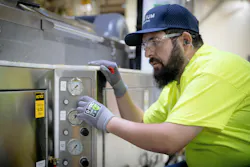
Ask most people to picture a factory, and you'll likely receive a dated answer: a workplace that’s dim, loud and repetitive. Walk the floor at Trivium Packaging’s plants and that picture doesn’t hold up for long.
In our business, you'll find operators running automated lines one hallway over from a designer in our graphics studio, proofing artwork to ensure the outcome meets the customer's expectations. You’ll find a 22-year-old training under someone who started the same job the year they were born. Our global R&D team includes over 80 professionals who test materials and coatings before a can ever reaches a customer's filling line, and each of our plants has someone tracking the environmental footprint for their location, feeding into a circular champions sustainability program that runs across our whole company.
Manufacturing has changed faster than most people’s picture of it, and that gap shows up in two main ways. Too few people know the breadth and value of manufacturing careers, and too little of the knowledge already sitting inside these plants is making its way to whomever comes next. Neither problem will be resolved on its own, but a day or a month dedicated to manufacturing can serve as an opportunity to bring awareness and help close both gaps.
Start with the visibility problem: that gap is costing the industry potential workers it can't afford to lose. The Manufacturing Institute and Deloitte estimate that U.S. manufacturers will need as many as 3.8 million additional workers by 2033, and roughly 1.9 million of those jobs could go unfilled if manufacturers don't close the skills and awareness gap themselves. That is exactly what Manufacturing Day exists to address.
Today: Open the Doors, Show the Work
This is why Manufacturing Day matters to us, and why we’ve come to treat it as more than a single event on the calendar. It’s the thinking behind our flagship programming, “The Foundation for Generations: Yesterday. Today. Tomorrow.”
Across our U.S. footprint, plants in communities including Bloomsburg, Pennsylvania; Conklin, New York; Roanoke, Virginia; Reno, Nevada; and Youngstown, Ohio, host their own mix of family events, plant tours and career-day conversations. Our U.S. plants have welcomed thousands of students, educators, community members and family members over the years.
Opening the doors only matters if we show people what’s behind them. A plant tour can be more than a walk past equipment while someone points and explains. For example, in our locations, students meet the people who operate that equipment, maintain it, design for it and find ways to improve it, enabling them to come away with a real sense of the range of careers a modern manufacturing company offers.
That breadth is something our own people describe better than any statistic can. Nicole Gailey, a senior director in our R&D group, calls manufacturing an ecosystem, one where quality systems, safety culture and relationships matter just as much as the machinery on the floor. Barbara Bertone, one of Trivium’s HR directors, describes something similar from a different vantage point: an industry that keeps reinventing itself through digitalization, sustainability and more collaborative ways of leading teams. Neither picture matches outdated image most people are still carrying around about the industry.
Reno Plant Manager Silvio Luis sees students’ impressions of manufacturing shift every year at our open house. Exposure and personal touch matter; young people can’t seriously consider career paths they’ve never been shown exist.
Yesterday: Knowledge That Doesn’t Live in a Manual
Getting people through the door only addresses the first problem. The second one is quieter and arguably more urgent.
Every process on a manufacturing floor carries the fingerprints of people who solved problems years before, often through nothing more formal than trial and experience. Much of what keeps a plant running was never written down because it never needed to be. When that knowledge leaves with a retiring employee before anyone’s had the chance to learn it, a plant loses years of problem-solving and lived experience.
Deloitte's 2025 Smart Manufacturing Survey found that preparing the workforce for what’s ahead remains an area where manufacturers lag, and closing that gap requires more than just hiring well. It takes intentional, deliberate knowledge transfer from experienced employees to the next generation, rather than hoping it happens on its own.
Manufacturing Day isn’t just for raising awareness and educating those outside the industry and in our communities. It serves as an opportunity to focus internally on knowledge transfer that goes above and beyond daily habits. It is an opportunity to consider cross-training, mentoring or hosting lunch-and-learns to share knowledge within your organization.
In addition, at Trivium, we’ve embraced developing technology and tools to remain at the forefront of innovation and serve as another solution for closing the knowledge gap. One of these is a proprietary AI tool to help train employees on company-specific skills and make decades of engineering knowledge easier to find than digging through old files and shared drives. Used well, this technology will help the next generation get there sooner while supporting experienced employees.
Tomorrow: Why We do This
Yesterday gives manufacturing its accumulated knowledge, and today shows how much the work itself has changed. Whether we manage to connect the two is really the question behind everything we aim to do to commemorate Manufacturing Day.
Sometimes those two generations work on the same floor at the same time. At Trivium, Christine Sink and her daughter, Sierra Barton, both work in MRO, in the same role but on opposite shifts. Neither one replaced the other. Each brought her own experience to work that keeps going across shifts, across careers and across generations.
That’s what Manufacturing Day gives us the chance to do: open the doors and let people see the real picture, instead of the one they’ve been carrying around for years.
About the Author
Catherine Hannebert
Senior Vice President, F&S North America, Trivium Packaging
Catherine has been a leader in the metal packaging business for over 25 years. She has held leadership positions in sales and marketing, supply chain, and operations for a number of divisions at Ball. Her track record as a leader includes the planning and start-up of new multi-line manufacturing facilities and the transformation of underperforming businesses to long-term sustainable growth and profitability.