Additive Is for Tooling First, Then Everything Else
Key Highlights
- How additive manufacturing achieved success with mass production.
- How manufacturing plants best leverage additive technology.
- Competitive advantage may depend on deploying additive.
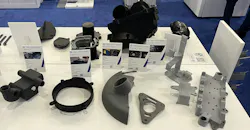
At RAPID + TCT 2026, billed as the biggest additive manufacturing conference in North America, we spent many hours poking around the show floor and had a chance to share our observations with Brett Conner, chief manufacturing officer at the Society of Manufacturing Engineers, who spent 13 years out of a 30-year career in the additive manufacturing space.
We sat down with Conner to talk about real mass production with 3D printing, how additive succeeds in factories and the most immediate challenges faced by additive manufacturers.
This interview is edited for length and clarity.
Dennis Scimeca: Amazingly large show. You learn a lot about additive very quickly if you can walk the whole floor in a day.
Brett Conner: Over the years, we've outgrown a lot of convention locations because of the size of this event.
DS: Because we’re in Boston, I see a lot of health care and defense.
BC: Boston’s got a nexus of health care technologies, defense technologies, and a lot of innovation.
DS: Do you think the additive manufacturing industry has permanently given up on the idea of replacing mass production wholesale? Because that was the dream at the very beginning. “We’re going to 3D print everything.”
BC: Additive manufacturing as an industry, as a sector, has to find those areas where it is the best tool in the toolbox. And in some cases, it has actually been mass manufacturing.
Whether you look at things like invisible braces, additive manufacturing is used as part of the processes, as a tool for that. So that’s a million additively manufactured parts a day. That’s mass manufacturing. Apple phones now have metal additively manufactured parts in them. So again, you look at that from a quantity standpoint.
Again, it’s finding that right fit. Is it something that is complex in its design, that would be exceptionally challenging to try to machine or to make the tooling for it? Is it something that’s customized? We [can talk] about [invisible] braces again. That is another example where additive manufacturing shines because each part can be completely different.
There are some things that are being looked at in terms of point of need manufacturing. In the military space it could be expeditionary. We’re starting to hear things about in-orbit manufacturing and manufacturing on the moon. So that's a good opportunity for additive manufacturing as well.

DS: One of the most popular applications for additive in heavy industry and automotive that I’ve found is using additive manufacturing to create custom tools, jigs and fixtures.
BC: Yes.
DS: Does it surprise you at all that heavy industry has taken to additive in that way?
BC: No, in fact that’s one of the early application areas for additive manufacturing. It was exceptionally successful. I remember when Lonnie Love from Oak Ridge National Lab said there are three main applications for additive manufacturing: tooling, tooling and tooling.
Where there’s often very unique tools that you know you’re only going to make one, two or three of in the production line, the entire production line could have several hundred tools in it that are produced by additive manufacturing. And so the business case really sells for that.
DS: How do AI and additive intersect in 2026 that’s different from a year ago?
BC: We’re going to see more and more of this AI being used to help on the quality side, to do in situ process work, where you can read from multiple sensors and use the AI to understand what's going on and help with what is kind of the holy grail, which is closed loop control.
Another thing that’s going to start this year, I don’t know that we're necessarily seeing a lot of it now, but what the AI industry is calling physical AI…humanoid robotics and self-driving cars and having that AI compute power at the edge.
For us that means having AI compute power in our additive manufacturing equipment, in that case allowing a greater degree of autonomy which then goes back to what I’m talking about with increased quality control, faster process development, those sorts of things will see a greater use of AI.
DS: If additive were facing a hurdle this year what would it be?
BC: There have been some headwinds in the industry. I think that as our first speaker [at the conference], the CEO of Stratasys pointed out, I think that there’s a certain degree of that’s a natural element to this. It is a struggle.
I think that it’s going to take the industry to…go from the standpoint of, yes, as cool as additive manufacturing is, some things in manufacturing fundamentals are kind of boring at the end of day. It has to be a stable process. It has to be repeatable. We have to have well characterized material properties and so forth. To get to production scale requires all those things happening, and I feel like the industry is maturing in that direction.
DS: Are there any sectors in which you don’t find additive, but you think it’s a really good fit and it’s overdue?
BC: Additive has made inroads in aerospace, it’s made inroads in defense, it’s made inroads in medical and dental. Heavy Industry. We’ve talked about that there’s a growing interest and capability in space, both terrestrial as well as beyond. Construction is finally starting to get, I think, significant traction.
But the food world has not, it hasn’t really taken hold yet. And I think part of that may be the combination of just trying to get things that taste or look good through a printer process to come out on the other side, and maybe some of the design elements.
DS: Have we reached a point where any manufacturer who can afford it, who has the infrastructure and the talent, has to leverage 3D printing in their plants or risk ceding competitive advantage?
BC: The absence of additive would be highly disruptive, I think, in the aerospace world. There are even some companies that have been formed recently around highly digitized machining, and they even got into the additive space eventually.
Is heavy industry one of those sectors where you need additive right now? Maybe, maybe not. But if we talk about what we talked about earlier, tooling, fixtures and jigs, that’s almost an area where you really do need an additive manufacturing piece of equipment, even if this is not your primary function.
You’re using other processes to make things. There’s almost always a need to have, even a desktop printer, to do tooling, fixtures and jigs, so additive is a primary production method. It really does depend, in terms of being able to do support from prototyping to fixtures and jigs and tooling and so forth. It’s starting to become pretty much a requirement.
About the Author
 Dennis Scimeca
Dennis Scimeca
Dennis Scimeca is a veteran technology journalist with particular experience in vision system technology, machine learning/artificial intelligence, and augmented/mixed/virtual reality (XR), with bylines in consumer, developer, and B2B outlets.
At IndustryWeek, he covers the competitive advantages gained by manufacturers that deploy proven technologies. If you would like to share your story with IndustryWeek, please contact Dennis at [email protected].