Pella Workers Talk to Machines, Errors Plummet
Key Highlights
- Pella created a proprietary implementation of a voice-activated system based on Honeywell software.
- Ensuring before testing that technology can scale greatly speeds expansion.
- Putting IT and OT on the same creative teams can break down the natural conflict between them.
- Avoiding custom solutions also aids scalability.
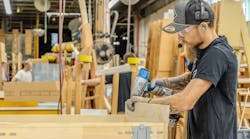
It’s a modern cliché, people grooving out to music only they can hear through headphones. What if, instead of listening to some jams, they were really learning how to do their jobs?
Almost all of Pella’s windows and doors are bespoke products. That equates to lots of service parts, a complex manufacturing process that moves at high speed and machinery that can be complicated for new operators. Pella had trouble retaining talent.
Enter headsets and Honeywell software that offers a voice-activated connected worker system, that the company simply named “Voice.”
“We’re a very data driven organization [and] that data was going to paperwork,” says Travis Turnbull, VP and CIO at Pella. “The team member had a piece of paper that said, ‘Here are the things to do.’ They were carrying this piece of paper everywhere…. And if you just watched them, you could just see the inefficiency.”
Then, someone asked, 'What if you could use a headset?'”
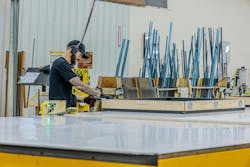
Operators receive verbal instructions on the bin number from which to pull a part. The operator then reads aloud check digits on the bin to confirm they picked the correct part. The operator then receives the next set of directions over the headset.
“How do we help our employees be more efficient and reduce the cognitive load and the decisions that they have to make? Because if they make a wrong decision, that impacts our customer. It was a great use case to help our team members not only identify what to pick, but where to pick it,” Turnbull says.
Laura Philips, VP of engineering & procurement, adds, “Operators could have two parts right next to each other and maybe the only difference is the profile of one edge of that part… so, it would be so easy to pick wrong from one bin over with the slight nuance of a difference. The tech ensures that you don’t make that wrong choice because you’re going too quickly.”
Manufacturing Technology as Continuous Improvement
Pella piloted Voice at its centralized parts plant in Pella, Iowa. New operators reached proficiency in a few days versus three-to-six months. Long-term, Voice reduced errors or bad picks by 90%.
There had never been a light bulb moment Pella realized it needed something such as Voice for its operations. The project arose from Pella’s continuing improvement efforts, such as encouraging gemba walks, touring the plant floor to observe work where it takes place.
“It was really that customer-first mindset and focus on reliability and quality [that] drove it. And then then we try to find jobs that are hard or difficult or potentially could be a failure point, and this was just a great example,” says Turnbull.
Voice also logs interactions such as expected and completed steps, providing full traceability. Errors become training opportunities. According to Turnbull and Philips, operators had no issue with their work histories spelled out so clearly for future review.
“The Pella team, broadly, at all levels, is really invested in getting better and continuous improvement, and so there isn’t a fear of, ‘You’re going to catch me doing something wrong.’ It’s ‘We want the insight so that we can go solve problems,’” says Philips.

When Scaling is Easy
Two years ago, Pella began broadening use cases for Voice. The intelligent operations team realized the technology would equally serve operators picking parts on the manufacturing floor. Early tests took place at a high-volume, wood window manufacturing plant in Carroll, Iowa. Voice now runs at half of Pella’s 20 plants in the United States.
“We’ve had some other solutions that, to get it to scale to other manufacturing sites, it was almost a push. … This [technology] was different. There was quickly a pull, everybody was raising their hand…. That’s important, not only for the team member, but the department manager needs to see the value, needs to buy in as well,” says Turnbull.
Frequently, Philips adds, plants pull Voice in for a specific task, see how the technology delivers and then ask for support to scale to other applications.
“It’s a really good indicator to us, when our manufacturing partners are asking for it, that it’s creating efficiency value for them,” says Philips.
IT and OT Converge
Turnbull and Philips made operational changes to address the biggest challenge to adoption they experienced—IT/OT convergence.
“The data that would feed paperwork had to now feed the headset, and that’s where the IT/OT convergence comes into play. We have a device, but now I need to get the data out of the system into that device for it to be effective,” says Turnbull.
Implementing Voice necessitated breaking down IT-vs-OT silos to promote a more agile tech development philosophy. So, Turnbull and Philips three years ago created pods of engineers working with OT and IT team members.
“We have a team dedicated to scaling from both sides, and then we have a team dedicated to the development of new applications from both sides, and they work together in unison to create solutions so there’s no more handoff wait in a dark hole for another team to execute,” says Turnbull.
“We have a data and insights pod. We have a pod for scaling known solutions and pushing them out further through the manufacturing system. And then we have a pod that’s dedicated to creating new things, new solutions,” says Philips. There are seven intelligent operations teams now working on projects.
Avoid Being Custom Happy
Another chief lesson for Turnbull and Philips is the need for standardization. Trying to come up with customized solutions for each challenge would have made scaling at the current speed almost impossible. Staying on course wasn’t always easy.
“We have gotten custom happy in the past and had to redo work because we have custom [solutions]…and we don’t have enough resources then to maintain and continue to scale solutions” says Philips.
“Each plant is unique and different, and so they kind of want to control [technology solutions] within their means. There was a bit of a trust factor that we had to overcome, that we’re going to build solutions that truly do solve problems in all plants, and that can scale … the scaling team makes sure that it truly gets adopted. We’re there to support it, and we just don’t throw it over the fence and go chase something else,” says Turnbull.
Language Barrier? No Problem.
In terms of next steps for Voice, Pella has yet to scale the solution to its remaining 10 plants so there’s plenty of work for the intelligent operations team responsible. Pella also loaded Spanish-language instructions to serve a plant with a large Latino population.
“It’s been a great example of starting small and then learning fast, applying and scaling broadly. The language barrier was a problem, and we immediately were able to solve that through that technology,” says Turnbull.
About the Author
 Dennis Scimeca
Dennis Scimeca
Dennis Scimeca is a veteran technology journalist with particular experience in vision system technology, machine learning/artificial intelligence, and augmented/mixed/virtual reality (XR), with bylines in consumer, developer, and B2B outlets.
At IndustryWeek, he covers the competitive advantages gained by manufacturers that deploy proven technologies. If you would like to share your story with IndustryWeek, please contact Dennis at [email protected].