GE Appliances Created a Virtual Maker Space for AI
Key Highlights
- GE Appliances encourages free experimentation with AI creation tools.
- Prioritizing problem solving over tool development led to scalable solutions.
- AI can be an effective teaching tool to drive efficiency.
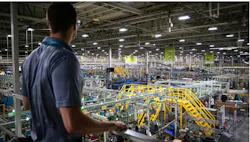
Demystifying AI by getting it into the hands of ground-level users and supporting a culture of experimentation has led GE Appliances to practical, scalable AI-based solutions.
The company’s virtual maker spaces like AI Park—a digital hub providing employees access to GEA’s officially supported AI creation tools—are a natural extension of First Build, its physical maker spaces for traditional manufacturing.
These virtual maker spaces encourage the same sense of creative freedom as the real-world maker spaces championed by CEO Kevin Nolan—who opened the second of GE Appliance’s FirstBuild public maker spaces in 2023 in Stamford, Connecticut, after the success of the original FirstBuild facility at University of Louisville.
By bringing those spaces to the workers, rather than trying to centralize AI, Nolan “truly is unleashing the innovative minds within the operation,” says Bill Good, vice president of manufacturing.
“There are plenty of other companies attempting to centralize AI within IT functions, and consequently I feel like it's too controlled, and you don't really get at the true innovators within your organization,” says Good.

AI Park is a creation of the AI Lab, an internal support function under the auspices of Richard Calvaruso, senior director for lean.
“AI fits perfectly into the lean methodology because it is basically limiting waste. Probably the biggest waste we're going after is time. Think about that. You can't get time back. You can't save it. If we could free up people's time, that is huge to the business,” says Calvaruso.
Good created the centralized resource group for AI under Calvaruso. The group does not push projects or initiatives, though it does support approved tools. Other than that, the prompt’s the limit for anyone ready to work with AI.
The AI Lab also coordinates with GE Appliance’s IT department. Governance, says Good, is the true IT function, making sure AI has the proper safety guardrails and doesn’t create cybersecurity risks or legal questions.
GE Appliances discussed three initiatives with us that show the power of wide freedom of experimentation around AI. These are all local plant initiatives achieved with local funding, decentralized pilots that turned into scaling technology successes.
Saving Millions by Scanning Steel
Good says that GE Appliances goes after problems with the Toyota approach.
“Where they look at model cell, model line, model value stream. … We look for duplicate applications in where we may be struggling with a similar problem across the organization, and then we go scale it,” says Good.
Take, for example, the countless hours associates (read: operators) at Appliance Park have collectively spent inspecting refrigerator doors for scratches, dings or other imperfections. It’s repetitive, boring, and not terribly accurate. It’s also a recurring challenge throughout multiple manufacturing processes.
Associates get tired looking at the surface of steel all day long. Achieving 98% or 99% reliability on defect detection is very difficult for a human. In other words, it’s a perfect use case where AI takes over and frees human inspectors up for more cerebral tasks.
“A refrigerator is 3 feet wide and 6 feet tall. It’s 18 square feet of steel … and it’s wrapped in film. … When you peel that film away, if there is a dent or a scratch or a mar or a ding all the way down to [very tiny measurements], to put a human on that to try to pick up that level of a dent in the cycle time that we’re expecting them to see, that is near impossible,” says Tim Vibbert, executive director for plant management.
The AI-based vision system first deployed in Appliance Park’s AP5 building uses 3D imaging to conduct comparative analysis on over 60 different SKUs and immediately inform maintenance staff if it detects quality issues. GE Appliances says the system achieved ROI in around three months, has saved the plant $1.2 million to date and is scaling across Appliance Park.
Detecting Leaks
The specific location where condensation forms on the bottom of a dishwasher unit indicates where in the manufacturing process an error took place. It is neither comfortable nor quick for a human being to conduct this inspection.
Enter AI once again.
This time installed in Alliance Park’s AP3 building, a second AI-based vision system inspects dishwasher units on the line and scans for condensation at the bottom of the unit. The AP can not only detect leaks but also determines which component(s) might cause the leak. The operator can then communicate the issue upstream.
Since installing the new vision system,12% fewer suspect units have made it past the condensation check station. Human beings could manage 87% accuracy. The vision system accuracy sits at 99%.
Balancing Lines
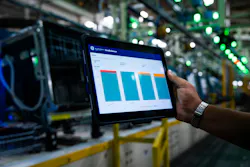
LineBalancer is a simulation tool meant to replace old pencil-and-paper methods for calculating changes on the line based on variable conditions. AI enabled the development of the application.
“So we can then quickly say … if you were able to change a process and run it at a different speed, here’s your opportunity,” says Calvaruso.
The app runs on PCs and smart devices and provides standard templates for ease of use.
“As somebody who goes to the sites [for] continuous improvement and projects, one of the first things we do is say ‘Do the math’: what's the current condition, what's the speed of the line, what's takt time, how much downtime [do] they have. And we would always do that on a spreadsheet or a piece of paper. And we said, ‘It'd be better if we had like this nice little app or something where we can do that,’” says Calvaruso.
While GE Appliances leverages “full-blown simulation” software from Rockwell Automation, the idea was to get a simpler tool into the hands of shift supervisors and other people on the shop floor who could make immediate, practical use of the information.
“It won't be something you use every day, but … if [a plant manager] has a change in demand in his plant, and he has to change the takt time on one of his lines because of demand chain up or down, he now has a really nice tool to just put the numbers in and go through and see where he's going to be. We could do that before, but it just took a lot more time,” says Calvaruso.
LineBalancer effectively became a teaching tool as associates and supervisors began making efficiency adjustments on the fly without having to depend on the software. GE Appliances estimates it has saved $1.5 million since adopting LineBalancer, savings created by lessons learned using the tool and applied in the real world.
Let Your People Solve Problems With AI
“You'll see a whole lot of interest from eager folks … that are getting creative. They're asking questions we didn't even know that we're out there to solve a problem. They're creating new new ideas and incubating those. … We'll share them with Bill and we'll say ‘This is a big one. Let's scale this,’” says Vibbert.
Calvaruso says the key to finding scalable technologies is to begin with the problem to solve versus the tool to implement.
“I think that's the key differentiator. If you start with a problem and you come up with a solution, it's pretty likely other people have the problem, and they'll want that solution as well,” says Calvaruso.
About the Author
 Dennis Scimeca
Dennis Scimeca is a veteran technology journalist with particular experience in vision system technology, machine learning/artificial intelligence, and augmented/mixed/virtual reality (XR), with bylines in consumer, developer, and B2B outlets.
At IndustryWeek, he covers the competitive advantages gained by manufacturers that deploy proven technologies. If you would like to share your story with IndustryWeek, please contact Dennis at [email protected].
Related
 Dreamstime M 115230724
 Dreamstime M 80800241

