Rockwell’s Singapore Lighthouse Plant Heavily Leverages AI
Key Highlights
- Multiple forms of AI run at Rockwell's Singapore plant.
- The plant is named a Lighthouse facility by the World Economic Forum.
- There's a right place to get easy wins for AI and build confidence in the technology.
Perhaps you have read the growing number of reports about businesses losing money by investing in artificial intelligence (AI) and not knowing what to do with it once they have it, or businesses that are unable to figure out how to determine ROIs for the technology.
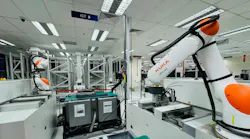
Meanwhile, Rockwell Automation at its Singapore facility has effectively built a one-stop-shop for understanding modern-day artificial intelligence (AI) and how it applies to manufacturing.
The World Economic Forum in June named the Singapore plant a Global Lighthouse Network facility, citing the plant’s productivity. Bob Buttermore, SVP and chief supply chain officer, calls the Singapore plant a “Rockwell on Rockwell” project where the company proves out technologies for scaling in its own plants before offering the solutions outside the organization.
“Singapore was already a world-class facility. Their efficiency, their scrap levels, everything, they were already a world-class plant, and this just took it to another level,” says Buttermore.
He presented successful use cases for traditional machine vision, generative AI (GenAI), and agentic AI running at the Singapore plant and scaling to other Rockwell plants.
Rockwell partnered with Microsoft to run all of these applications in the cloud on Azure servers.
"It's a strategic partnership. It's not only what we can do in our own factories, leveraging their tools, but it's also what we can do for our customers, and ultimately deploying AI, deploying MES that's cloud based sitting in an Azure platform, [along with] our computerized maintenance management software," says Buttermore.
Venerable Machine Learning
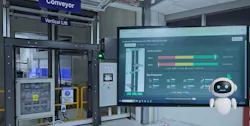
Predictive maintenance software deploys more traditional machine-learning algorithms versus today’s complex AI models. Rockwell applied predictive maintenance to a conveyor system that constantly runs between two levels of the Singapore plant.
“We took hundreds of thousands of data points from our controller and from our MES that feed into 64 different machine learning algorithms for this conveyor system,” says Buttermore.
The predictive maintenance system for the conveyor came online two years ago. The conveyor system has not had a single instance of negatively impacting production since.
GenAI-Powered Connected Workers
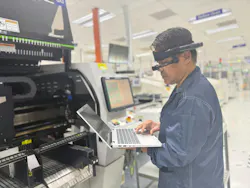
The Singapore plant also deploys a connected worker system that leverages generative AI (GenAI) and augmented reality (AR), allowing operators to access operational details and repair processes. Operators can use either text or voice to query the “maintenance copilot,” as Buttermore calls it.
“In Singapore, we have 394 pieces of equipment. … When you bring someone new in, it can take nine to 12 months to bring them up to speed,” says Buttermore.
Rockwell decided to build the maintenance copilot by way of attacking the learning curve.
All the data from the Singapore plant’s control layer that passes through the plant’s manufacturing execution system (MES), as well as data related to maintenance and troubleshooting downtime, feed into the AI engine. Rockwell also added institutional knowledge into the system.
“We actually sat down with all the technicians and had them document all the really intelligent things in their heads that they've learned over the years, document that into the AI engine, and then also we took all the manuals for all of those 394 different machines and put that into this AI engine, Microsoft’s OpenAI on Azure,” says Buttermore.
It used to take 12 months to achieve time to competency for new technicians. Rockwell now achieves this at the Singapore plant in four months. Mean time to repair (MTTR) reduced from 18 to 12 minutes, and the plant enjoyed a 25% reduction in spares inventory.
Agentic Inspection
The newest buzzword in AI is “agentic,” giving AI the ability not only to process data but also to understand why things happen and make recommendations.
Rockwell’s Singapore plant runs a “multi-agent quality assurance system.” Think of “agents” as department heads, each solely responsible for one aspect of an operation. The agent can monitor and report on that aspect, whether it be visual quality inspections or vibration analyses or metrology, etc., much faster and more accurately than any human.
Now imagine these department head AI agents all seated at the same table as their boss, a human being. One of the agents at the table is an “AI action agent” that proposes the options for the human boss to decide between.
The agentic AI-based quality control system processes data from machines on the line, control systems and other sources, and can correlate rising error rates with specific parts of the manufacturing process.
“When we combined all that [data] together, [technicians] prompt the AI and it comes back with ‘These are the three things that have repaired that issue in the past.’” And the [technician is] interacting with [the AI] in real time as they're trying to troubleshoot the machine. The AI allows them to very quickly get to ‘This is how you repair this potential issue,’” says Buttermore.
Since installing the multi-agent quality assurance system, the Singapore plant has enjoyed a 35% reduction in defects.

Target Waste With AI
Deciding what to do first with AI flummoxed Buttermore and his team. The more successful deployments of AI-based technology we see over a wider range of applications, the more difficult deciding where to begin might become.
“When we started this journey two and a half years ago, when we were looking at the use cases for AI that we wanted to tackle first, the team was struggling with ‘How much benefit are we going to get?’ … The cost to implement these things was not that substantial, but I kept driving for how much savings are we going to get? Where's the benefit going to come from in quality, defect reductions, efficiency, productivity and people. There was a little bit of struggle with that at the beginning,” says Buttermore.
He and his team decided to focus on something simple that could deliver an early, easy win: waste.
“Attack those areas where you have those largest pockets of waste. What we focus on is: Don't try to solve the whole use case at one time. Solve the easiest part of the use case first—and so if you get a 2% improvement in quality, that's probably going to have a return on it for the initial thing, and then you continue to build to where you get that really large-scale solution,” says Buttermore.
AI Gets Operators to the Office
Finally, Buttermore mentioned another AI application used by Rockwell to help manage the employee transportation services offered at various plants, including the Singapore facility. Bus travel data was fed through an AI agent for analysis.
“In all of our plants around the world where we have this, Singapore included, we were able to use AI to actually optimize the routes and save over a half a million dollars in our transportation services. [The AI] let us know that people aren't getting on at that location—they're actually getting on here even though they live over there—and allowed us to optimize our bus routes. Just another way to take expense out of the operations.”
About the Author
 Dennis Scimeca
Dennis Scimeca
Dennis Scimeca is a veteran technology journalist with particular experience in vision system technology, machine learning/artificial intelligence, and augmented/mixed/virtual reality (XR), with bylines in consumer, developer, and B2B outlets.
At IndustryWeek, he covers the competitive advantages gained by manufacturers that deploy proven technologies. If you would like to share your story with IndustryWeek, please contact Dennis at [email protected].