Podcast: IFS Unleashed Reveals the Next Phase of Industrial AI
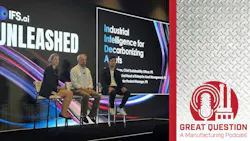




In this episode of Great Question: A Manufacturing Podcast, Dennis Scimeca and Scott Achelpohl discuss key announcements and emerging trends from the IFS Unleashed Conference, where industrial AI dominated the conversation. They explore new partnerships between IFS, Siemens and Aveva, the evolution of agentic AI and digital workers, and how manufacturers are using AI to automate workflows and improve operations. The conversation also examines growing concerns about AI governance, cybersecurity and the gap between factory-floor adoption and executive oversight.
Below is an excerpt from the podcast:
Dennis Scimeca: Hello, my name is Dennis Scimeca, Senior Editor for Technology at IndustryWeek, joined today by Smart Industry’s Head of Content, Scott Achelpohl, to talk on this episode of Great Question about what we saw at the IFS Unleashed Conference two weeks ago. Now, if you need a reminder, IFS is a global supplier of enterprise and industrial software. IFS CEO Mark Moffat said at his keynote that $2.4 trillion in assets use IFS software. IFS has also invested substantial time and energy into stressing the AI functionality of its software and so AI was, of course, the major theme at IFS's Unleashed conference in Orlando, Florida. Hey, Scott, thanks for joining us today.
Scott Achelpohl: Hey Dennis and hello everyone. I'm glad to join you for our pod again. It seems like we just did this.
Dennis Scimeca: Wow, we did. Well, you know, we have such good chemistry. The audience wants some more, so let's give it to them.
Scott Achelpohl: Happy to provide it.
Dennis Scimeca: As far as I'm concerned, the biggest news out of the conference came in the form of a pair of announcements for new partnerships. So first they talked about a partnership with Siemens Digital Industries Software, whose CEO Tony Hemmelgarn presented at Unleashed. And he positioned this relationship as taking advantage of Siemens's digital twin and design technology.
Scott Achelpohl: Yeah, from my perspective, the top headline I think was IFS's introduction of its multi-spoke, if you will, industrial AI product IFS Intelligence. The software is interesting in and of itself, but the reveal was newsworthy as a continuation of what seems to be the IFS strategy of building upon recent advancements such as the agentic AI digital workers of IFS Loops. What is Loops, you may ask? Well, it's an agentic AI platform and workforce solution, IFS says, developed following its acquisition of The Loops, which was a separate company in 2025. It's got a few components to it. “Digital workers” which deploy autonomous software agents (agentic AI) that act as virtual colleagues to handle high volume multi-step operational tasks across enterprise systems – familiar ones: ERP, FSM, and EAM. Features execution versus insight. IFS says that unlike traditional tools that only show like dashboards and general alerts, IFS Loops is built to execute workflows. Dennis and I heard a lot about workflows, not as AI digital workers doing isolated things, but being part of a team, so to speak. Workflows such as logging machine faults, triggering inventory replenishments and updating production plans automatically. There was something else: part of Loops is a new product that was not announced last year when Loops was, but has since debuted. It's called Industrial AI Harness and it is designed to connect with over 75 enterprise systems and data sources while keeping governance, security, and human approval gates in place. We're going to talk more, of course, later about governance. IFS Loops also includes what's called Agent Studio. That's also been launched since last year. And it lets operational teams configure, test, and manage custom digital workers, ones that you can build using Agent Studio. And they're built using natural language instructions and safe sandbox environments.
Dennis Scimeca: Thank you for that rundown because I wasn't sure what it was and now I feel like I do. So thank you for that. The second partnership announced at Unleashed was between Aveva and IFS. I actually met with Aveva at the conference and they said that this partnership aims to leverage each other's software to develop something called Continuous Asset Decision Intelligence or CADI. It's composed of versions of Aveva and IFS software specifically configured to allow the systems to interact. The idea is that the two systems working together give you a larger breadth of the entire manufacturing process from supply chain to distribution. So you put those two pieces of software together, you get something larger, and that's what Aveva and IFS are working on. So Scott, those are two big partnerships announced at the show. Do you think they speak to any broad trends in M&A in the industrial AI market specifically?
Scott Achelpohl: Well, Dennis, I had my own take, which maybe is a little bit different than yours. You guys are used to covering M&A a lot more than I am and partnerships between big industrial software companies. I just think that big software vendors find they don't have all the answers themselves to create catch-all industrial platforms. The next big thing, I guess. And they have to involve another big partner. I was kind of blown away that IFS would partner with a company like Siemens, which I was under the impression was a market rival, for example. But thinking on it since the conference ended, it does make a lot of sense. It makes for better platform for customers, right, regardless of whose nameplate is involved. I've also detected a certain amount of collective conscience among these big software companies, the ones that are aimed at our market for manufacturing and big industrials. I mean, let's face it, industrial AI is kind of an invented term, but it's sort of kind of crazy viewed as the next best thing that happens to be taking place like right now. And I think they'd rather be in on the innovations regardless of how they get there, whether it's involving another big partner or not. I just think industrial AI, whatever you call it, is so big that it's transcending the typical proprietary protectiveness on the part of these companies. I mean, it seems so.
Dennis Scimeca: Yeah. Did you get a chance to attend any panels outside the press briefings? I hit three.
Scott Achelpohl: Well, I did. I did. I'll speak about two, and then I'll just kind of speak first about sort of the international flavor of the show. Dennis and I do quite a bit of traveling together at these big conferences. And I'm always blown away by what the international flavor of these shows is and how many reps from all over the world we meet. I counted people I met from 10 to 15 different countries, and representing some big customers – these are very big customer shows. And so there were a lot of people from all over the world. Dennis and I went to an interesting session about decarbonization strategies that IFS was pursuing and with their industrial AI software products. And then, I was interested by the Tom Brady motivational podcast, Tom Brady late of the NFL, and he talked a lot about his post NFL life and parenting honestly. He's the parent of teenagers and young adults by now and I just found his session a refreshing break from the seriousness of the show, talking about industrial software. I got a little bit of break from talking about AI. It's Smart Industry, we cover AI constantly, and it was just nice to have a little breather at the show and sit in on that.
Dennis Scimeca: Yeah, it's not just you, man. The amount of AI content that we have on IndustryWeek is amazing. But, you know, I saw a panel about pet and human food manufacturer Kale, and the wide number of AI-based applications they employ, and they're just saving a lot of time. So when you take individual agents working in the individual parts of the process and each one of them saving some time, you put it all together, you can save a lot. I was at a panel with Nestle where they talked about a deployment of the connected worker system, Poka, as kind of like a post-mortem. And he said the company reduced the amount of time needed to make content, like how-to or help guides, by 75%, which is not a small number, right? Especially if you're trying to build a huge repository of institutional knowledge. And then the last one I attended was presented by IPL Schoeller. They're a plastic part manufacturer, among other things. They're in 11 countries. And they had 26 plants as a company built through M&A. And the panel was about how they got every plant onto the same ERP system. There's 26 different plants onto the same ERP, which is not a small, easy thing. And of course, all of those panels are talking about using IFS products. So I did get a chance to jump out of the AI info stream a little bit. And it was interesting to talk a little bit about Connected Worker, a little about ERP, and then the last panel, the KLN panel about AI.
So we also addition to our panels and the press briefings, we heard at IFS discussions about AI and governance, which is part of a growing theme in some of the AI stories I'm working on. I know some manufacturers are using de facto help desks or like AI organizations or certain common materials they're sharing with everybody. And the idea is that governance will grow out of that in part because employees are being given all of these rules at the same time they're given access to these tools. Did you hear anything Unleashed about governance?
Scott Achelpohl: You know, I did. Governance is, it's kind of happening kind of cart before the horse, honestly. It's not surprising that the surge toward industrial AI is such a tsunami that governance would frankly be lagging. We covered this in an October 13 Smart Industry story we wrote from the conference actually. Governance was part of IFS's own research. It was sort of a preview story of the show. And their research showed that there was a divide between immediate factory floor level industrial AI execution and strategies in the C-suite for the technology. As operational workers, they're already driving real AI implementation while leadership is trying to catch up on AI safety and how to scale the technology longer term. That is all about governance, how to govern the technology. They kind of have to make up the rules behind when implementations are actually starting. You know, there are cybersecurity worries too, and headstrong adopters, I just feel like are having to meet the stark realities. There's implementations going on and the rules to govern all of it are just kind of trying to catch up.
Dennis Scimeca: Well, you have, I mentioned it before, you have manufacturers and they're trying to get everybody experimenting with AI and building agents. And I just wrote something for our So That Happens segment that would have been October 21, about how IT departments are going onto their networks and they're finding AI agents on the network that nobody knew about prior to making the check, which should be terrifying. We're not just talking about little rogue packets of software. We're talking about AI agents that are empowered to gather data and make assessments and to have those running around on your network without knowing sounds very scary to me. So I feel like everybody needs to get on governance sooner rather than later. Now, the third thing from the conference that stuck with me is the concept of digital workers. It's an agentic AI based technology. We talked about that earlier in the podcast. And at first it sounded to me just like new branding for agentic AI.
Scott Achelpohl: I take a little bit more of a nuanced view. IFS is very big on adding products onto familiar branding that add functionality to software that they've already released. Like in the last year, year and a half, you had Loops, Harnesses, IFS Intelligence. We've kind of reached a point where agentic AI might need some new branding in order to keep looking fresh since we hear about it so much. But the products, however, are interesting as are the functionality. And in the case of digital workers, as you mentioned, how IFS is adding more job descriptions onto the manufacturing roles that agentic AI can fill. They're adding more into the workflow, and not making it an isolated task there. The digital workers are now starting to become, as they emphasized at the conference, part of a whole team of digital workers that do some of the same jobs, but not the same, but form a kind of an AI agent team. It all made for very flashy demonstrations, but there was a fair amount of substance at the show. I benefit from having covered all of this before and kind of been to IFS's shows each year and had been able to watch the progression of their releases and what they're trying to do.
Dennis Scimeca: When we asked what a digital worker actually is, we were told it's like a series of different AI agents working in concert as a single identity, the “digital worker.” Then I suggested this sound like a schizophrenic AI agent at a quick, it's a joke. But IFS assured us that incorporating more than one agent into a digital worker let these digital workers more flexibility than individual AI agents, and that's the difference between them. Now, you clearly have your finger on the Loops pulse more than I do. That's how I understood what a digital worker is. Did you take anything different away from that?
Scott Achelpohl
Well, my take is just like the new IFS Intelligence adds to the functionality of Loops. The digital workers within Loops, like I mentioned earlier, are getting more jobs to do under the same job descriptions. That's not all that different than humans in the workplace and how they try to work according to their job descriptions. In our company, for example, we're writers, but we're also editors and podcasters and contributed content recruiters, supervisors, and general cat herders. At IFS Intelligence is kind of cool where it incorporates the IFS advances from before. And as I mentioned before, Loops came almost a year ago, for example, and even another product there, Studio, which we talked about earlier that helps manufacturers write agentic AI job descriptions for themselves, that in my book isn't too bad. Look at Smart Industry from a couple of weeks ago for a lot of coverage of this out of the conference.
Dennis Scimeca: Maybe we could close out with some final overall impressions of the show. I wouldn't say that Unleashed covers AI with fanfare. They're no longer announcing the brand new AI trend. AI is just a thing now, it's just another tool. Rather than seeing people oo-ing and ah-ing at how brilliant the technology is, people just seem more focused on practical deployments now. That's the end of the Gartner hype cycle, where we figure out what applications actually work. Now, unless that's just me being hopeful.
Scott Achelpohl: Yeah, the focus is definitely on practical deployments. We're well beyond the shiny new things stage and customers particularly, customers that pay a lot of money for this software really want to know what they can do, what the practical applications are. In our coverage, Smart Industry’s coverage, we're trying to tamp down the fanfare and see where industrial AI applications are progressing. Now, as a little bit of a preview, our ARC Advisory Group colleague, Colin Mason, is debuting a new series starting next week, Monday, on Smart Industry that tries to take, you'll love it, Dennis. They try to take a skeptical view of what AI in manufacturing settings can do. We'll unveil a new part of this series every Monday in November, starting Monday. So check it out, Dennis. And our staff writer, staff, Sarah Mattalian, has some interesting reporting on Hitachi's findings. That's coming out later on Friday, October 30th. So by the time you all hear this podcast, that story might already be out. But Hitachi's findings show that progress is actually very limited when it comes to AI in manufacturing. AI-powered inspection and predictive maintenance is a way of scaling of other applications. But they notice that implementations of everything else is a lot slower. It's a lot smaller percentage of their respondents are saying they're doing it.
Dennis Scimeca: That's the end of today's episode. I'm Dennis Scimeca, Senior Editor for Technology at Industry Week. I was joined today by Smart Industry’s Head of Content, Scott Achelpohl. And we thank you both for joining us today on the Great Question podcast.
About the Podcast
Great Question: A Manufacturing Podcast offers news and information for the people who make, store and move things and those who manage and maintain the facilities where that work gets done. Manufacturers from chemical producers to automakers to machine shops can listen for critical insights into the technologies, economic conditions and best practices that can influence how to best run facilities to reach operational excellence.
Listen to another episode and subscribe on your favorite podcast app
About the Author
 Dennis Scimeca
Dennis Scimeca is a veteran technology journalist with particular experience in vision system technology, machine learning/artificial intelligence, and augmented/mixed/virtual reality (XR), with bylines in consumer, developer, and B2B outlets.
At IndustryWeek, he covers the competitive advantages gained by manufacturers that deploy proven technologies. If you would like to share your story with IndustryWeek, please contact Dennis at [email protected].